From Silicon Valley to Somber Sketches: The Dual Life of Craig R. Barrett
Craig R. Barrett’s story is one of remarkable duality, a narrative that intertwines the relentless innovation of the tech world with the deeply human and often harrowing realities depicted in his art. Born in San Francisco in 1939, Barrett initially charted a course firmly rooted in science, earning a doctorate in materials science from Stanford University. This rigorous academic foundation, emphasizing precision and observation, would subtly yet profoundly inform his later artistic endeavors. For decades, however, he was known as a titan of industry, ascending to the role of CEO at Intel Corporation in 1998, a position he held until 2005, followed by serving as Chairman of the Board until 2009. Under his leadership, Intel navigated the turbulent waters of the dot-com era and solidified its dominance as a global technology leader—a legacy built on strategic vision and an unwavering commitment to research and development. Yet, beneath the surface of this high-powered executive life lay a burgeoning artistic sensibility, waiting for the space to fully bloom.The Echoes of War: Finding Voice Through Poetry and Monochrome
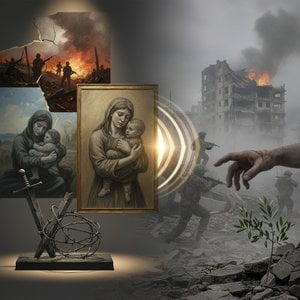
Following his retirement from Intel, Barrett turned with increasing dedication to his passion for art. He didn’t embrace vibrant colors or abstract forms; instead, he found his voice in the stark emotional power of monochrome sketches. These are not merely depictions of scenes, but visceral responses to the poignant verses of World War I poetry, particularly the work of Wilfred Owen. A profound empathy for the soldiers whose experiences Owen so unflinchingly documented permeates Barrett’s art. The influence is direct and deliberate; many pieces directly respond to or draw inspiration from specific poems, exploring themes of loss, courage, and the devastating human cost of conflict. This isn't a detached historical observation but an intimate engagement with the psychological weight of war—the isolation, the fear, the enduring trauma. Barrett’s artistic journey is thus not simply about creating images; it’s about translating the emotional truth of poetry into a visual language.A Style Forged in Shadow and Line
Barrett's distinctive style is immediately recognizable for its deliberate austerity. The predominantly monochrome palette—often shades of charcoal, ink, and gray—lends a somber quality to his depictions, mirroring the bleakness of the landscapes and experiences he portrays. But within this restraint lies immense expressive power. His line work isn’t merely descriptive; it's dynamic and emotive, capturing both the physical realities of trench warfare – the mud, the barbed wire, the crumbling structures – and the psychological toll it takes on individuals. There is a rawness to his technique, an immediacy that conveys a sense of urgency and grief. He doesn’t shy away from depicting the horrors of war, but he does so with a sensitivity that avoids sensationalism, focusing instead on the human element—the resilience, the sacrifice, and the enduring power of the spirit in the face of unimaginable adversity. Notable works like “Attack no. 1” embody this approach, offering a chaotic and brutal depiction of combat, while pieces such as "Banishment" evoke feelings of profound isolation and displacement. “Hospital barge at Cérisy no. 1”, directly inspired by Owen’s poem, is particularly poignant, capturing the quiet desperation and fragile hope within a wartime medical facility.Legacy: A Bridge Between Worlds
Craig R. Barrett's journey represents something truly unique—a successful business leader who has found profound meaning and purpose in artistic expression. His work serves as a powerful reminder of the human cost of war, offering a visual interpretation of the emotional landscape explored by poets like Wilfred Owen. While his achievements at Intel are well-documented and widely celebrated, his artistic contributions offer a compelling new dimension to his legacy. He demonstrates that creativity isn’t confined to specific disciplines; it can flourish in unexpected places and emerge from diverse experiences. Barrett's art is not simply a hobby pursued in retirement but a deeply felt response to history, a testament to the enduring power of empathy, and a poignant exploration of the human condition. His monochrome sketches stand as a powerful visual echo of Owen’s words, ensuring that the lessons—and the tragedies—of World War I continue to resonate with future generations.Notable Works
- “Attack no. 1” – A visceral depiction of the chaos and brutality of combat.
- “Banishment” – Evoking feelings of isolation and displacement.
- “Red sky” - Capturing a haunting atmosphere.
- “The unreturning” – Reflecting on loss and remembrance.
- “Hospital barge at Cérisy no. 1” – A poignant scene depicting wartime medical care, inspired by Owen’s poem.
- “Everyman no. 1” - An expressionistic drawing evoking despair and the human condition.
Questions & Answers
What are the birth city and country of Craig R. Barrett?
Craig R. Barrett was born in San Francisco, in United States of America.
What are the birthplace and birth year of Craig R. Barrett?
Craig R. Barrett was born in San Francisco in 1939.
Can I browse Craig R. Barrett's works by color palette?
The By Palettes page groups Craig R. Barrett's artworks by their color palettes.