early life and training
cornelis van poelenburgh, a prominent dutch landscape painter, was born in utrecht, netherlands in 1594. he initially trained with abraham bloemaert, a renowned artist of the time. this foundational training laid the groundwork for van poelenburch's future success.artistic career and influences
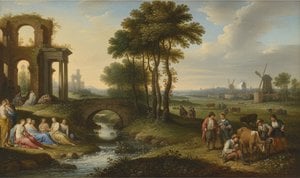
van poelenburch's travels to rome in the early 17th century significantly influenced his work, making him a leading representative of the first generation of dutch landscape painters active in italy. his small-scale paintings, often featuring italianate landscapes with small figures enacting biblical or mythological scenes, showcased his unique style. notable works:- satyrs spying on nymphs (after 1627), a characteristic example of van poelenburch's work, featuring archaic landscapes with figures bathing. (view on WahooArt)
- council of the gods (c. 1630), a painting showcasing van poelenburch's idealized hilly landscape and roman-inspired goddesses, now housed in the mauritshuis (the hague, netherlands). (view on WahooArt)
legacy and later life
van poelenburch's work was highly regarded by his contemporaries, including the grand duke of tuscany and the dutch stadholder. he later returned to utrecht, where he passed away in 1667, just a few years after his old teacher abraham bloemaert. key points:- born in utrecht, netherlands in 1594
- trained with abraham bloemaert
- influenced by his time in rome
- known for small-scale italianate landscapes with figures
- died in utrecht in 1667 view cornelis van poelenburch's artworks on WahooArt learn more about cornelis van poelenburgh on wikipedia
Questions & Answers
Where is Cornelis Van Poelenburch from?
Cornelis Van Poelenburch was born in Netherlands.
In which historical period did Cornelis Van Poelenburch work?
Cornelis Van Poelenburch worked in the Early-Modern period. The period situates the artist's activity in history.
Can I explore Cornelis Van Poelenburch's works by keyword?
To find works by Cornelis Van Poelenburch on a specific theme, use the artist's By Keywords page, which groups the artworks by keyword.
What moods do Cornelis Van Poelenburch's artworks express?
Cornelis Van Poelenburch's works can be browsed by mood on the artist's Mood Room page, which arranges the artworks by their recorded moods.
What are the birth city and country of Cornelis Van Poelenburch?
Cornelis Van Poelenburch was born in Utrecht, in Netherlands.
What are the birthplace and birth year of Cornelis Van Poelenburch?
Cornelis Van Poelenburch was born in Utrecht in 1594.
How many artworks by Cornelis Van Poelenburch are available to browse?
You can browse 83 artworks by Cornelis Van Poelenburch on the All Artworks page.