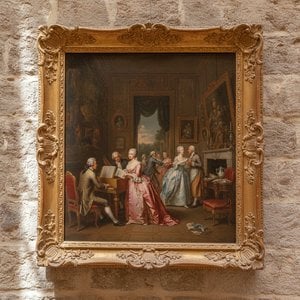
Claudius Jacquand: Life and Legacy
Early Life and Education
- Born: December 11, 1803, in Lyon, France.
- Jacquand came from a family of artisans; his father was a comb-maker. This background instilled in him an appreciation for craftsmanship that would later influence his artistic approach.
- He received his initial art training at the École nationale des beaux-arts de Lyon under Fleury François Richard, laying the foundation for his future career.
Paris and Early Success
- Following his mother’s death in 1836, Jacquand moved to Paris, a pivotal moment that marked the beginning of his professional artistic journey.
- He began exhibiting his work soon after arriving in Paris, quickly gaining recognition for his talent and skill.
- Recognition: In 1839, he was knighted in the Legion d'Honneur. A year later, he received a Gold Medal at an exposition in Brussels, followed by another Gold Medal and the Order of Leopold at an exhibition in The Hague.
Personal Life and Social Standing
- The death of his father provided Jacquand with financial stability, enabling him to marry Lydia de Forbin, a woman from the aristocracy. She was the daughter of Louis Nicolas Philippe Auguste de Forbin and widow of the Viscount Alexandre Paul de Pinelli.
- He became Mayor of Émeringes in 1844, demonstrating his involvement in local affairs.
- Jacquand built a mansion in Émeringes inspired by Parisian architecture, reflecting his refined taste and social status.
Artistic Style and Themes
- Key Genres: Jacquand specialized in historical tableaus, genre scenes, and religious subjects. His works often depicted dramatic narratives with meticulous detail.
- His style is generally categorized within the Romanticism movement, characterized by emotional intensity, vibrant colors, and a focus on storytelling.
- Notable Works: Include “The Count of Comminges Recognizing Adélaide,” “Cinq-mars surrendering his épée to louis xiii”, and “Pietro Perugino painting for the monks of perugia”.
Later Life and Challenges
- The French Revolution of 1848 significantly impacted Jacquand’s financial situation, leading to a decline in his income.
- He sought employment but was unsuccessful in securing the position of director at the Musée de l'Histoire de France at Versailles.
- Jacquand and his wife moved to Boulogne-sur-Mer in 1852, selling their properties to maintain their lifestyle. They later faced further financial hardship and were forced to move to less expensive quarters in Paris.
- Final Years: Lydia’s death in 1863 compounded his difficulties. He continued to exhibit but struggled financially until his death on April 2, 1878, in Paris.
Legacy and Historical Significance
- Although not as widely celebrated today as some of his contemporaries, Claudius Jacquand was a respected artist during his lifetime.
- His works provide valuable insights into 19th-century French society, history, and artistic tastes.
- Influence: He taught painting to his son-in-law, Auguste de Pinelli, who also became a well-known artist, continuing the family’s artistic legacy.