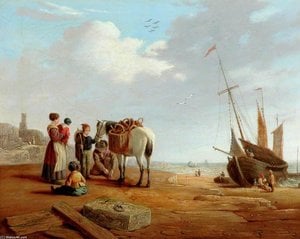
Early Life and Influences
- Birth and Family: Clarkson Frederick Stanfield was born in Sunderland, United Kingdom, in 1793, the son of James Field Stanfield (1749–1824), an Irish-born author, actor, and former seaman. His mother's identity is less known but is believed to have been an artist herself.
- Early Apprenticeship: In 1806, he briefly apprenticed as a coach decorator before leaving due to the master’s wife’s drunkenness. This early experience likely contributed to his later skills in color and composition.
- Maritime Experience: Stanfield's time as a sailor on a collier (1808) and subsequent service in the Royal Navy (pressed into service in 1808, discharged in 1814) profoundly shaped his artistic vision. His voyages to China in 1815 provided him with valuable sketches that would later inform his work.
Career Development: Theatre, Dioramas and Early Painting
- Theatre Scene Painter: Stanfield began his career as a decorator and scene-painter at the Royalty Theatre in London (1816). He then worked at the Coburg Theatre and became a resident scene-painter at Drury Lane Theatre (1823-1834), where he gained fame for creating spectacular scenery.
- Diorama and Panorama Projects: Partnering with David Roberts, Stanfield created large-scale dioramas and panoramas in the 1820s and 1830s. These included moving panoramas depicting historical events like the bombardment of Algiers and the Battle of Navarino, showcasing his ability to create immersive experiences.
- Transition to Easel Painting: After leaving Drury Lane in 1834, Stanfield dedicated himself more fully to easel painting, particularly marine subjects. He exhibited at the Royal Academy from 1820 onwards.
Artistic Style and Major Works
- Romantic Seascapes: Stanfield is best known for his dramatic and evocative seascapes, reflecting the Romantic movement's emphasis on emotion and grandeur. His paintings often feature turbulent waters, atmospheric perspective, and a sense of awe-inspiring power.
- Key Characteristics: His style is characterized by skillful use of light and shadow, dynamic brushwork, and an ability to capture the mood and atmosphere of maritime scenes. He employed impasto techniques to create texture and depth.
- Notable Works: Some of his most celebrated works include:
- St. Michael's Mount (National Gallery of Victoria)
- The opening of New London Bridge (Royal Collection)
- Venetian subjects for Bowood House and Trentham Park
- On the Scheldt
- Cityscape With Fish Market
Recognition and Legacy
- Royal Academy Membership: Stanfield was elected an Associate Member of the Royal Academy in 1832 and a full Academician in 1835, solidifying his position within the British art establishment.
- Influence on Later Artists: His dramatic seascapes influenced subsequent generations of marine painters. He helped to elevate the genre of maritime painting to new heights of artistic expression.
- Historical Significance: Stanfield's contributions extended beyond easel painting; his work in theatre and panorama production demonstrated his innovative approach to visual storytelling and immersive entertainment, foreshadowing aspects of modern cinema.
- Death and Remembrance: Clarkson Frederick Stanfield died in 1867, leaving behind a significant body of work that continues to be admired for its technical skill and emotional power.
Questions & Answers
Where are Clarkson Frederick Stanfield's artworks organized by color?
The Spectral Index of Clarkson Frederick Stanfield is a page that organizes the artist's artworks by their colors.
In which historical period did Clarkson Frederick Stanfield work?
Clarkson Frederick Stanfield worked in the 19th-Century period. The period situates the artist's activity in history.
What are the birthplace and birth year of Clarkson Frederick Stanfield?
Clarkson Frederick Stanfield was born in Sunderland in 1793.