Early Life and Artistic Foundations
Clarence Holbrook Carter, affectionately known as “Cartie” to his friends, emerged from the quiet river town of Portsmouth, Ohio, in 1904—a birthplace that would subtly yet profoundly influence the contemplative stillness found within his art. Even as a child, Carter displayed an exceptional talent for visual expression, a gift nurtured by a keen observation of the world around him and a sensitivity to the often-unseen poetry of everyday life. This early aptitude led him to Cleveland in 1923, where he enrolled at the Cleveland School of Art, seeking formal training that would hone his innate abilities.
At the school, Carter benefited from the guidance of influential painters like Henry Keller and Paul Travis, but it was the patronage of William Millikin, director of the Cleveland Museum of Art, that truly launched his career. Millikin recognized a unique spark in the young artist—a blend of meticulous realism and an emerging sense of abstraction—and facilitated a pivotal opportunity for Carter to study with Hans Hofmann in Capri, Italy, in 1927. This experience proved transformative, exposing him to modernist principles that would later inform his distinctive style. Upon returning to the United States, he briefly taught at the Cleveland Museum of Art, beginning a long and dedicated career as both artist and educator.
A Period of Recognition and Public Works
The 1930s marked a period of burgeoning recognition for Carter. He quickly established himself within the regional art scene, winning numerous accolades—including an impressive thirteen first prizes at the Cleveland Museum of Art’s annual exhibition—and attracting attention for his evocative depictions of rural America and the hardships endured during the Great Depression. His work resonated with audiences not only through its technical skill but also through its quiet dignity and empathetic portrayal of ordinary people.
In 1935, Carter received a commission to paint murals in Ravenna, Ohio, as part of the Public Works of Art Project (PWAP), a testament to his growing reputation. He later served as regional superintendent for Northeastern Ohio under the Works Progress Administration (WPA), overseeing artistic endeavors and further solidifying his role within the cultural landscape. These public works, while often overlooked today, demonstrate Carter’s commitment to making art accessible and reflecting the realities of American life during a challenging era.
The Development of a Unique Visual Language
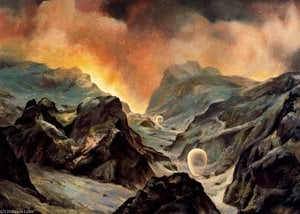
While initially celebrated for his realistic portrayals, Carter's artistic journey took an unexpected turn in the post-World War II period. Dissatisfied with purely representational painting, he embarked on a path toward surrealism and abstraction, exploring mystical structural forms and recurring motifs—particularly eggs—that became hallmarks of his later work. This shift wasn’t abrupt; it evolved organically from his earlier explorations of form and texture.
Carter's technique remained remarkably consistent throughout his career, characterized by precise lines, careful color washes, and a meticulous attention to detail. He possessed an uncanny ability to recreate the surfaces of various materials—weathered wood, glistening metal, rough stone—imbuing his paintings with a tactile quality that drew viewers in. However, as he moved toward abstraction, this technical mastery was employed not to replicate reality but to evoke emotion and explore deeper symbolic meanings.
Major Achievements and Lasting Legacy
Throughout his prolific career, Clarence Holbrook Carter achieved numerous milestones. He was the first Ohio resident artist to have a painting acquired by the Metropolitan Museum of Art—*The Creepers*, purchased in 1936—and by 1948, over twenty-seven major American museums held examples of his work. His paintings were featured in prestigious exhibitions at institutions like the Museum of Modern Art and the Art Institute of Chicago, solidifying his position as a leading figure in American art.
In 1972, Carter received the Cleveland Arts Prize for Visual Arts, an honor recognizing his lifetime contributions to the field. Publications dedicated to his life and work began appearing around this time, further cementing his legacy. Even after his death in 2000, new discoveries—such as a trove of reference photographs used for his paintings—continue to reveal the depth and complexity of his artistic process.
Clarence Holbrook Carter’s significance lies not only in his technical skill but also in his willingness to evolve and experiment. He was an artist who embraced both realism and abstraction, capturing the essence of everyday moments while simultaneously exploring deeper philosophical themes. His work continues to resonate with audiences today, offering a poignant reflection on the human condition and the enduring power of art.