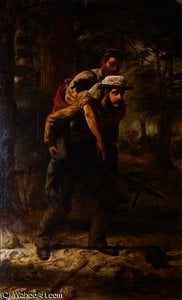
Chevalier Louis William Desanges: A Portraitist of Victorian Valor
Louis William Desanges, born in Bexley, Kent, in 1822, was a British artist whose legacy rests primarily on his evocative and historically significant military portraits. His life, intertwined with the grand narratives of the Victorian era, saw him evolve from depicting historical scenes to becoming a celebrated painter of Victoria Cross recipients – a testament to his skill and an intimate reflection of Britain’s imperial ambitions. Desanges' work offers a fascinating glimpse into the values and ideals of 19th-century England, particularly its reverence for courage, duty, and military prowess.Early Life and Artistic Training
Desanges’ lineage held a subtle yet influential connection to European aristocracy; his great-grandfather had settled in England eighty years prior, granting him the title of “Chevalier,” a mark that subtly informed his artistic approach – one characterized by meticulous detail and an appreciation for formal presentation. Initially, Desanges' artistic pursuits centered on historical subjects, drawing inspiration from classical art and the burgeoning Romantic movement. He spent formative years traveling through France and Italy, absorbing the techniques and aesthetics of these influential artistic centers. This early exposure undoubtedly shaped his understanding of composition, light, and shadow – elements he would later master in his portraits. Returning to London in 1845, he began exhibiting at the Royal Academy between 1846 and 1887, showcasing a diverse range of works including battle scenes like the Battle of Inkermann (though sadly now lost), demonstrating an early ambition and willingness to tackle large-scale historical commissions.The Rise of the Victoria Cross Portraits
A pivotal moment in Desanges’ career arrived through his association with Lord Wantage, a nobleman who had earned the Victoria Cross at the Battle of Alma. Recognizing the public's fascination with military heroism and the desire to commemorate these acts of bravery, Lord Wantage conceived an ambitious project: a series of portraits depicting all recipients of the Victoria Cross. Desanges was commissioned to undertake this monumental task, a commitment that consumed much of his artistic energy for several years. The process involved extensive research, meticulous sketching from life, and a deep understanding of military uniforms and equipment. He didn’t merely paint likenesses; he sought to capture the character and spirit of each individual soldier, conveying their courage, determination, and sacrifice. The resulting paintings were exhibited at the Crystal Palace in 1862 and later at the Egyptian Gallery in Piccadilly, becoming immensely popular and cementing Desanges' reputation as a portraitist of distinction.Technique and Style
Desanges’ style is characterized by its realism and attention to detail. He employed a meticulous approach to rendering fabrics, uniforms, and weaponry, striving for an almost photographic accuracy. His portraits are often imbued with a sense of dignity and solemnity, reflecting the gravity of the subjects' achievements. While influenced by academic traditions, Desanges’ work possesses a subtle warmth and expressiveness that elevates it beyond mere technical proficiency. He skillfully used light and shadow to create depth and volume, drawing the viewer's eye to key features and conveying a sense of presence. His depictions of military scenes, such as “Fighting in the Ashantee Forest,” demonstrate his ability to capture the dynamism and chaos of battle, albeit with a controlled and formal aesthetic.Legacy and Significance
Louis William Desanges died in 1905, leaving behind a significant body of work that continues to fascinate art historians and enthusiasts alike. His Victoria Cross portraits stand as a remarkable tribute to British military heroism and a valuable historical record. The dispersal of these paintings after Lord Wantage’s death underscores their cultural importance, with many now residing in regimental collections across the United Kingdom. Desanges' work offers not only aesthetic pleasure but also a window into the social and political context of Victorian Britain – an era defined by imperial expansion, military prowess, and a fervent belief in national identity. His legacy endures as a testament to the power of art to commemorate history and celebrate human courage.Questions & Answers
In which historical period did Chevalier Louis William Desanges work?
Chevalier Louis William Desanges worked in the 19th-Century period. The period situates the artist's activity in history.
Where can I see Chevalier Louis William Desanges's artworks in a 3D gallery?
A virtual visit is possible: the 3D Museum page of Chevalier Louis William Desanges presents the artist's works in a three-dimensional gallery.
Where can I see all artworks by Chevalier Louis William Desanges?
Every work by Chevalier Louis William Desanges on this website can be browsed from the artist's All Artworks page.