Charles Ernest Cundall

1890 - 1971

Quick Facts

  • Born: 1890
  • Copyright status: Under copyright
  • Mediums: oil on canvas
  • Movements: post-impressionism
  • Art period: Modern
  • Lifespan: 81 years
  • Topics explored:
    • panoramic view
    • townscape
    • landscape
    • victorian era
    • british art
  • Creative periods: mature period

The Visionary Eye of Charles Ernest Cundall

Born in Stretford, Lancashire, Charles Ernest Cundall emerged as a remarkably versatile figure within the British art landscape of the early twentieth century. His journey began not with a brush, but with the delicate precision of a designer, working amidst the intricate patterns of pottery and stained glass for Pilkington's Lancastron Pottery & Tiles. This early foundation in decorative arts provided him with a unique sensitivity to texture and form, which he would later translate into much larger, more sweeping canvases. His formal education at the Manchester School of Art and his subsequent scholarship to the Royal College of Art in 1912 marked the beginning of a profound artistic evolution that would see him master everything from intimate portraits to vast, panoramic townscapes.

The trajectory of Cundall's life was irrevocably altered by the shadows of the Great War. Serving with the Royal Fusiliers, he sustained a significant wound to his right arm, an injury that threatened to silence his creative impulses. Yet, in a testament to his sheer tenacity, he learned to paint with his left arm, returning to the Royal College of Art and later attending the Slade School of Art. This period of recovery and retraining infused his work with a resilient spirit. His travels through Paris, Italy, Sweden, Russia, and Spain further expanded his visual vocabulary, allowing him to absorb the diverse light and atmosphere of the European continent, which would eventually manifest in his mastery of topographical subjects.

A Master of Scale and Atmosphere

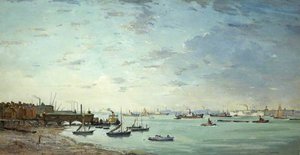
Cundall became most renowned for his ability to command large-scale panoramic canvases, works that captured the bustling energy of British life and the quiet majesty of the landscape. He possessed a rare technical facility, particularly when navigating the complexities of crowd scenes and aerial perspectives. His paintings were often rich with texture, light, and movement, making him a master of capturing the ephemeral spirit of a moment. Whether he was depicting the vibrant seaside atmosphere of Bank Holiday, Brighton or the sweeping vistas of townscapes like Gravesend, his work resonated with an ability to blend topographical accuracy with an expressive, almost cinematic quality.

During the tumultuous years of World War II, Cundall’s artistry took on a profound historical weight. Serving as an official artist for the Air Ministry and working on commissions for the Admiralty, he documented the vital rhythms of the war effort. His canvases from this era, such as those focusing on Bomber Command, Coastal Command, and the arrival of American troops in Northern Ireland, serve as poignant visual records of a nation in flux. Through his eyes, we see the heavy machinery of war—the servicing of a Sunderland or the presence of the B-17 Flying Fortress—rendered with a profound sense of duty and artistic grace.

Legacy within the British Tradition

The significance of Cundall's contribution to art lies in his ability to bridge the gap between decorative design and monumental painting. His election as a Royal Academician in 1944 was a crowning achievement, reflecting his standing among the most distinguished painters of his generation. Throughout his career, he remained a mainstay of the Royal Academy, exhibiting consistently and contributing to the prestige of institutions such as the New English Arts Club and the Royal Watercolour Society.

His artistic legacy is characterized by several key elements:

  • Versatility: An extraordinary range that spanned from pottery design and stained glass to large-scale oil paintings.
  • Resilience: The remarkable feat of overcoming physical injury to continue a prolific career as a left-handed painter.
  • Historical Documentation: His vital role as an official war artist, capturing the essence of the British home front and military operations.
  • Panoramic Mastery: A unique ability to capture expansive, complex scenes with remarkable texture and light.

Though much of his work as a war artist has yet to receive the full breadth of attention it deserves, Cundall remains an essential thread in the tapestry of twentieth-century British art history. His ability to find beauty in both the grand panoramic view and the detailed topographical subject ensures his place in the annals of painters who captured the very soul of their era.

Questions & Answers

In which historical period did Charles Ernest Cundall work?

Charles Ernest Cundall worked in the Modern period. The period situates the artist's activity in history.

Where are Charles Ernest Cundall's artworks grouped by technique?

Charles Ernest Cundall's works can be browsed by medium on the artist's All Medium page.

Is there a timeline of Charles Ernest Cundall's works?

A timeline of Charles Ernest Cundall's works exists: the artist's Artwork Timeline page orders the artworks by creation date.

Where are Charles Ernest Cundall's artworks organized by color?

Charles Ernest Cundall's works can be explored by color on the artist's Spectral Index page.

How many artworks by Charles Ernest Cundall are available to browse?

You can browse 93 artworks by Charles Ernest Cundall on the All Artworks page.

Is there a chronological account of Charles Ernest Cundall?

A chronological account of Charles Ernest Cundall's work is available on the artist's Chronicle page, where the artworks pass in order of creation, chapter by chapter.

Where can I see all artworks by Charles Ernest Cundall?

Every work by Charles Ernest Cundall on this website can be browsed from the artist's All Artworks page.

Art Quiz

There is only one correct answer for each question.

Question 1:
In which town was Charles Ernest Cundall born?
Question 2:
Which institution awarded Cundall a scholarship in 1912?
Question 3:
What was Cundall's profession before his formal art studies?
Question 4:
During which war did Cundall serve with the Royal Fusiliers?
Question 5:
Which famous painting of Brighton is held in the Tate collection?