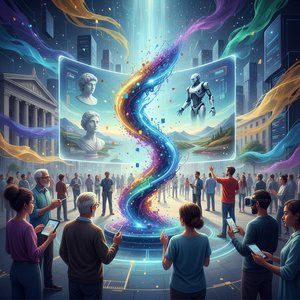
Carlo Alberto Treccani: Bridging the Digital and the Human in Contemporary Art
Carlo Alberto Treccani’s artistic journey is a fascinating convergence of academic rigor, technological exploration, and a profound engagement with Asian perspectives. Born in Kowloon Tong, China, his life has been shaped by a unique blend of Eastern and Western influences, informing an approach to art that is both deeply rooted in tradition and boldly forward-looking. Currently holding the position of research assistant professor at the Department of Humanities and Creative Writing at Hong Kong Baptist University, Treccani’s work transcends traditional boundaries, delving into the complex relationship between artificial intelligence, creativity, and our understanding of what constitutes “art” itself. This isn't simply about replicating images; it’s a critical interrogation of how technology is reshaping artistic expression and, consequently, our very perception of reality.
Academic Foundations and Early Influences
Treccani’s intellectual trajectory began with a strong grounding in humanities research. His previous roles at the City University of Hong Kong and Ningbo University provided him with invaluable experience in media studies, contemporary art, aesthetics, and visual culture – disciplines that would become central to his artistic investigations. Notably, he holds a book titled ‘Reconceptualizing the Digital Humanities in Asia: New Representations of Art, History and Culture,’ a testament to his commitment to examining how digital tools are impacting traditional fields of study. This work demonstrates an early awareness of the transformative potential—and inherent challenges—of integrating technology into artistic discourse. His academic background isn’t merely a stepping stone; it's the very foundation upon which he builds his innovative approach, constantly referencing and challenging established paradigms. The award for Outstanding Academic Performance from the Research Grants Council in 2018 further underscores the recognition of his scholarly contributions and intellectual curiosity.
Exploring AI, Creativity, and Asian Perspectives
Treccani’s current research focuses on the development of “visually intelligent” machines – systems capable of generating art autonomously or collaboratively with human artists. This isn't a nostalgic yearning for a return to pre-digital methods; rather, it’s an active exploration of what happens when creative processes are mediated by algorithms. His work investigates the philosophical implications of AI’s role in artistic creation: does originality still hold meaning if a machine contributes? How do we define authorship and value in such contexts? Crucially, Treccani's investigations aren’t confined to Western perspectives. He brings an essential Asian lens to this dialogue, considering how traditional aesthetics, cultural values, and historical narratives intersect with the emerging field of AI art. This intersection is particularly evident in his collaborative work within the ‘Creativity, Self, and Society’ faculty niche, suggesting a broader exploration of human experience through the prism of technological advancement.
A Unique Artistic Voice: The “HELLO GOOGLE, FUCK YOU GOOGLE #2” Piece
Examining Treccani's artwork database reveals a piece titled "HELLO GOOGLE, FUCK YOU GOOGLE #2 811-823 HALULA PL, KAILUA, HI 96734, USA." This work, visually represented in the database image, offers a potent commentary on our relationship with technology and its pervasive influence. The title itself is deliberately provocative, encapsulating a complex mix of frustration, dependence, and perhaps even a touch of ironic detachment. While details about the piece’s specific execution are limited, its very existence speaks volumes about Treccani's artistic concerns – a willingness to engage directly with the anxieties and contradictions inherent in our digital age. The inclusion of a physical address—a seemingly random detail—further complicates the work, suggesting an attempt to ground the abstract concept of AI in the tangible realities of human experience.
Historical Significance and Future Directions
Carlo Alberto Treccani’s work is significant not just for its immediate aesthetic qualities but also for its prescient engagement with a rapidly evolving landscape. As digital technologies continue to reshape our world, artists like Treccani are playing a crucial role in prompting critical reflection on the nature of creativity, authorship, and the very definition of art. His research into “visually intelligent” machines is poised to have a lasting impact on the field of digital humanities, pushing us to reconsider long-held assumptions about artistic practice and its relationship to human consciousness. His ongoing exploration promises to yield further insights into how technology can both challenge and enrich our understanding of ourselves and the world around us – solidifying his position as a leading voice in contemporary art and thought.