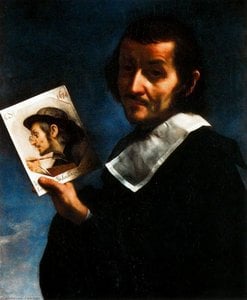
A Florentine Master of Baroque Piety
Carlo Dolci, born in Florence in 1616, stands as a compelling figure within the Italian Baroque landscape—a painter whose intensely devotional works and meticulous technique secured his place among the most sought-after artists of his era. Unlike many contemporaries drawn to the dramatic grandeur of Rome, Dolci remained steadfastly rooted in Florentine tradition, cultivating a style characterized by quiet intensity and profound spiritual depth. His life unfolded against a backdrop of artistic fervor, yet he carved a unique path defined not by prolific output but by an unwavering commitment to detail and emotional resonance. From his earliest training under Jacopo Vignali, Dolci demonstrated a precocious talent, quickly establishing a reputation for precision that would become the hallmark of his oeuvre. He wasn’t driven by expansive compositions or dynamic narratives; instead, he focused on intimate portrayals of religious subjects, often repeating favored themes across multiple versions—a testament to their enduring appeal and perhaps reflective of his methodical approach.Early Life and Artistic Formation
Dolci's artistic journey began within a family already touched by creativity, providing an early nurturing ground for his innate abilities. Apprenticed to Jacopo Vignali at a remarkably young age, he absorbed the lessons of a master known for dramatic flair, yet Dolci soon began to forge his own distinct voice. Even as a boy, his dedication to capturing minute details and conveying emotional weight was evident. Stories abound of his painstaking approach—a commitment so thorough that it reportedly took weeks to complete even a single limb on a figure. This deliberate pace wasn’t born of slowness but rather an intense desire for perfection, a striving to imbue each brushstroke with spiritual significance. He quickly gained recognition within Florentine circles, attracting commissions from prominent families and establishing his workshop before reaching adulthood. While other artists sought the bustling artistic scene of Rome, Dolci remained in Florence, deeply connected to its traditions and patrons. This steadfast loyalty to his native city shaped not only his career but also the very essence of his art.Style and Notable Works
Dolci’s style is immediately recognizable—a harmonious blend of rich color, meticulous detail, and profound emotional expression. His paintings aren't about grand spectacle; they are intimate encounters with faith, rendered with a tenderness that invites contemplation. He frequently depicted scenes from the lives of saints and biblical narratives, focusing on moments of quiet devotion or poignant suffering. St Sebastian, for example, is not portrayed as a heroic martyr but as a figure consumed by spiritual anguish, his body exquisitely rendered to emphasize vulnerability rather than strength. Similarly, his depictions of the four Evangelists reveal a deep understanding of human psychology, capturing their individual personalities with remarkable sensitivity. Christ Breaking the Bread, another celebrated work, exemplifies his ability to convey sacred moments with understated grace and emotional power. His daughter, Agnese Dolci, played an important role in disseminating his artistic vision, skillfully creating copies of her father’s paintings that further extended his reach and influence. These reproductions, while not original creations, attest to the demand for Dolci's work and the enduring appeal of his style.Legacy and Historical Significance
Carlo Dolci’s impact on Florentine art is undeniable. He stands as a key figure in the development of the Baroque style within the city, contributing significantly to its rich artistic heritage. While influenced by earlier masters like Giovanni Bellini and Bramantino, he forged his own unique path, characterized by a quiet intensity and devotional focus that set him apart from many of his contemporaries. His paintings continue to grace prestigious institutions such as the Uffizi Gallery in Florence, where the Contini Bonacossi Collection offers a particularly rich representation of his oeuvre. The enduring appeal of Dolci’s work lies not only in its technical brilliance but also in its ability to evoke profound spiritual emotions. He wasn't merely painting religious scenes; he was creating visual meditations on faith, inviting viewers to connect with the divine on a deeply personal level. His legacy extends beyond his paintings—he represents a commitment to artistic excellence and a belief in the power of art to inspire piety and contemplation. Even today, exploring Dolci’s masterpieces offers a glimpse into the heart of 17th-century Florence and the enduring power of Baroque artistry.Questions & Answers
Where is Carlo Dolci from?
Carlo Dolci was born in Italy.
Where are Carlo Dolci's artworks grouped by palette?
To find works by Carlo Dolci in a specific palette, use the artist's By Palettes page.
How many artworks by Carlo Dolci are available to browse?
You can browse 55 artworks by Carlo Dolci on the All Artworks page.
Can I browse Carlo Dolci's works by movement?
The movements Carlo Dolci worked in can be seen on the artist's All Movements page, which groups the artworks by movement.
What are the birth city and country of Carlo Dolci?
Carlo Dolci was born in Florence, in Italy.
What are the birthplace and birth year of Carlo Dolci?
Carlo Dolci was born in Florence in 1616.
Can I browse Carlo Dolci's works by mood?
The Mood Room of Carlo Dolci is a page that arranges the artist's artworks by mood.