The Umbrian Dawn and Formative Years
Born amidst the vibrant cultural landscape of Perugia around 1478, Bernardino di Mariotto dello Stagno emerged as a significant voice in the Italian Renaissance. His early years were defined by rigorous training under the watchful eyes of masters such as Lodovico di Angelo Mattioli or perhaps Fiorenzo di Lorenzo. This formative period in Umbria was not merely an education in technique but an immersion into a world where meticulous detail and profound perspective were paramount. As he absorbed the stylistic precepts of his contemporaries, including the influences of masters like Carlo Carracci, Mariotto began to develop a unique artistic language—one that would eventually blend the grandeur of classical ideals with the intimate, regional traditions of his homeland.
A Wandering Spirit: Expansion of Style and Workshop
The trajectory of Mariotto’s career was marked by a restless movement through the heart of Italy, a journey that significantly enriched his stylistic repertoire. By 1502, he had established himself in San Severino Marche, where the influence of the studio of Lorenzo da San Severino the Younger and the works of Vittore Crivelli left an indelible mark on his brushwork. Following the death of Lorenzo in 1503, Mariotto demonstrated remarkable entrepreneurial spirit by taking over the workshop, a role that allowed him to sustain a prolific output for decades. His eventual return to Perugia in 1522 signaled a homecoming of a seasoned master, bringing with him new techniques and an expanded vision that would define his later years until his activity waned around 1541.
The Radiance of Devotion and Technical Mastery
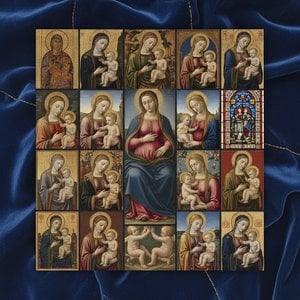
At the heart of Mariotto’s oeuvre lies a profound devotion to religious subject matter, most notably in his celebrated compositions of the Madonna and Child. His works, such as the Madonna and Child with Sts Severino and Dominic, serve as theological meditations rendered with exquisite grace. In these pieces, one observes a masterful handling of light that seems to emanate from a celestial source, softly illuminating rich draperies and lending a palpable glow to the figures' skin. Through the innovative use of sfumato, he achieved a delicate interplay of light and shadow, creating an atmosphere of heavenly tranquility.
His monumental contributions are perhaps most visible in the frescoes adorning the Oratorio di San Bernardino in Perugia, where his collaboration with other prominent artists showcased a mastery of color and composition. These works remain a testament to the artistic fervor of the era, reflecting an artist who successfully bridged the gap between the spiritual and the tangible through:
- Meticulous attention to detail that captures the weight and flow of sacred garments.
- A profound understanding of perspective that grounds divine figures in a realistic space.
- The use of light as a narrative tool, guiding the viewer's eye through layers of heavenly attendants and soft, atmospheric landscapes.