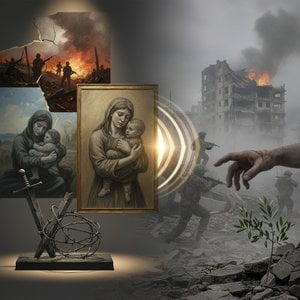
Bernard Meninsky: A Life Painted in Shadows and Light
Born in Konotop, Ukraine – a place steeped in both Ukrainian and Yiddish heritage – Bernard Meninsky’s artistic journey began far from the bustling art centers of London. His early life, marked by a swift move to Liverpool with his family, laid the foundation for an artist deeply attuned to human emotion and the quiet dignity of everyday moments. Despite leaving formal education at eleven, a remarkable talent for drawing quickly surfaced, leading to scholarships that propelled him towards the prestigious Slade School of Fine Art in 1912. This pivotal period wasn’t merely about technical training; it was a transformative immersion into the burgeoning world of modern art, profoundly influenced by figures like Walter Sickert and Henry Tonks, while simultaneously challenging the established norms championed by Roger Fry.
The Slade's rejection of avant-garde movements – particularly Cubism – shaped Meninsky’s approach. He didn’t immediately embrace radical experimentation but instead developed a distinctive style characterized by evocative figures, poignant landscapes, and above all, his deeply moving ‘Mother and Child’ scenes. These works, imbued with a sense of melancholy and quiet strength, became the hallmark of his oeuvre. His time at the school fostered connections that would prove invaluable throughout his career, including a lifelong friendship with William Roberts and mentorship from Walter Sickert, who provided a crucial platform for his work.
The War Artist’s Eye
World War I irrevocably altered Meninsky's trajectory. Enlisting in the Royal Fusiliers in 1918, he transitioned into a war artist under the British War Memorials Committee, documenting the realities of conflict with unflinching honesty and sensitivity. His wartime paintings – particularly ‘The Arrival of a Leave Train, Victoria Station’ – offer a powerful glimpse into the lives of returning soldiers, capturing their weariness, longing, and quiet resilience. These works weren't simply depictions of battle; they were intimate portraits of human experience amidst devastation. Meninsky’s commitment to this role extended beyond mere observation; he sought to convey the emotional weight of the war, reflecting a profound empathy for those affected by it.
Following the war, Meninsky continued his teaching career at the Central School of Arts and Crafts, nurturing a new generation of artists. His dedication to instruction was matched by an unwavering belief in the power of art to illuminate the human condition. His work during this period reflected a shift towards greater introspection, with a focus on domestic scenes and familial relationships – particularly his celebrated ‘Mother and Child’ series. These paintings, rendered in muted tones and imbued with a sense of quiet intimacy, became increasingly central to his artistic identity.
Style and Influences
Meninsky's style is often described as Post-Impressionist, yet he developed a unique voice that transcended simple categorization. He absorbed the bold colors and expressive brushwork of artists like Cézanne and Van Gogh, but tempered them with a distinctly British sensibility. His landscapes are characterized by atmospheric perspective and a subtle use of color, while his figures possess a remarkable sense of realism combined with emotional depth. The influence of Walter Sickert is particularly evident in Meninsky’s use of light and shadow, as well as his ability to capture the mood and atmosphere of a scene.
The impact of his wartime experiences undoubtedly shaped his artistic vision. The trauma of war instilled in him a deep appreciation for the fragility of life and the importance of human connection. This sensitivity is powerfully conveyed in his ‘Mother and Child’ paintings, which are not merely sentimental depictions but rather profound meditations on motherhood, loss, and hope. His work stands as a testament to the enduring power of art to bear witness to history and explore the complexities of the human spirit.
Legacy and Continuing Relevance
Bernard Meninsky's legacy extends beyond his individual paintings. He was a significant figure in the London Group and contributed to the development of British modernism. His work continues to resonate with viewers today, offering a poignant reminder of the enduring power of art to capture the human experience. The Imperial War Museum holds a substantial collection of his wartime works, ensuring that his powerful depictions of conflict will continue to be studied and appreciated for generations to come. His dedication to teaching also left an indelible mark on the artistic landscape of Britain, shaping the careers of countless aspiring artists.
Questions & Answers
Where are Bernard Meninsky's artworks grouped by technique?
To find all works by Bernard Meninsky in a given medium, use the artist's All Medium page.
Can I explore Bernard Meninsky's works by color spectrum?
The Spectral Index page organizes Bernard Meninsky's artworks by color.
Can I explore Bernard Meninsky's works by subject?
The Subject Atlas of Bernard Meninsky is a page that maps the artist's artworks by their subjects.