The Dramatic Vision of Bénigne Gagneraux
In the twilight of the Baroque era, a period defined by theatricality and profound emotional depth, the name Bénigne Gagneraux emerged as a beacon of dramatic intensity. Born in 1756 in the historic French city of Dijon, Gagneraux was destined for a life shaped by the brush and the chisel. While his father worked as a cooper, the young artist’s path was illuminated by the prestigious École Royale Supérieure des Beaux-Arts in Dijon. Under the rigorous guidance of François Devosge, Gagneraux mastered the essential principles of classical composition and anatomical precision. This early training instilled in him a profound reverence for disegno—the meticulous art of drawing—which would later serve as the structural backbone for his most exuberant and chaotic compositions.
The trajectory of Gagnerax’s life took a transformative turn in 1778 when he embarked on a pilgrimage to Rome. This journey to the Eternal City was more than a mere relocation; it was an immersion into the very heart of artistic innovation. In Rome, Gagneraux breathed the air of papal patronage and engaged with the intellectual currents of the Enlightenment. His time in Italy allowed him to absorb the grandeur of Baroque architecture and the monumental scale of classical sculpture, influences that would forever color his approach to narrative painting. It was during this period that his reputation began to flourish, bolstered by his ability to translate the epic scale of Roman history into vibrant, fleshy, and palpable canvases.
A Master of Myth and Motion
Gagneraux’s true genius lay in his ability to breathe life into the mythological and the historical. He found his most profound expression in the depiction of Bacchanals—scenes of divine revelry featuring satyrs, bacchantes, and cupids. These works were not merely decorative; they were studies in movement, texture, and the visceral energy of the human form. His canvases pulsate with a rhythmic vitality, where the soft curves of a nymph might clash against the rugged musculature of a satyr, all rendered with a command of color that elevates the subject matter from simple myth to immersive experience.
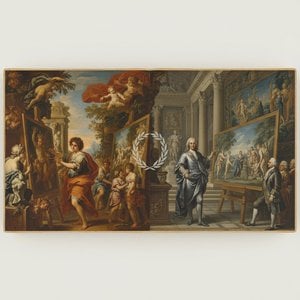
Beyond the mythological, Gagneraux achieved significant renown through his portrayal of historical and political encounters. One of his most celebrated achievements was capturing the meeting between King Gustav III of Sweden and Pope Pius VI within the Vatican Galleries. This work demonstrated his capacity for large-scale, complex staging, blending the dignity of royal portraiture with the sweeping grandeur of a historical event. His ability to attract the attention of European royalty, particularly the Swedish court, solidified his status as one of the most sought-after painters of his generation, bridging the gap between French academic training and the burgeoning Romantic sensibilities of the late 18th century.
Legacy and Artistic Significance
Though his life was tragically short, ending in Florence in 1795, Gagneraux left behind a legacy that resonates with the transition from the structured elegance of the late Baroque to the emotional turbulence of early Romanticism. His work serves as a vital link in the evolution of European art, showcasing a unique synthesis of French precision and Italian passion. To study a Gagneraux painting is to witness a master at work, balancing the delicate anatomical accuracy learned in Dijon with the sweeping, theatrical drama discovered in Rome.
His contributions can be summarized through several key artistic pillars:
- Narrative Mastery: The ability to transform historical and mythological subjects into gripping, cinematic experiences.
- Technical Precision: A lifelong dedication to disegno, ensuring that even the most chaotic battle scenes or bacchanals remained grounded in anatomical truth.
- Cultural Bridge-Building: Acting as a stylistic conduit between the French academic tradition and the vibrant, classical atmosphere of the Italian Renaissance and Baroque legacies.