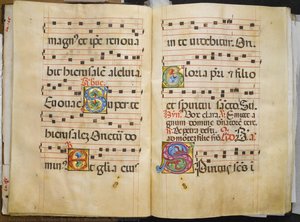
The Illuminating Hand of Belbello da Pavia
Belbello da Pavia remains a somewhat enigmatic figure in the landscape of 15th-century Italian illumination, yet his surviving works speak volumes about the artistic sensibilities flourishing in Lombardy during the Renaissance. Active primarily in Pavia, a city steeped in both religious tradition and burgeoning humanist thought, Belbello’s artistry offers a fascinating glimpse into the transition from Gothic manuscript traditions to the more refined aesthetics of the early Renaissance. While biographical details are scarce—a common fate for many medieval illuminators whose work was often considered devotional craft rather than high art—his surviving masterpiece, the Benedictine Antiphonary of 1467, provides ample evidence of his skill and stylistic preferences.A Life Shrouded in Mystery
Unfortunately, concrete details regarding Belbello’s life are elusive. We know he was active in Pavia during the mid-15th century, a period marked by political instability and artistic innovation. The city itself served as an important center of learning, home to a prestigious university that attracted scholars and artists from across Italy. It is reasonable to assume Belbello benefited from this intellectual climate, though the extent of his formal training remains unknown. His name suggests a local origin—"Belbello” meaning “beautiful beauty”—and it’s likely he worked within a scriptorium or workshop setting, catering to the demands of religious institutions and wealthy patrons. The lack of extensive documentation underscores the challenges in reconstructing the lives of artisans who often operated outside the spotlight enjoyed by their painter counterparts. His focus appears to have been almost entirely on manuscript illumination, suggesting a dedicated specialization rather than a broader artistic practice.The Benedictine Antiphonary: A Testament to Skill
Belbello’s reputation rests largely upon his exquisite illumination of the Benedictine Antiphonary completed in 1467. This magnificent example of Gothic manuscript art showcases Belbello's mastery of color, composition, and detail. The antiphonary, intended for liturgical use within a Benedictine monastery, features vibrant miniatures depicting scenes from the life of Christ, the Virgin Mary, and various saints. What sets Belbello’s work apart is his skillful blending of Gothic elegance with emerging Renaissance naturalism. Figures are rendered with graceful lines and expressive faces, while backgrounds are adorned with intricate floral motifs and architectural elements. Key characteristics of his style include:- Rich, saturated colors—particularly blues, reds, and golds.
- Delicate rendering of drapery folds and textures.
- A penchant for detailed floral ornamentation.
- An evolving sense of perspective, hinting at Renaissance spatial awareness.
Influences and Artistic Development
Pinpointing Belbello's specific influences is a complex undertaking given the limited scope of his known oeuvre. However, scholars suggest connections to other Lombard artists active during the period, particularly those working in Milan and Pavia. The influence of International Gothic style is readily apparent in the elegance of his figures and the decorative richness of his compositions. Simultaneously, one can detect subtle hints of early Renaissance naturalism—a growing interest in anatomical accuracy and spatial depth—suggesting Belbello was attuned to the artistic currents sweeping across Italy. His work represents a transitional phase, bridging the gap between the stylized conventions of the Gothic era and the more realistic depictions favored by Renaissance masters. The use of gold leaf, while characteristic of Gothic illumination, is employed with a refined sensibility that anticipates later Renaissance techniques.Historical Significance and Legacy
While Belbello da Pavia may not be a household name, his contribution to the history of Italian manuscript illumination is significant. His Benedictine Antiphonary stands as a testament to the artistic skill flourishing in Lombardy during the 15th century—a period often overshadowed by the achievements of Florence and Venice. The antiphonary provides valuable insights into the religious practices and aesthetic preferences of the time, offering a glimpse into the world of medieval monastic life. Furthermore, Belbello’s work exemplifies the evolving artistic sensibilities of the early Renaissance, demonstrating a skillful blending of Gothic traditions with emerging naturalistic tendencies. Though his biography remains incomplete, the enduring beauty of his art ensures that Belbello da Pavia will continue to be celebrated as a master illuminator whose hand brought vibrant life and devotion to the sacred pages he adorned.Questions & Answers
How did Belbello Da Pavia's art evolve over time?
Belbello Da Pavia's career unfolds period by period on the artist's Chronicle page: a horizontal timeline of the artworks, grouped into career-period chapters.
Can I browse Belbello Da Pavia's works by mood?
The artist's Mood Room page shows Belbello Da Pavia's artworks arranged by their atmosphere.
How do I find works by Belbello Da Pavia in a specific palette?
To find works by Belbello Da Pavia in a specific palette, use the artist's By Palettes page.