The Silent Collaborator of Renaissance Vision
In the luminous tapestry of the Early Netherlandish period, certain names shine with an undeniable brilliance, while others linger in the soft shadows of history, their contributions felt through the profound beauty they left behind. Barthélemy d’Eyck is precisely such a figure—a master whose understated genius helped shape the visual language of the fifteenth century. Born around 1420 in the Netherlands, d’Eyck emerged during an era of unprecedented artistic revolution, a time when the mastery of oil painting was beginning to unlock new realms of realism and light. Though often overshadowed by the monumental legacies of Jan van Eyck and Rogier van der Weyden, d’Eyck’s hand is woven into some of the most significant artistic achievements of his age, acting as a vital bridge between the meticulous traditions of the North and the burgeoning courts of France and Burgundy.
The early life of d’Eyck remains shrouded in a certain historical mist, yet the traces of his training suggest a lineage of excellence. It is widely believed by scholars that he honed his formidable skills within the workshop of Jan van Eyck in Dijon. This apprenticeship would have been transformative, providing him with access to the revolutionary techniques of oil glazing—a method that allowed for an almost supernatural luminosity and a breathtaking attention to textural detail. Through this lineage, d’Eyk inherited a dedication to the microscopic observation of the world, a trait that would later define his ability to render the weight of fabric, the glint of metal, and the profound psychological depth of the human countenance.
A Legacy Written in Gold and Ink
While much of d’Eyck's work is identified through stylistic attribution rather than explicit signatures, his presence is most vibrantly felt in the delicate world of illuminated manuscripts. He is frequently recognized as the Master of René of Anjou, a title that speaks to his role as a premier chronicler of the soul for one of the era's most influential patrons. His work on the London Hours of René of Anjou stands as a testament to his ability to marry grand narrative with intimate emotion. In these miniature masterpieces, d’Eyck did not merely decorate parchment; he breathed life into the pages, capturing the turbulent personal history and the spiritual reflections of his patron with an emotional resonance that few of his contemporaries could match.
Beyond the confines of manuscripts, d’Eyck's prowess extended to monumental panel paintings. His ability to manipulate light and shadow—leading some to associate him with the Master of the Shadows—is evident in works that demand a meditative gaze. Consider the following hallmarks of his artistic output:
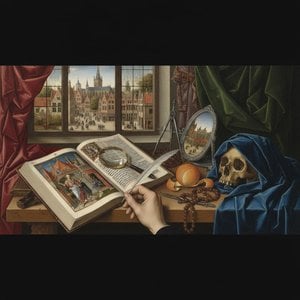
- Still Life with Books in a Niche (1442-1445): A breathtaking display of perspective and texture, where the artist invites the viewer into a quiet, scholarly sanctuary, rendering every edge of paper and grain of wood with startling clarity.
- Français Christ en croix: An intimate and visceral exploration of the Crucifixion, where the boundaries between the earthly and the divine blur through a profound sense of empathy and physical realism.
- Portraiture: His ability to capture the psychological complexities of his subjects, imbuing even the most formal portraits with a sense of living, breathing presence.
The Enduring Echo of a Master
The historical significance of Barthélemy d’Eyck lies in his role as a silent architect of the Northern Renaissance. He was an artist of movement and transition, working across the landscapes of France, Burgundy, and the Netherlands, carrying the technical innovations of the Flemish masters into new territories. His work represents a moment in art history where the meticulousness of the medieval tradition met the burgeoning humanism of the Renaissance, creating a style that was both deeply symbolic and strikingly real.
Though his life ended after 1470, leaving behind a legacy that is often reconstructed through the careful study of anonymous masterpieces, his impact remains indelible. To look upon a work attributed to d’Eyck is to witness the dawn of a new way of seeing—a way that finds the infinite within the infinitesimal and the divine within the details of our everyday world. He remains a vital, if quiet, cornerstone of the Netherlandish tradition, reminding us that true greatness often resides in the subtle, masterful strokes that define the edges of history.
Questions & Answers
In which historical period did Barthélemy D'Eyck work?
Barthélemy D'Eyck worked in the Renaissance period. The period situates the artist's activity in history.
Where are Barthélemy D'Eyck's artworks grouped by art movement?
The movements Barthélemy D'Eyck worked in can be seen on the artist's All Movements page, which groups the artworks by movement.
How do I find works by Barthélemy D'Eyck on a specific theme?
Barthélemy D'Eyck's works can be explored by keyword on the artist's By Keywords page. Each keyword groups the related artworks.