Early Life and Academic Foundations
Arthur Hacker, born in St Pancras, London, on September 25th, 1858, emerged from a family steeped in artistic tradition. His father, Edward Hacker, was a respected line engraver specializing in animal and sporting prints—a profession that undoubtedly instilled in young Arthur an early appreciation for meticulous detail and technical skill. This foundation proved crucial as Hacker embarked on his formal art education at the Royal Academy Schools between 1876 and 1880. However, seeking broader horizons, he continued his studies at the prestigious Atelier Bonnat in Paris, a move that would profoundly shape his artistic trajectory. The influence of French academic painting became immediately apparent, providing Hacker with a rigorous framework for composition, anatomy, and color theory. He debuted at the Royal Academy Summer Exhibition in 1878, signaling the beginning of his public career.A Synthesis of Styles: Religious Scenes and Portraiture
Hacker’s artistic output was remarkably diverse, yet consistently characterized by a refined elegance and a deep sensitivity to light and atmosphere. While he gained recognition for painting religious scenes—works imbued with a quiet spirituality and emotional depth—he also excelled in portraiture. His travels through Spain and North Africa left an indelible mark on his palette and subject matter, introducing exotic elements and vibrant color schemes into his work. He twice exhibited at the Royal Academy, in 1878 and 1910, demonstrating a sustained commitment to the established art world. In 1910, Hacker was elected an Academician—a testament to his growing reputation and mastery of the craft. This period saw him balancing grand religious compositions with increasingly sought-after portrait commissions, capturing the likenesses of prominent politicians, army officers, clergy, and figures from the artistic community.Navigating Victorian Tastes: Genre Painting and Symbolism
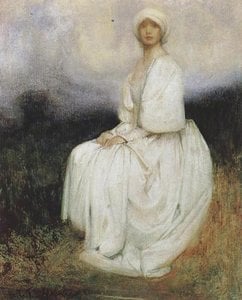
As the Victorian era transitioned into the Edwardian period, Hacker adeptly navigated shifting aesthetic preferences. The demand for literary and historical subjects waned, prompting him to diversify his repertoire. He revisited rustic and domestic genre scenes, showcasing a natural versatility that allowed him to adapt to changing tastes. During the Boer War, he contributed works reflecting the bittersweet nature of conflict—subtle symbolic explorations rather than explicit depictions of battle. His painting *The Cloister of the Bell*, for example, exemplifies this period, featuring an ethereal woman within a serene landscape, evoking a sense of contemplation and tranquility. He also demonstrated a fascination with Pre-Raphaelite values, attempting to revive their aesthetic in his own unique style.Major Works and Lasting Legacy
Hacker’s oeuvre includes several notable paintings that continue to captivate audiences today. *The Annunciation* at the Tate Britain is a prime example of his religious artistry—a delicate rendering of a pivotal biblical moment. *Pelagia and Philammon*, housed in Liverpool's Walker Art Gallery, showcases his skill in depicting classical narratives with emotional nuance. Other significant works include *The Children’s Prayer* (1888) at the Atkinson Museum, Southport, and *The Temptation of Sir Percival* in Leeds City Art Gallery. In 1902, Hacker built a new house called Hall Ingle in Checkendon, Oxfordshire, commissioning architect Maxwell Ayrton and personally overseeing the decorations—a testament to his holistic artistic vision. He died on November 12th, 1919, in Kensington, London, and is buried in Brookwood Cemetery, Surrey.Historical Significance and Modern Appreciation
Arthur Hacker occupies a unique position within British art history. He successfully bridged the gap between French academic training and Victorian sensibilities, creating works that were both technically accomplished and emotionally resonant. His ability to adapt to changing tastes while maintaining his distinctive style ensured his continued success throughout his career. While perhaps not as widely celebrated as some of his contemporaries, Hacker’s paintings are increasingly recognized for their beauty, sophistication, and insightful portrayal of the human condition. Today, his works can be found in prominent public collections and private galleries, offering a glimpse into a fascinating era of artistic innovation and refinement. His legacy endures through the captivating scenes he created—a testament to his skill as a painter and his enduring contribution to British art.Questions & Answers
How many artworks by Arthur Hacker are available to browse?
You can browse 94 artworks by Arthur Hacker on the All Artworks page.
Is there a 3D virtual tour of Arthur Hacker's works?
The 3D Museum of Arthur Hacker is a page that displays the artist's artworks in a virtual three-dimensional gallery.
Can I browse Arthur Hacker's works by color palette?
Arthur Hacker's works can be browsed by color palette on the artist's By Palettes page.