The Master of Petals: The Life and Legacy of Antoine Berjon
In the grand tapestry of nineteenth-century French art, few names evoke the delicate splendor of nature as intimately as Antoine Berjon. A painter and designer of profound sensitivity, Berjon emerged as one of the most significant flower painters of his era. Born in Saint-Pierre-de-Vaisé, a commune near Lyon, he was the son of a butcher, yet his destiny was woven from much more delicate threads. His early artistic journey began under the guidance of the local sculptor Antoine-Michel Perrache, a foundation that would later allow him to master the structural nuances of the natural world. While some uncorrobed accounts suggest a possible past in medicine or even a religious vocation during a novitiate, it was through the study of botanical forms that Berjon truly found his voice.
Berjon’s career was deeply intertwined with the economic and cultural pulse of Lyon. Initially working as a designer for the city's prestigious silk industry, he witnessed firsthand the transformative power of art in commerce. However, the upheaval of the French Revolution brought the collapse of this textile boom, forcing Berjon to navigate a changing landscape. His move to Paris in 1794 marked a period of significant professional growth; during his seventeen years in the capital, he became part of an elite circle of artists and exhibited his works at the prestigious Paris Salon. It was here that his talent for capturing the ephemeral beauty of flora began to garner widespread recognition.
A Symphony of Technique and Botanical Realism
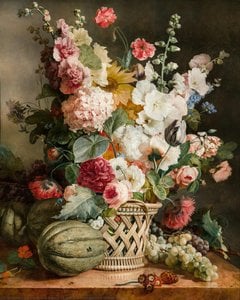
The artistry of Antoine Berjon is characterized by a remarkable versatility and a pursuit of unparalleled realism. He moved effortlessly between various media, including oil, pastel, watercolour, and ink, each chosen to best capture the specific textures of his subjects. His work often reached beyond mere imitation of the Dutch and Flemish masters; instead, he sought to push the boundaries of illusionistic still life. In masterpieces such as Fruit and Flowers in a Willow Basket, Berjon achieved a level of detail so precise that the viewer might almost sense the weight of a plump grape or the subtle movement of a fly resting upon a melon.
His technical virtuosity is most evident in his ability to manipulate light and color to create a convincing three-dimensional space. He possessed a unique gift for rendering the velvet touch of rose petals, the translucent quality of white blooms, and the rugged texture of wicker baskets. This mastery of light allowed him to breathe life into his compositions, turning simple botanical studies into profound sensory experiences. Whether through the vibrant hues of a summer garden or the soft, muted tones of chalk drawings, Berjon’s work remains a testament to his deep understanding of organic form and the play of light upon it.
The Educator and the Lyon Renaissance
Upon his return to Lyon in 1810, Berjon played a pivotal role in the city's artistic revival. As the professor of flower design at the newly established École des Beaux-Arts, he became a cornerstone of an institution founded by Napoleon’s decree to revitalize Lyon's silk and luxury industries. For thirteen years, he shaped the next generation of designers, imparting his knowledge of botanical accuracy and aesthetic elegance. Though his tenure ended in 1823 following conflicts with the school's administration—a reflection of a temperament known for its stubbornness—his influence on the region's design legacy remained indelible.
Berjon’s historical significance lies not only in his individual paintings but in his role as a bridge between the classical traditions of the past and the burgeoning decorative arts of the nineteenth century. His life, spanning from the late eighteenth century to the mid-nineteenth, mirrored the turbulent transitions of France itself. Through his dedicated studio practice and private instruction, he ensured that the art of flower painting would continue to flourish, leaving behind a body of work that serves as an eternal spring for all who admire the delicate wonders of the natural world.
Questions & Answers
How many artworks by Antoine Berjon are available to browse?
You can browse 5 artworks by Antoine Berjon on the All Artworks page.
Where is Antoine Berjon from?
Antoine Berjon was born in France.
Where are Antoine Berjon's artworks mapped by subject?
The Subject Atlas of Antoine Berjon is a page that maps the artist's artworks by their subjects.