Early Life and Artistic Beginnings
Antal Berkes, a name perhaps less familiar than some of his contemporaries in the vibrant Hungarian art scene of the early 20th century, nevertheless left an indelible mark on the visual record. Born in Budapest in 1874, he emerged from a city brimming with both historical grandeur and burgeoning modernity – a potent combination that profoundly shaped his artistic vision. His formative years were spent within the framework of the Academy of Fine Arts, where he initially honed his skills in landscape painting, a traditional pursuit often considered a stepping stone to more ambitious subjects. However, Berkes’s gaze soon turned outwards, drawn to the dynamic energy and intricate details of Budapest itself – a city undergoing rapid transformation under the Austro-Hungarian Empire.
The late 19th and early 20th centuries in Hungary were a period of intense social and political change. The rise of urban centers like Budapest brought with it a new wave of industrialization, immigration, and cultural exchange. Berkes’s artistic journey coincided perfectly with this era of transformation, providing him with a rich tapestry of subjects to explore – from the bustling marketplaces and crowded streets to the elegant facades of historic buildings and the everyday lives of its inhabitants. His early exposure to academic training provided a solid foundation in technique, but it was his keen observation and willingness to experiment that truly distinguished his work.
The Rise of Street Scene Painting
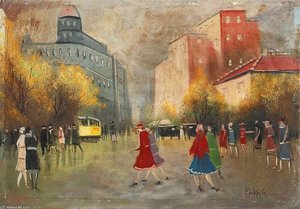
Berkes’s artistic trajectory shifted decisively towards street scene painting during the late 1890s. This wasn't merely a stylistic choice; it reflected a deeper engagement with the realities of urban life and a desire to capture the spirit of his native city. Unlike many artists who idealized or romanticized their subjects, Berkes presented a remarkably honest portrayal of Budapest – its grime, its vibrancy, and its inherent contradictions. His paintings are not polished portraits but rather snapshots of daily existence, teeming with activity and populated by a diverse cast of characters: vendors hawking their wares, children playing in the streets, horse-drawn carriages navigating the crowded thoroughfares, and laborers going about their work.
Crucially, Berkes’s approach was deeply rooted in Impressionism. He embraced the techniques of loose brushwork, broken color, and a focus on capturing fleeting moments – mirroring the transient nature of urban life itself. He skillfully employed light and shadow to create a sense of depth and atmosphere, drawing the viewer into the heart of his scenes. This stylistic choice was not arbitrary; it aligned perfectly with the broader artistic trends of the time, reflecting a growing interest in portraying the modern world through a subjective lens.
- Key Techniques: Loose brushwork, broken color, emphasis on light and shadow.
- Subject Matter: Budapest street scenes, capturing daily life and urban activity.
- Influences: Impressionism, particularly the work of artists who depicted modern cityscapes.
Parisian Influences and Artistic Evolution
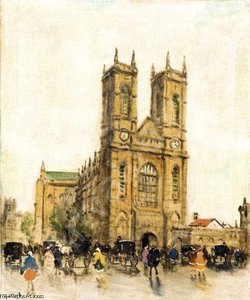
In the early 1900s, Berkes spent a significant period living and working in Paris – a hub of artistic innovation during that era. This sojourn proved to be transformative, exposing him to new ideas, techniques, and influences. While he continued to paint scenes of Budapest, his Parisian experience broadened his perspective and led to subtle shifts in his style. He began incorporating elements of realism into his work, paying closer attention to detail and exploring the psychological complexities of his subjects.
Despite this evolution, Berkes never abandoned his characteristic approach to street scene painting. His Parisian works retained a strong sense of immediacy and spontaneity, capturing the energy and dynamism of urban life with remarkable skill. He continued to experiment with color and composition, refining his technique and developing a unique visual language that was both distinctly Hungarian and undeniably modern.
It’s important to note that Berkes's artistic output fluctuated throughout his career, reflecting periods of experimentation and stylistic shifts.Legacy and Historical Significance
Antal Berkes died in 1938, leaving behind a substantial body of work that offers a valuable glimpse into the social and cultural landscape of early 20th-century Budapest. His paintings are not merely depictions of urban scenes; they are windows into the lives of ordinary people – laborers, merchants, children, and travelers – who shaped the city’s identity. Berkes's ability to capture the essence of Budapest in his art has ensured his place as one of Hungary’s most important street scene painters.
His work is now housed in museums and private collections around the world, testament to its enduring appeal and historical significance. Berkes’s legacy extends beyond his individual paintings; he represents a pivotal moment in Hungarian art history – a time when artists began to actively engage with the realities of modern life and explore new ways of representing the world around them. His influence can be seen in the work of subsequent generations of Hungarian painters, who followed in his footsteps and continued to capture the spirit of their city on canvas.