Early Life and Artistic Beginnings
Andrew Pisacane, known professionally as gaia, emerged from the vibrant street art scene of New York City in 1988. His upbringing amidst the city’s dynamic cultural landscape profoundly shaped his artistic vision, fostering a deep connection to urban spaces and their inherent narratives. Unlike artists who might begin with formal training, Pisacane's education was rooted in direct engagement with the environment – observing the interplay of architecture, community life, and the ever-evolving layers of history etched onto city walls. This early immersion instilled in him not only technical skills but also a profound sense of social responsibility, which would become a defining characteristic of his work.
The Evolution of a Muralist: Technique and Themes
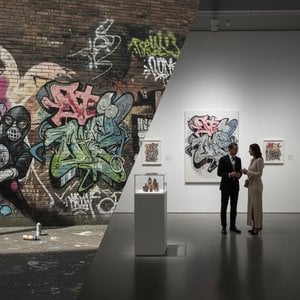
Pisacane’s artistic journey quickly transcended traditional graffiti, evolving into large-scale murals that function as powerful interventions in the public sphere. His technique is characterized by a masterful blend of realism and abstraction, often employing muted color palettes punctuated by striking details. He doesn't simply paint *on* walls; he engages with their existing textures and imperfections, incorporating them into the artwork itself. This approach creates a sense of dialogue between the mural and its surroundings, grounding the work in a specific place and time.
Central to Pisacane’s oeuvre is an exploration of history and sociology. He meticulously researches the neighborhoods where he works, unearthing forgotten stories and marginalized voices. These narratives are then translated into visually arresting murals that serve as poignant reminders of the past and catalysts for contemporary reflection. His work often addresses themes of displacement, gentrification, and the human cost of development, prompting viewers to confront uncomfortable truths about their communities.
Recognition and Major Achievements
Pisacane’s commitment to socially engaged art has garnered significant recognition within the art world. He has received numerous museum showings, a testament to the artistic merit and intellectual depth of his work. His murals can be found in cities across the globe, each one a unique response to its local context. Beyond exhibitions, Pisacane's influence extends into education; he currently teaches at the Maryland Institute College of Art (MICA), nurturing the next generation of artists and fostering a critical approach to public art.
- Large-Scale Murals: Pisacane is renowned for his expansive murals that transform urban landscapes, often incorporating historical imagery and sociological commentary.
- Community Engagement: His process actively involves researching and collaborating with local communities, ensuring the artwork resonates authentically with its surroundings.
- Museum Exhibitions: Recognition through museum showings solidifies his position as a significant contemporary artist.
- Teaching at MICA: Pisacane’s role as an educator demonstrates his dedication to fostering critical thinking and artistic expression in aspiring artists.
Historical Significance and Lasting Impact
In a world increasingly dominated by digital imagery, gaia's murals offer a powerful counterpoint – tangible interventions that demand physical presence and encourage direct engagement. His work stands as a compelling example of how art can be used to challenge dominant narratives, amplify marginalized voices, and foster a deeper understanding of our shared history. The Human Cost of Development, for instance, exemplifies his ability to synthesize complex sociological issues into visually arresting forms that resonate with broad audiences.
Pisacane’s legacy extends beyond the aesthetic beauty of his murals; it lies in his unwavering commitment to social justice and his belief in the transformative power of art. He has redefined the role of the street artist, elevating the practice from a subcultural expression to a vital form of public discourse. As he continues to create, Pisacane’s work promises to inspire future generations of artists to use their voices to build more equitable and compassionate communities.
Questions & Answers
What are the birthplace and birth year of Andrew Pisacane?
Andrew Pisacane was born in New York in 1988.
How popular are Andrew Pisacane's artworks?
A Stats page exists for Andrew Pisacane, presenting statistics about the artist's artworks on this website.
Can I browse Andrew Pisacane's works by medium?
The All Medium page groups Andrew Pisacane's artworks by technique.
Where are Andrew Pisacane's artworks grouped by art movement?
The movements Andrew Pisacane worked in can be seen on the artist's All Movements page, which groups the artworks by movement.
What are the birth city and country of Andrew Pisacane?
Andrew Pisacane was born in New York, in United States of America.
Where is Andrew Pisacane from?
Andrew Pisacane was born in United States of America.
Can I sort Andrew Pisacane's artworks by color?
The Spectral Index page organizes Andrew Pisacane's artworks by color.