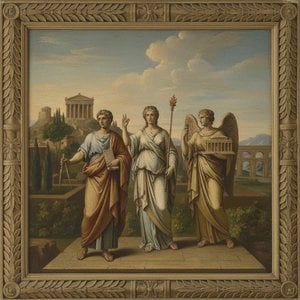
Alfred Le Petit: A Parisian Illustrator Shaping Victorian Morality
Alfred Le Petit (1841 – 1909) was a French illustrator and painter whose distinctive style—characterized by meticulous detail, expressive brushwork, and a penchant for capturing the nuances of human emotion—established him as one of the most prominent figures in late nineteenth-century Parisian art. Though often overshadowed by his contemporaries like Daumier and Toulouse-Lautrec, Le Petit’s contribution to visual culture is undeniable, particularly through his prolific work for *Le Charivari*, a satirical magazine that championed social reform and moral responsibility during its heyday.
Early Life and Artistic Training
Born in Aumale, Normandy, Alfred Le Petit received an aristocratic upbringing and benefited from private tutoring focused on drawing and painting. His father, Jean-Baptiste Le Petit, was a diplomat stationed in Constantinople, exposing young Alfred to diverse cultures and fostering his artistic sensibilities. Recognizing his talent early on, Le Petit’s family encouraged him to pursue formal training at the École Supérieure des Beaux-Arts in Paris, where he honed his skills under influential instructors like Alexandre Cabanel and Jean-Léon Gérôme. These formative years instilled in him a disciplined approach to artmaking and cultivated an unwavering commitment to realism—a stylistic choice that would define his artistic career.
The Charivari Years: Moral Critique Through Illustration
Le Petit’s fame ascended dramatically during his tenure as illustrator for *Le Charivari*. Founded in 1832 by Charles Philipon and Gabriel Aubert, the magazine swiftly gained notoriety for its daring critiques of societal ills—ranging from political corruption to social hypocrisy. Le Petit embraced this journalistic mission with fervor, transforming complex moral dilemmas into visually arresting narratives that resonated deeply with the Parisian public. His illustrations weren’t merely decorative embellishments; they functioned as potent vehicles for conveying ideas about virtue and vice, often depicting scenes of everyday life infused with symbolic significance. Consider his depictions of Parisian street performers—a series of prints capturing both the vibrancy and vulnerability of urban existence—which subtly questioned prevailing social norms. He skillfully employed chiaroscuro lighting and meticulous detail to heighten emotional impact and guide the viewer’s gaze toward key thematic elements.
Style and Technique: Precision and Emotional Depth
Le Petit's artistic style was marked by an unparalleled level of precision and technical mastery. He meticulously studied anatomy, perspective, and color theory—skills honed through extensive observation and experimentation. Unlike many Impressionists who prioritized capturing fleeting moments of light and atmosphere, Le Petit favored a more deliberate approach, prioritizing psychological realism over optical illusion. His brushstrokes were controlled yet expressive, conveying subtle nuances of emotion and gesture. He achieved remarkable textural effects by layering thin glazes of pigment—a technique he perfected during his travels to Italy—resulting in surfaces that shimmered with luminosity and depth. This meticulous attention to detail extended beyond mere visual representation; it reflected Le Petit’s profound belief in the power of art to illuminate moral truths and inspire social reform.
Legacy and Influence
Alfred Le Petit's influence extends far beyond his own artistic output. He served as a mentor to numerous aspiring illustrators, shaping the aesthetic sensibilities of an entire generation. His unwavering commitment to realism—combined with his masterful use of technique—established him as a cornerstone of Victorian art history. Furthermore, *Le Charivari*, fueled by Le Petit’s illustrations and writings, played a crucial role in fostering public discourse on ethical dilemmas and advocating for social justice. Today, his paintings reside primarily in the Musée du Petit Palais in Avignon, France – a testament to his enduring artistic legacy and a celebration of Parisian art's contribution to Victorian morality. His work continues to inspire artists and scholars alike, reminding us that visual art can serve as both a mirror reflecting society’s values and a catalyst for transformative change.