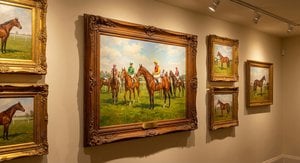
Alfred FitzWalter Grace: A Painter of Sussex Serenity
Alfred FitzWalter Grace (1844 – 1903) remains a relatively obscure figure in British art history, yet his landscapes—particularly those depicting the rolling hills and tranquil waters of West Sussex—possess a remarkable quality of stillness and observation that speaks to the Victorian fascination with capturing the beauty of the natural world. Born in Storrington, Grace’s artistic journey began modestly, influenced by the pastoral surroundings of his upbringing and nurtured by early exposure to watercolor painting techniques. While biographical details remain sparse, evidence suggests he pursued formal training at Slade School of Fine Art in London, honing his skills alongside fellow artists of the era.
- Early Influences: Grace’s artistic sensibilities were undoubtedly shaped by Romantic landscape painters like Turner and Constable, whose dramatic compositions celebrated the sublime power of nature. However, unlike many of his contemporaries who sought to convey grand narratives or heroic ideals, Grace prioritized capturing subtle nuances of light and atmosphere—a characteristic that distinguishes his work from more overtly emotive styles.
- Technique: Grace’s favored medium was watercolor, a technique he mastered with meticulous precision. He employed delicate washes and layering techniques to achieve luminous effects, skillfully blending colors to create harmonious tonal gradations that faithfully reproduced the textures of foliage, water surfaces, and distant horizons. His brushstrokes were understated yet purposeful, conveying a sense of quiet contemplation rather than forceful gesture.
Grace’s oeuvre comprises approximately sixty paintings—primarily landscapes—primarily focused on scenes from West Sussex. These works depict idyllic rural vistas: hedgerows teeming with birdsong, arable fields bathed in golden sunlight, and serene lakes reflecting the azure sky. Recurring motifs include trees – particularly beech and oak – which Grace rendered with exceptional accuracy, capturing their branching forms and dappled shadows with remarkable sensitivity. The artist’s meticulous attention to detail extended beyond botanical representation; he meticulously observed atmospheric conditions—misty mornings, hazy afternoons—transforming them into evocative visual experiences.
- Notable Paintings: Among his most celebrated pieces are “Lea Farm, Storrington” and “Hedgerow and Trees,” both executed in 1897 and 1898 respectively. These canvases exemplify Grace’s signature style—characterized by a restrained palette, subtle tonal variations, and an unwavering commitment to capturing the essence of place. They stand as testament to his ability to distill complex visual information into deceptively simple compositions.
- Legacy: Although Grace’s name rarely appears in art historical surveys, his paintings continue to resonate with viewers today. Their understated beauty—their quiet contemplation of the natural world—reflects a broader cultural trend toward valuing tranquility and observation during the Victorian period. Furthermore, Grace's dedication to watercolor technique—his masterful blending of colors and meticulous rendering of textures—served as an inspiration for subsequent generations of landscape artists.
Grace’s contribution to British art lies not in grand ambition or revolutionary innovation but rather in his unwavering pursuit of artistic integrity. He sought to honor the beauty of Sussex, not through dramatic spectacle, but through quiet contemplation and skillful execution. His legacy endures as a reminder that true artistry resides in capturing the subtle wonders of everyday life—a lesson that remains profoundly relevant in our contemporary world.