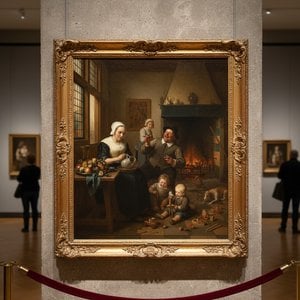
Adriaen van Gaesbeeck: A Subtle Master of Dutch Realism
Adriaen van Gaesbeeck, a name perhaps less familiar than those of Rembrandt or Vermeer, nevertheless represents a significant and quietly compelling figure in the history of 17th-century Dutch painting. Born in Haarlem in 1621 and tragically passing away at the young age of 29 in 1650, Van Gaesbeeck’s brief career produced a remarkably small but intensely personal body of work – primarily genre scenes and portraits – that reveals a profound sensitivity to light, detail, and the everyday realities of life. His paintings are characterized by an understated elegance and a remarkable ability to capture fleeting moments of domesticity, often imbued with a melancholic beauty.
Van Gaesbeeck’s artistic lineage is inextricably linked to the masters of Haarlem, particularly Gerard Dou and Pieter van Slingelandt. These artists, known for their meticulous observation and masterful use of light, profoundly influenced Van Gaesbeeck's approach. Like his mentors, he eschewed grand narratives or dramatic compositions in favor of intimate scenes depicting ordinary people engaged in routine activities. This preference aligns him firmly within the burgeoning genre painting movement that flourished during the Dutch Golden Age – a period dedicated to portraying the lives and customs of the common citizen.
Early in his career, Van Gaesbeeck’s style closely mirrored that of Dou, evident in works like “The Seamstress,” currently housed in the Berlin Gallery. This painting exemplifies his signature technique: a soft, diffused light emanating from an unseen source, bathing the scene in a gentle glow and creating a sense of quiet contemplation. The details are rendered with astonishing precision – the texture of the fabric, the wrinkles on the seamstress’s face, the dust motes dancing in the light – all contribute to a remarkably realistic portrayal of a humble profession.
A Portraitist of Quiet Moments
While his genre scenes are perhaps more widely recognized, Van Gaesbeeck was also a skilled portrait painter. A notable example is “Young Man in a Study,” held at the Amsterdam Museum, which offers a glimpse into the private world of a young gentleman. The painting’s strength lies not in its grandiosity but in its subtle psychological depth. The subject's gaze, his slightly furrowed brow, and the carefully arranged objects within the study – a book, a writing desk, a lute – all speak volumes about his character and aspirations. Van Gaesbeeck masterfully conveys a sense of introspection and quiet contemplation, hallmarks of his artistic sensibility.
Interestingly, Van Gaesbeeck’s output was remarkably limited. Scholars believe he only completed around thirty paintings throughout his career. This scarcity contributes to the mystique surrounding his work, making each piece all the more precious and revealing. The fact that so few works survive underscores the artist's dedication to perfectionism – a trait likely inherited from his influences like Dou.
Technique and Style: Light, Detail, and Emotion
Van Gaesbeeck’s artistic technique is characterized by an extraordinary attention to detail and a masterful manipulation of light. He employed a technique known as “chiaroscuro,” using subtle gradations of light and shadow to create depth and volume within his compositions. This approach wasn't dramatic or theatrical; rather, it was used to enhance the realism and emotional impact of his scenes. He frequently utilized thin layers of paint, allowing the texture of the canvas to peek through – a technique that adds to the paintings’ intimate quality.
Furthermore, Van Gaesbeeck's compositions are remarkably uncluttered, focusing on a small number of figures within carefully constructed spaces. This simplicity allows him to concentrate his attention on capturing the nuances of human expression and the subtle details of everyday life. His portraits, in particular, are notable for their psychological insight – he seems to penetrate the subject’s inner world with remarkable sensitivity.
Legacy and Historical Significance
Despite his tragically short career, Adriaen van Gaesbeeck left a lasting mark on Dutch painting. While often overshadowed by more celebrated contemporaries, his work is increasingly recognized for its quiet beauty, psychological depth, and technical mastery. His paintings offer a poignant glimpse into the lives of ordinary people during the Dutch Golden Age – a period of unprecedented prosperity and artistic innovation.
Van Gaesbeeck’s influence can be seen in the works of later artists who followed in his footsteps, particularly those associated with the “Haarlem School.” His legacy lies not in grand pronouncements or revolutionary innovations but in his unwavering commitment to capturing the beauty and complexity of everyday life with a delicate touch and profound empathy. His paintings continue to resonate today, inviting viewers to pause and contemplate the quiet moments that shape our lives.