The Architect of Italian Elegance
Born in Saint Petersburg, Russia, to German parents, Adolf Hohenstein emerged as a transformative figure whose creative reach extended far beyond the boundaries of a single medium. Though his roots were in the Russian Empire, his artistic soul was forged in the vibrant cultural landscapes of Vienna and Milan. As a painter, illustrator, advertiser, and set designer, he possessed a rare ability to weave together the theatrical and the graphic, ultimately earning him the prestigious title of the father of Italian poster art. His journey from the imperial atmosphere of his birthplace to the heart of the Italian Stile Liberty—the local expression of Art Nouveau—is a testament to a life lived at the intersection of diverse European traditions.
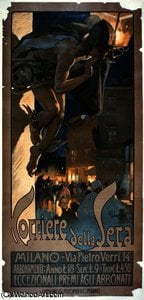
Hohenstein’s career was defined by an extraordinary versatility that allowed him to command both the grand stage and the intimate printed page. His early years in Vienna provided a foundation of classical training, while his travels through India offered him unique perspectives on decoration and ornamentation. However, it was his move to Milan in 1879 that would forever alter the course of graphic design history. Settling in this burgeoning metropolis, he became an essential collaborator for the legendary musical publisher Giulio Ricordi. Within the Ricordi Graphical Workshops, Hohenstein acted as a visionary, translating the soaring emotions of opera into striking visual narratives. His hand was instrumental in creating the iconic posters for masterpieces such as Puccini’s Tosca and Madama Butterfly, works that required a delicate balance of dramatic tension and aesthetic grace.
A Legacy of Line and Light
The artistry of Hohenstein is characterized by a profound command over atmosphere and the evocative power of the line. Whether he was designing elaborate costumes and sets for La Scala or crafting advertisements for brands like Campari, his work breathed with a rhythmic vitality. In his poster designs, one finds a masterful use of flowing, organic shapes and a vibrant color palette that could capture the public's imagination instantly. He had a singular talent for world-building; even in a single sketch or a promotional print, he could evoke the heavy, cloud-swept skies of Rome or the glamorous allure of a modern cityscape.
His contributions to the visual language of his era cannot be overstated. Beyond the realm of fine art, his work as an advertiser and illustrator helped define the commercial aesthetic of the early 20th century. His achievements include:
- Pioneering Graphic Design: Establishing the foundations of the Italian poster movement through highly decorative and emotionally resonant illustrations.
- Theatrical Mastery: Creating immersive environments for opera through meticulous set and costume designs that complemented the musical drama of composers like Verdi and Puccini.
- Art Nouveau Exponent: Serving as a leading figure of the Stile Liberty, integrating classical revivalism with the modern, flowing aesthetics of the period.
Ultimately, Adolf Hohenstein remains a seminal figure whose influence resonated through the evolution of graphic design in Italy and beyond. His ability to bridge the gap between high culture—the opera house and the theater—and the everyday experience of the public through posters and postcards ensures his place in the pantheon of great illustrators. He did not merely decorate the world; he redesigned how it was seen, leaving behind a legacy of elegance, drama, and enduring beauty.
Questions & Answers
Is there a 3D virtual tour of Adolf Hohenstein's works?
Adolf Hohenstein's artworks can be seen in a 3D gallery on the artist's 3D Museum page.
What are the birth city and country of Adolf Hohenstein?
Adolf Hohenstein was born in Saint Petersburg, in Russia.
Can I browse Adolf Hohenstein's works by mood?
Adolf Hohenstein's works can be browsed by mood on the artist's Mood Room page, which arranges the artworks by their recorded moods.
Where is Adolf Hohenstein from?
Adolf Hohenstein was born in Russia.
Where are Adolf Hohenstein's artworks grouped by palette?
Adolf Hohenstein's works can be browsed by color palette on the artist's By Palettes page.
What are the birthplace and birth year of Adolf Hohenstein?
Adolf Hohenstein was born in Saint Petersburg in 1854.
Where are Adolf Hohenstein's artworks grouped by art movement?
The All Movements page groups Adolf Hohenstein's artworks by art movement.