The Rejection of Realism: The Birth of the Symbolist Vision
 Symbolism (movement)
Symbolism was a late 19th-century art movement of French and Belgian origin in poetry and other arts seeking to represent absolute truths symbolically through language and metaphorical images, mainly as a reaction against naturalism and realism. In l...
To understand the profound allure of the Symbolist movement, one must first contemplate the era from which it emerged—a period defined by a restless dissatisfaction with the visible world. In the late 19th century, the art landscape was dominated by Naturalism and Realism, movements that sought to document the gritty, unadorned particulars of everyday life with almost scientific precision. Yet, for a certain generation of visionaries, this obsession with the tangible felt hollow. They yearned to move beyond the mere representation of external reality, seeking instead to capture the unseen: the whispers of the soul, the weight of a dream, and the absolute truths that reside beneath the surface of perception.
Originating primarily in France and Belgium, Symbolism was not merely an aesthetic choice but a profound philosophical rebellion. It sought to replace the literal with the metaphorical, using color, form, and composition as a language for the intangible. This movement drew its initial strength from literature, finding its heartbeat in the evocative verses of Charles Baudelaire, particularly his seminal Les Fleurs du mal. By embracing the influence of Edgar Allan Poe, Symbolist artists began to weave a tapestry of stock tropes—shadows, enigmas, and haunting figures—that served as gateways to a deeper, more spiritual realm. It was an era where the artist’s role shifted from that of a chronicler to that of a medium, translating the vibrations of the subconscious into visual poetry.
Metaphysical Shadows: Decoding the Subconscious in Art
 25 Masterpieces of Giorgio de Chirico: The King of Metaphysical Art
Introduction Step into a world where the sun never quite sets, where shadows stretch like long, dark fingers across deserted piazzas, and where the silence is so heavy you can almost hear it. To explore the top 25 artworks of Giorgio de Chirico is to...
As the movement matured, it evolved into something far more unsettling and profound than simple decoration. The exploration of the subconscious led to the birth of what would later be recognized as Metaphysical art, most notably embodied in the works of Giorgio de Chirico. To step into a De Chirico canvas is to wander through a dream that refuses to wake. His mastery lay in his ability to capture the heavy, silent pulse of the psyche, using deserted Italian piazzas and unnaturally long shadows to evoke a sense of existential dread and profound stillness. In his world, architecture does not merely provide structure; it holds its breath, waiting for a truth that remains perpetually out of reach.
This metaphysical dimension relies heavily on the juxtaposition of the familiar with the uncanny. A classical archway or a marble statue, rendered with meticulous care, becomes a vessel for mystery when placed within an illogical space or under a twilight sun that never seems to set. The shadows stretch like long, dark fingers across empty squares, creating a tension that is both beautiful and disquiet of mind. This technique forces the viewer to confront the irrationality of time and space, reminding us that much of our existence occurs in those quiet, unobservable intervals between conscious thoughts. It is an art of the void, where the absence of life becomes more communicative than its presence.
The Fin de Siècle Spirit: Dreams, Nightmares, and Decadence
Strange Realities: The Symbolist Imagination explores this cultural landscape from many perspectives and geographies, including France, Belgium, Norway, ...
The term fin de siècle—the end of the century—carries with it a complex emotional weight, encompassing both a sense of social decay and the shimmering hope of a new dawn. The late 1880s and 18 رؤ90s were characterized by an atmosphere of ennui, cynicism, and a fascination with the decadent. This cultural landscape was a fertile ground for Symbolism, as artists navigated the thin line between the sublime dream and the terrifying nightmare. There was a widespread belief that civilization was reaching a point of exhaustion, leading to an aesthetic that embraced exoticism, spirituality, and even the macabre.
This period was marked by a fascination with the darker aspects of human experience—the shadows of the mind that haunt our most private moments. The works of this era often reflect a tension between the classical heritage of Europe and the fractured, modern psyche emerging from the industrial age. Whether through the melancholic landscapes of Norway or the urban, cosmopolitan explorations in Romania, the Symbolist spirit remained consistent in its pursuit of the ideal. It was an era of intense emotionality, where even the most beautiful imagery could harbor a hidden sting of mortality, reflecting the dual nature of a world caught between the closing of one epoch and the uncertain onset of another.
From Baudelaire to De Chirico: Literary and Visual Intersections
 Robert de Montesquiou
Marie Joseph Robert Anatole, comte de Montesquiou-Fézensac (19 March 1855, Paris – 11 December 1921, Menton) was a French aesthete, Symbolist poet, painter, art collector, art interpreter, and dandy. He is reputed to have been the inspiration both fo...
The lineage of Symbolism is a seamless thread woven through both the written word and the painter's brush. The movement’s aesthetic was meticulously developed by poets such as Stéphane Mallarmé and Paul Verlaine, who utilized language to suggest rather than to state. This literary foundation provided the essential toolkit for visual artists, offering them a framework of metaphors and symbols that could be translated into pigment and canvas. The influence of Baudelaire's fascination with the beauty found in decay provided a blueprint for an art form that celebrated the evocative power of the morbid and the mysterious.
The Architecture of Silence: Exploring Space and Mystery in Symbolist Landscapes
 Le Ballon ( La Ville de Paris investie, confie à l'air son appel à la France ). Allégorie à la défense de Paris (1870 1871). Siège de Paris
Le Ballon : Une Allegorie de Résilience et d'Espoir pour Paris Pierre Puvis de Chavannes, un artiste dont l’œuvre transcende les conventions esthétiques du XIXe siècle, demeure une figure emblématique de la peinture française. Son œuvre monumentale, ...
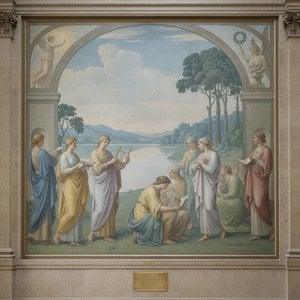
In the hands of a true Symbolist, landscape painting transcends the mere depiction of nature. It becomes an architectural construction of silence. Consider the works of Pierre Puvis de Chavannes, whose monumental approach to the landscape often feels as though it exists outside of time itself. In masterpieces such as Le Ballon, we see an allegory of resilience and hope, where the landscape is not just a setting but a participant in a larger emotional narrative. His use of muted tones and simplified forms creates an atmosphere of serenity and contemplation, inviting the viewer to lose themselves in a world that feels both ancient and eternal.
This architectural approach to space involves a careful manipulation of perspective and light to create a sense of profound stillness. The landscapes are often devoid of the frantic movement found in Impressionism; instead, they possess a heavy, almost palpable quietude. By stripping away the unnecessary details of the natural world, Symbolist artists were able to highlight the essential emotional truths of a scene. This focus on the "essential" allows for a deeper connection with the viewer, as the landscapes become mirrors for our own internal states—spaces where we can confront our solitude and find beauty in the vast, silent expanses of the unknown.
Preserving the Dream: Bringing Symbolist Elegance into Modern Interiors
 Gala's Dream (Dream of Paradise), circa 1972
Explore Salvador Dali’s mesmerizing ‘Gala’s Dream,’ a surreal landscape masterpiece from 1972 featuring a woman gazing at a colossal cat-like figure—a captivating glimpse into the artist's subconscious and dream world.
While the Symbolist movement was a reaction against the realities of its time, its aesthetic continues to offer profound inspiration for the contemporary collector and interior designer. The movement's emphasis on atmosphere, depth, and the evocative power of shadow provides a sophisticated toolkit for creating spaces that transcend mere decoration. Integrating pieces that evoke this dreamlike mystery—whether through a large-scale reproduction of a De Chirico square or a delicate, atmospheric landscape—can imbue a room with a sense of history, intellect, and quiet luxury.
For the discerning homeowner, the challenge lies in balancing these evocative works with modern sensibilities. The key is to treat art as an architectural element, using its inherent tension and depth to anchor a space. A well-placed, hand-painted oil reproduction can serve as a window into another realm, providing a focal point that encourages contemplation and conversation. At WahooArt.com, we specialize in bringing these historical masterpieces to life through meticulous craftsmanship. Our artists, trained in the finest academic traditions, recreate the visible brushstrokes and rich tonal ranges of the masters on premium cotton canvas. Whether you are seeking to transform a private study with the haunting beauty of the Metaphysical style or looking for a custom commission that reimagines a personal memory through a Symbolist lens, our expertise ensures that your collection remains as timeless and profound as the movement itself.