A still life (pl.: still lifes) is a work of art depicting mostly inanimate subject matter, typically commonplace objects which are either natural (food, flowers, dead animals, plants, rocks, shells, etc.) or human-made (drinking glasses, books, vase...
The impulse to capture the inanimate is as old as human record-keeping itself. Long before the term "still life" entered the Western lexicon, artists were utilizing the depiction of food and objects to bridge the gap between the physical world and the eternal. In the quiet darkness of ancient Egyptian tombs, paintings of offerings were not merely decorative; they were functional, intended to ensure that sustenance and essential items would manifest in the afterlife for the deceased. This early use of art as a vessel for permanence established a fundamental truth about the genre: an object, once rendered with care, carries weight far beyond its physical form.
This concept of permanence found a different expression in the Greco-Roman world. In the villas of Pompeii and Herculaneum, wall paintings and floor mosaics displayed a growing fascination with realistic perspective and the beauty of everyday abundance. The emblema mosaics, often placed in the homes of the Roman upper classes, showcased bowls of fruit and seasonal delicacies as signs of hospitality and prosperity. These works were not intended to deceive, but to celebrate the bounty of the present moment. This ancient tradition of using natural motifs to signal status and seasonal change remains a foundational element of how we perceive the arrangement of objects in art today.
The Vanitas Tradition: Mortality and Symbolism in the Dutch Golden Age
Still Life: An Allegory of the Vanities of Human Life is an oil-on-panel painting by the Dutch Golden Age painter Harmen Steenwijck. Created around 1640, the work is an allegorical vanitas. It has been in the collection of the National Gallery in Lon...
By the seventeenth century, the depiction of objects had taken on a much more somber and philosophical dimension. In the Netherlands, the emergence of the vanitas genre transformed the simple arrangement of items into a complex moral lesson. These paintings were designed to remind the viewer of the transience of earthly life and the inevitability of death. The Dutch masters utilized specific motifs—a skull with missing teeth, a guttering candle, or a wilting flower—to communicate the concept of memento mori.
A profound example of this can be found in the work of Harmen Steenwijck, particularly his paintingStill Life: An Allegory of the Vanities of Human Life. In this piece, an ornate Japanese sword, a lute, and a watch are arranged alongside a skull, creating a tension between worldly wealth and human mortality. A single shaft of light cuts through the composition, perhaps suggesting a higher power or the fleeting nature of clarity. This tradition of using objects to represent abstract concepts like knowledge, wealth, and decay established a symbolic language that artists would continue to refine for centuries, moving from overt religious allegory toward more subtle emotional resonance.
The Rise of a Genre: Still Life as a Professional Specialization
A Life Immersed in Dutch Stillness: Hubert van Ravesteyn Hubert van Ravesteyn, born in Dordrecht in 1638 and passing away sometime between 1683 and 1691 in the same city, was a painter deeply rooted in the traditions of the Dutch Golden Age. His life...
While still life elements appeared in religious works as early as the time of Giotto, it was not until the late sixteenth and seventeenth centuries that it emerged as a distinct professional specialization in Western painting. This era saw the development of the Dutch word stilleven, which eventually gave us the English term "still life." As the middle class grew, so did the demand for paintings that celebrated domesticity, craftsmanship, and the tangible beauty of the natural world. Artists began to focus on specific niches, such as floral arrangements, game pieces, or kitchen scenes, honing their ability to render textures with scientific precision.
This period of specialization allowed for a remarkable level of technical mastery. Painters like Hubert van Ravesteyn, working within the Dutch Golden Age, demonstrated how an artist could find profound depth in subdued tones and quiet interiors. His work often utilized a distinctive brownish palette that emphasized atmospheric depth over bright display. This shift toward specialized subject matter allowed the genre to move away from being a mere adjunct to religious narratives and instead become a primary vehicle for exploring light, shadow, and the physical reality of the objects themselves.
Technical Evolution: From Trompe-l'œil Realism to Impressionist Light
A Symphony of Citrus and Light: Exploring Van Gogh’s Still Life Vincent van Gogh's “Still Life with a Bottle, Lemons and Oranges” (1888) is far more than a depiction of everyday objects; it’s a vibrant exploration of color, texture, and the artist’s ...
The history of still life is also a history of technical experimentation. One of the most specialized branches of the genre is trompe-l'œil, or "deceive the eye," where the artist uses extreme realism to trick the viewer into believing the painted objects are three-dimensionally real. This pursuit of optical perfection was famously celebrated in the legends of Zeuxis and Parrhasius, setting a standard for artists who sought to master the illusion of depth, texture, and light.
As art progressed toward the nineteenth century, this rigid focus on deception began to yield to a new interest in the perception of light. The Impressionists and Post-Impressionists moved away from the smooth, blended surfaces of the past toward more broken brushstrokes and heightened color palettes. In Paris, Vincent van Gogh began to experiment with these new approaches, moving from the somber, earthy tones of his early Dutch period toward a much brighter, more energetic style. His work Still Life with Bottle, Lemons and Oranges shows this transition clearly; while the subject remains a simple arrangement of fruit and glass, the application of paint is far more concerned with capturing the vitality of light than with achieving a photographic illusion.
Van Gogh and the Expressive Surface: The Power of Impasto
Impasto is a technique used in painting where paint is laid on an area of the surface thickly, usually thick enough that the brush or painting-knife strokes are visible. Paint can also be mixed right on the canvas. When dry, impasto provides texture;...
Perhaps no artist redefined the tactile nature of the still life as significantly as Vincent van Gogh. He moved beyond the mere representation of objects to capture the emotional energy behind them. This was achieved through his masterful use of impasto, a technique where paint is applied so thickly that the brush or palette knife strokes remain visible on the surface. This heavy application of pigment creates a three-dimensional quality, making the textures of a lemon peel or a wicker basket feel almost reachable.
In works like Still Life with Clogs and Pots, we see the remnants of his earlier, more grounded realism, where he meticulously rendered the coarse weave of fabric and the grain of wood. However, as his style matured in Arles and Saint-Rémy, the impasto became more rhythmic and expressive. In his later floral works, such as Still Life Vase with Roses, the thick, undulating strokes do not just depict petals; they convey a sense of growth and vitality. The paint itself becomes a physical presence on the canvas, transforming the still life from a static observation into a dynamic emotional experience.
Modern Interpretations: The Continued Relevance of Inanimate Subjects
Introduction To step into the world of Vincent van Gogh is to step into a landscape of the soul. It is an invitation to feel the warmth of a Provençal sun, to hear the rustle of wheat under a swirling night sky, and to witness the profound beauty fou...
Today, the boundaries of the still life continue to expand. While the foundations laid by the Old Masters remain, the genre now incorporates found objects, photography, and even digital media. Yet, despite these technological shifts, the core appeal of the still life remains unchanged: the ability to find profound meaning in the mundane. Whether it is a contemporary arrangement of modern artifacts or a hand-painted reproduction of a classical scene, the genre continues to invite us to slow down and observe.
The enduring strength of this tradition lies in its capacity for customization and personal connection. Just as Van Gogh found divinity in a sunflower, modern collectors and decorators use these works to bring a sense of history and stability to contemporary spaces. Whether through the heavy, sculptural textures of an oil painting or the structured elegance of a multi-panel arrangement, the still life remains a vital tool for transforming a room into a place of contemplation. At WahooArt.com, we celebrate this continuity by providing high-quality, hand-painted reproductions that honor these historical techniques while making them accessible for modern architectural needs.
Explore 10 defining masterpieces of Romantic Realism! Discover Courbet, Millet & Daumier's powerful paintings—capturing emotion and social realities. Find museum-quality reproductions for your home at WahooArt.com.
Explore the Dutch Golden Age of painting with WahooArt. Discover Rembrandt, Vermeer & other Masters. Learn about key characteristics, iconic artworks, and lasting influence. Expert insights for collectors & enthusiasts.
Explore the visceral power of Van Gogh's impasto technique. Discover how thick, textured brushstrokes convey raw emotion and transform canvas into sculpture. An expert guide to the artistry and enduring legacy of Post-Impressionism's most iconic textures.
Explore the rich history of still life painting & the symbolism of fruit across art movements. Discover masterpieces from Caravaggio to Cézanne with WahooArt – expert guidance & museum-quality reproductions.

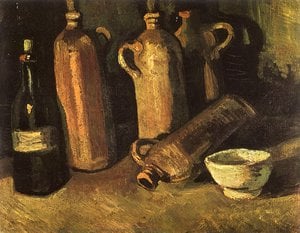


 Still life
 Still Life: An Allegory of the Vanities of Human Life
 Hubert van Ravesteyn
 Still Life with a Bottle, Lemons and Oranges
 Impasto
 Masterpieces of Emotion: The Top 25 Vincent van Gogh Artworks


