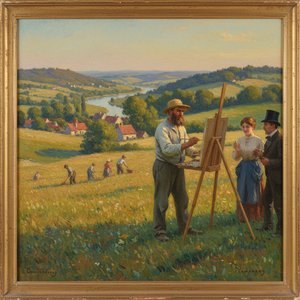
The Mirror of Daily Life: The Tradition of Genre Painting
 Potato Harvest 1
A Chronicle of Rural Labor: Camille Pissarro’s “Potato Harvest 1” Camille Pissarro's "Potato Harvest 1," painted in 1874, is more than just a depiction of agricultural work; it’s a poignant snapshot of rural life during the burgeoning Impressionist m...
Social Rituals and the Canvas: From Ancient Banquets to Modern Gatherings
 Witchcraft in ancient Greece and Rome
The earliest evidence of attitudes toward witchcraft in Europe can be traced back to ancient Greece. The concepts of witchcraft in both ancient Greece and Rome invite exploration, as they are intertwined with cultural identities, political dynamics, ...
Humanity has always used ritual to define its boundaries, and art has served as the primary record of these gatherings. From the earliest civilizations, the depiction of communal activity has been a cornerstone of visual storytelling. In ancient Egyptian tomb decorations, one finds elaborate scenes of banquets and agrarian celebrations, intended to ensure the continuity of life through the depiction of social abundance.
As societies evolved, so did the complexity of their depicted rituals. The Hellenistic period introduced painters like Peiraikos, who found beauty in the mundane—the barbershop, the cobbler’s stall, and the textures of urban interaction. These were not grand ceremonies, but the small, repetitive social threads that bind a community together.
We see this same fascination with communal energy in the Impressionist era. While the subjects shifted from the sacred to the secular, the focus remained on the shared atmosphere of a moment. Whether it is the bustling energy of a Parisian boulevard or the quietude of a rural harvest, the art captures how individuals occupy space together, creating a collective mood that transcends the sum of its parts.
The Intimacy of Presence: Capturing Human Connection in Impressionism
 White House
White House, Pierre-Auguste Renoir
There is a specific quality found in the way light interacts with human presence. In the late nineteenth century, the Impressionists moved away from the rigid, studio-bound shadows of the Academy to embrace the en plein air revolution. They were not merely interested in landscapes; they were interested in how light settles upon the people within them.
The movement sought to capture the ephemeral—the way a glance is lost in a crowd or how a shadow falls across a face during a conversation. This was achieved through broken brushstrokes and a palette that prioritized sensory perception over photographic accuracy. The goal was to record the vibration of a single, unrepeatable second.
This sensitivity to the fleeting moment is perhaps most evident in the works of Pierre-Auguste Renoir. In his 1915 work, White House, we see a serene countryside where the light and the architecture exist in a state of quiet harmony. It reflects his lifelong fascination with the warmth of everyday life, proving that the most profound connections are often found in the softest, most transient light.
The Tension of the Gaze: Social Dynamics and the Evolution of the Nude
 Nude (art)
The nude, as a form of visual art that focuses on the unclothed human figure, is an enduring tradition in Western art. It was a preoccupation of Ancient Greek art, and after a semi-dormant period in the Middle Ages returned to a central position with...
Light, Atmosphere, and Interaction: The Sensory Experience of Shared Spaces
 The Water Lily Pond, Pink Harmony
Captivating Subject and Enchanting Atmosphere This exquisite impressionist masterpiece transports viewers to a tranquil water lily pond, where nature’s delicate beauty is captured in a harmonious balance of light and color. The scene centers around a...
Preserving the Fleeting Moment: Art as a Chronicle of Human Society
 Wallraf-Richartz Museum - Fondation Corboud
A Tapestry of Time: The Soul of Cologne’s Artistic Heritage Nestled in the historic heart of Cologne, Germany, the Wallraf-Richartz Museum & Fondation Corboud stands as a profound testament to the enduring evolution of European creativity. It is far ...
The application of oil and pigment captures the social realities that the years often obscure. In the seventeenth-century Dutch Republic, painters like Vermeer captured the heavy stillness of a room or the precise weave of a linen cloth. These details anchor a moment in an unrepeatable reality, going beyond mere decoration. This precision ensures that a domestic scene from centuries ago remains as legible today as the day the oil dried.
We preserve these visual records to maintain a dialogue with the past. To look upon a landscape from the nineteenth century is to witness the light as it actually fell, rather than a romanticized reconstruction. This continuity allows us to inhabit the shared experiences of those who came before us.
WahooArt.com maintains this standard of historical fidelity. Our artists, trained in classical techniques, produce hand-painted oil reproductions that honor the original brushwork and the tonal shifts of the old masters. We offer custom portrait commissions that translate personal history into the language of traditional oil painting. From private studies to public halls, our work ensures that the weight of history remains a tangible presence in your own environment.