The Mirror of Humanity: Art as an Enduring Instrument of Social Critique
 Reflecting Society's Shadows: Social Commentary in Art Through the Ages
Introduction: The Enduring Power of Art as Social Critique Wikipedia: Social realism Social realism is work produced by painters, printmakers, photographers, writers, filmmakers and some musicians that aims to draw attention to the real socio-politic...
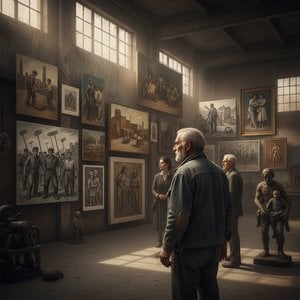
To gaze upon a masterpiece is often to encounter more than mere aesthetic delight; it is to confront the very soul of an era. Throughout the annals of human history, art has functioned as far more than a decorative luxury for the elite or a silent ornament for grand halls. It has served as a profound mirror held up to the collective consciousness, reflecting not only our triumphs and the sublime beauty of the natural world but also our deepest anxieties, our systemic failures, and our most pressing moral dilemmas. From the primal echoes of cave paintings documenting the communal struggle for survival to the sweeping historical narratives that adorn Renaissance palaces, the impulse to document the human condition is inextricably linked to the act of creation.
This enduring power of art as a social critique lies in its ability to transcend the limitations of language. Where words may falter or be suppressed by censorship, the visual medium offers a potent, often unassailable, vocabulary of dissent. Art provides a space where the invisible can be made visible—where the plight of the marginalized, the corruption of the powerful, and the shifting tides of political upheaval are captured with a permanence that text alone cannot achieve. It is this capacity to act as both a witness and a catalyst for dialogue that elevates certain works from mere objects of beauty to essential pillars of our cultural heritage.
Satire and Subversion: From Hogarth’s Moralizing Prints to Daumier’s Parisian Wit
 Honoré Daumier: Social Commentary & Artistic Innovation in 19th-Century France
Early Life & Artistic Foundations: From Marseille to Parisian Satire Wikipedia: Honoré Daumier Honoré-Victorin Daumier (French: [ɔnɔʁe domje]; February 26, 1808 – February 10 or 11, 1879) was a French painter, sculptor, and printmaker, whose many wor...
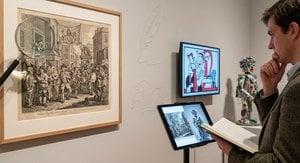
The history of social commentary is perhaps most vibrantly expressed through the sharp, often biting lens of satire. In the eighteenth century, the English master William Hogarth revolutionized the concept of the moralizing print. His works, such as the dramatic South Sea Scheme, were far more than chronicles of financial catastrophe; they were scathing indictments of greed and the unchecked ambition that characterized the era. Through a sophisticated use of caricature and complex symbolism, Hogarth transformed the chaos of economic collapse into a structured narrative of societal decay, using distorted figures to represent the various strata of a society blinded by speculation.
As we move into the nineteenth century, this tradition of subversion found a new, equally incisive voice in France through the lithographs of Honoré Daumier. Emerging from an artisan background, Daumier utilized the burgeoning medium of lithography to capture the political ferment of a Paris grappling with the aftermath of the 1830 Revolution. His work was characterized by a remarkable ability to lampoon the ruling class, exposing their hypocrisy and excesses with a skill that often skirted the boundaries of legality. By elevating caricature from simple comic illustration to a sophisticated tool of political commentary, Daaumier ensured that the tensions of his age would be etched into the very stone of art history, reminding us that the artist’s hand is often most potent when it is used to puncture the illusions of power.
The Aesthetics of Dissent: Exploring Social Realism and the Power of Visual Metaphor
 Visual metaphor
A visual metaphor is a metaphor the medium of which is visual. Like in any other metaphor, one part of it, usually named "source", applies to another part, usually named "target", and reconstructs it. The point is that the metaphorical application or...
Beyond the sharp edges of satire lies the profound, often somber weight of Social Realism. This movement, characterized by its commitment to depicting the authentic socio-political conditions of the working class, seeks to strip away the romanticized veneer of history to reveal the raw truth beneath. It is an art of empathy and observation, where painters and printmakers utilize a grounded, unembellished style to draw attention to the struggles of those often ignored by the grand narratives of history. In these works, the texture of the canvas and the heavy application of pigment serve to underscore the gravity of the subject matter, making the hardship of the human experience palpable to the viewer.
Central to this mode of expression is the use of visual metaphor—the artful reconstruction of reality through symbolic imagery. A masterfully executed metaphor allows an artist to communicate complex, often dangerous, ideas by applying a visual source to a political or social target. Whether it is the use of light and shadow to represent the encroaching darkness of tyranny, or the depiction of a fractured landscape to symbolize a broken social contract, these metaphors provide a layer of intellectual depth that invites the collector to engage in a deeper level of interpretation. It is through this sophisticated interplay of form and meaning that art transcends simple representation, becoming a profound exploration of truth.
Modern Provocations: The Rise of Street Art, Shock Art, and the Anonymity of Banksy
 Subverting Convention: Banksy's Identity, Art & Socio-Political Impact – A Critical Examination
The Enigma of Banksy: Anonymity, Authorship & the Cult of Personality Wikipedia: Street art Street art is visual art created in public locations for public visibility. It has been associated with the terms "independent art", "post-graffiti", "neo-gra...
In the contemporary landscape, the boundaries of social commentary have been pushed into even more radical territories. The emergence of street art—often categorized as guerrilla or independent art—has reclaimed the public sphere as a canvas for political defiance. Perhaps no figure embodies this modern phenomenon more enigmatically than Banksy. By operating through deliberate anonymity, Banksy creates a paradox where the absence of an identifiable persona forces the viewer to focus entirely on the work’s potent message. This subversion of authorship is a critique in itself, challenging the commodification of the art world and the cult of personality that often overshadows intrinsic meaning.
Parallel to this is the provocative movement known as "Shock Art," which utilizes disturbing imagery or sensory experiences to unsettle the complacent. While critics may dismiss such works as mere provocation, proponents argue they are essential for breaking through the apathy of modern society. Much like the early modernists who used fractured and decaying forms to reflect a world in flux, contemporary shock artists use the unexpected to demand attention to the uncomfortable truths of our era. Whether through the urban grit of a stencil on a London wall or a provocative installation in a high-end gallery, the impulse remains the same: to disturb the comfortable and comfort the disturbed.
The Collector's Perspective: Preserving Historical Narratives through Masterful Reproductions
For the discerning collector, acquiring art that carries such profound historical weight is an act of stewardship. To possess a work that speaks to social change is to hold a piece of our collective memory. However, the rarity and fragility of original masterpieces often make them inaccessible for private collections or large-scale interior design projects. This is where the artistry of high-quality, hand-painted oil reproductions becomes invaluable. These are not mere copies; they are meticulous recreations that honor the original artist's technique, from the visible, textured brushstrokes of an impasto masterpiece to the delicate tonal ranges of a classical landscape.
At WahooArt.com, we believe in the democratization of these powerful narratives. Our artisans, holding degrees from prestigious Fine Arts academies, specialize in recreating the soul of historical commentary on 100% cotton canvas. Whether you are an interior designer seeking to anchor a hotel lobby with a large-scale mural or a private collector looking to commission a "period shift"—transforming a modern moment into a Rembrandt-style masterpiece—our process ensures museum-grade excellence. By investing in these hand-painted reproductions, one does not simply decorate a space; one curates a legacy, ensuring that the voices of the past continue to resonate within the architectural landscapes of the present.