Foundations of Identity: The Early Portraitists
The roots of a national visual language often begin with the face. In the seventeenth century, before the formal structures of academies had taken hold, Scottish painting was defined by an intimate, almost urgent need to document the individual. George Jamesone, frequently referred to as the Scottish Van Dyck, provided this essential service. His work did not rely on the grand, sweeping allegories found in the courts of Europe, but rather on a directness that captured the burgeoning sense of self within the Scottish borders. This early period established a standard of character that later artists would find impossible to ignore. John Michael Wright, working in the shadow of Jamesone’s influence, carried this tradition into the Baroque era with a more polished, international sensibility. It was a time when the brush served as a tool for permanence. Even today, when we look at a well-executed portrait from this era, we see that same commitment to the sitter's true presence—a quality we strive to preserve in our own hand-painted oil reproductions, where the physical texture of the paint honors the depth of the subject.Enlightenment Clarity: The Refinement of Character
As the eighteenth century dawned, the intellectual rigor of the Scottish Enlightenment demanded a corresponding shift in artistic execution. The era moved away from the heavy shadows of the previous century toward a clarity of thought and light. This was the age of professionalization, where artists like William Aikman began to bridge the gap between local tradition and the sophisticated London markets. Yet, even as some sought fame abroad, a distinct domestic school was flourishing. The work of Allan Ramsay brought a refined, intimate grace to the royal portrait, while Sir Henry Raeburn achieved something far more profound: he anchored the movement within Scotland itself. Raeburn’s ability to capture the spirit of his contemporaries—most notably in the celebrated image of the Skating Minister—demonstrated that Scottish art could be both intellectually sophisticated and deeply rooted in local life. This period taught us that true greatness does not require artifice; it requires only the correct light. We see this same pursuit of clarity when our artists prepare a canvas, ensuring every tonal range is balanced to reflect the original's inherent truth.Highland Romanticism: The Drama of Landscape
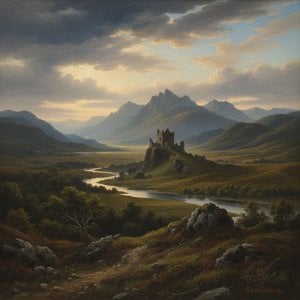
While the cities were being reshaped by intellect, the rugged periphery of the country was being reimagined through the lens of Romanticism. This movement sought to find the sublime in the untamed. Alexander Nasmyth, often credited as the founder of the Scottish landscape tradition, provided the structural foundation for this exploration. He moved beyond mere topography, treating the land as a subject with its own emotional weight.
Following this path, artists such as Horatio McCulloch populated the Scottish consciousness with dramatic depictions of the Highlands. His canvases captured the tension of mist and mountain, creating a visual mythos for the nation. This era proved that landscape is an expression of the soul's relationship to the earth. It is this same reverence for atmosphere that our specialists bring to custom commissions, particularly when recreating the light-drenched textures of a historical vista on heavy cotton canvas.