


The Metaphor of the Voyage: Ships as Symbols of the Human Condition
 Set Sail: 10 Iconic Artworks That Masterfully Capture the Spirit of Boats
Introduction To gaze upon a vessel adrift on the horizon is to witness one of humanity's most enduring metaphors: the delicate balance between courage and vulnerability. Throughout the annals of art history, the boat has served as far more than a mer...
To gaze upon a vessel adrift on the horizon is to witness one of humanity's most enduring and profound metaphors. Throughout the annals of art history, the boat has served as far more than a mere subject of maritime documentation; it is a poignant symbol of the human journey, representing our collective desire to navigate the unknown, to seek new frontiers, and to endure the tempestuous whims of fate. Whether depicted as a sturdy merchant cog braving a North Sea gale or a solitary skiff reflecting the quiet solitude of a sunset, the presence of watercraft in the canon of masterpieces invites us to contemplate the delicate balance between courage and vulnerability.
In these works, we encounter the intersection of man-made precision and the untamable rhythms of nature. A ship, with its intricate rigging and structural elegance, represents human ingenuity and our capacity for exploration, yet its placement within the vast, shimmering expanse of the ocean reminds us of our inherent fragility. To look upon a painted boat is to witness the tension between stability and drift, between the safety of the shore and the allure of the deep. This universal magnetism continues to resonate in the modern era, offering a much-needed reflection on resilience amidst life's unpredictable currents.
The Golden Age of Dutch Marine Art: Mastery of Light and Naval Power
 Sailing Vessels on an Inland Body of Water, Salomon van Ruysdael, c. 1640 - c. 1645
In the 1640s Salomon van Ruysdael started painting scenes dominated by water and sailing ships which can be regarded as marines.5 Stechow made a selection of almost 40 works of this kind, only 16 of which are dated.6 The earliest is from 1642,7 and s...
The seventeenth century marked a pivotal era where marine painting emerged as a distinct and powerful genre, driven largely by the economic and naval supremacy of the Dutch Republic. During this Dutch Golden Age, maritime art functioned both as a literal record of burgeoning global trade and as a deeply spiritual exploration of movement and light. Artists such as Salomon van Ruysdael began to dominate the scene, creating works that transitioned from monochromatic studies to increasingly vibrant and colorful views of inland waters and coastal expanses.
The technical mastery displayed during this period was unparalleled. Van Ruysdael’s ability to manipulate light—using dark foreground bands to heighten the luminosity of the middle ground—created a breathtaking sense of depth that drew the viewer into the very heart of the scene. These paintings often captured the rhythmic pulse of estuaries and rivers, where the calm waves and specific vessel types, such as the smalschip, documented a period of immense maritime prosperity. This era established the foundation for the marine tradition, celebrating the structural beauty of the sail and mast as symbols of national identity and economic might.
Romanticism and the Sublime: Capturing the Tempestuous Fury of the Sea
 Sailing Through History: The Majestic Beauty and Artistry of 19th-Century Marine Masterpieces
The Golden Age of Sail: An Introduction to 19th-Century Maritime Romanticism To gaze upon a nineteenth-century marine painting is to embark on a voyage through an era defined by exploration, conquest, and the sublime power of the natural world. This ...
As the nineteenth century dawned, the focus of maritime art shifted from the documentation of trade to the exploration of the sublime. The Romantic movement reclaimed the sea and the coast as stages for profound emotional response, where artists sought to capture not merely physical reality, and the ocean's dual nature: at once a serene cradle and a formidable, untamable force. This period, often referred to as the Golden Age of Sail, provided the perfect canvas for depicting the sheer power of the natural world.
In Romantic works, the sea is portrayed with a dramatic intensity that evokes awe and even terror. The heavy impasto strokes and turbulent compositions of this era allow the viewer to feel the salt spray and hear the rhythmic creak of timber under duress. These masterpieces do not merely depict ships; they capture the atmosphere of an era defined by conquest and the overwhelming majesty of the elements. Through the lens of Romanticism, the vessel becomes a protagonist in a grand struggle against the infinite, embodying the human spirit's attempt to find meaning within the chaos of the storm.
Luminism and Impressionism: The Ethereal Beauty of Coastal Serenity
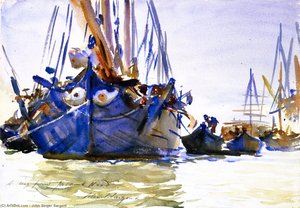 Sailing Vessels at Anchor
A Moment of Tranquility on the Water: Sargent’s ‘Sailing Vessels at Anchor’ John Singer Sargent's 1904 painting, “Sailing Vessels at Anchor,” offers a serene glimpse into a world of leisure and maritime elegance – a quintessential scene reflecting th...
Contrasting the dramatic tempests of the Romantics, the movements of Luminism and Impressionism brought a newfound fascination with light, atmosphere, and the tranquil beauty of maritime life. In the hands of artists like John Singer Sargent or Frederick Childe Hassam, the sea was transformed into a playground of shimmering reflections and sun-drenched surfaces. These works often moved away from the heavy drama of battle or storm toward scenes of leisure, serenity, and the fleeting essence of time.
Sargent’s Sailing Vessels at Anchor, for instance, offers a serene glimpse into a world of maritime elegance, where the careful arrangement of figures and the gentle billowing of sails suggest a simultaneous sense of movement and stillness. Similarly, the Impressionists utilized broken brushstrokes to capture the way light dances upon rivercraft and coastal waters, turning the sea into a fluid tapestry of color. This era celebrated the ephemeral—the way a sunset might melt into the horizon or how mist might shroud a harbor—inviting the viewer to find peace in the rhythmic, quiet magic of the water.
Architectural Grandeur: Integrating Maritime Masterpieces into Luxury Interiors
 Interior of Hagia Sophia, Constantinople
Discover the exquisite interior of Hagia Sophia, Constantinople, by John Frederick Lewis. A detailed architectural sketch capturing Byzantine grandeur, perfect for art collectors and history enthusiasts.
For the discerning collector and interior designer, maritime art offers an unparalleled opportunity to introduce narrative depth and historical prestige into a space. A well-placed reproduction of a nineteenth-century masterpiece can serve as a profound focal point, anchoring a room with its themes of exploration and endurance. Whether it is a large-format multi-panel work spanning a wide wall or a singular, intimate portrait of a vessel, these pieces bring a sense of "soul" to modern architectural environments.
Integrating such works requires an appreciation for scale, texture, and light. For grander installations, such as those found in luxury hotels or estate foyers, one might consider the impact of custom-sized oil reproductions that echo the grandeur of the original masters. The tactile nature of hand-painted oils—with their visible brushstrokes and deep tonal ranges—provides a richness that digital prints simply cannot replicate. By selecting pieces that resonate with the existing color palette of a room, collectors can create a sophisticated dialogue between contemporary luxury and the timeless, salt-sprayed legacy of the sea.
Discover the Art of the Voyage at WahooArt.com
At WahooArt.com, we specialize in bringing these historical maritime treasures to life through exquisite, hand-painted oil reproductions. Our artists, trained in the finest academic traditions, meticulously recreate the textures and light of the Old Masters on premium cotton canvas. Whether you seek a bespoke commission to transform a personal photograph into a 17th-century masterpiece or wish to explore our curated collection of nautical legends, we provide a seamless, luxury service. From professional digital mockups to global white-glove delivery via DHL and FedEx, WahooArt.com ensures that every piece is a lasting legacy for your collection.


