A Glimpse into the World of Jan Meerhout The name Jan Meerhout resonates quietly within the annals of 17th-century landscape painting, a period brimming with innovation and a burgeoning appreciation for the natural world. While biographical details s...
To observe a river is to witness a constant state of becoming. It is a silver thread woven through the landscape, acting as a silent witness to history and a profound metaphor for the inevitable passage of life. In the realm of fine art, water does not merely occupy space; it embodies transition. We see this duality in the way a current carries the sediment of the past toward unknown horizons, much like the movement of time itself.
The Dutch Golden Age provided an early, sophisticated lens through which to view this continuity. Consider the works of Jan Meerhout, whose landscapes often feature winding river valleys and the romantic suggestion of distant architecture. His ability to balance detailed textures with a sense of atmospheric depth allows the viewer to feel the weight of history within the landscape. In his compositions, the water is not just a geographical feature but a medium for contemplation, bridging the gap between the tangible earth and the ephemeral sky.
The river remains a vital subject because it mirrors our own human experience. It offers a rhythmic constancy that persists even as the world around it changes. Whether through the structured compositions of the Old Masters or the more fluid interpretations of later eras, the river serves as an anchor for our understanding of permanence amidst change.
Luminous Currents: From American Luminism to Impressionist Light
Luminism is a style of American landscape painting from the 1850s to 1870s, characterized by effects of light in a landscape, through the use of aerial perspective and the concealing of visible brushstrokes. Luminist landscapes emphasize tranquility,...
The pursuit of light has always been the primary driver of innovation in landscape painting. In the mid-19th century, a specific American style known as Luminism emerged, characterized by an almost spiritual focus on the effects of light through aerial perspective. Artists such as Fitz Henry Lane and Martin Johnson Heade sought to conceal the artist's hand, using smooth, glass-like surfaces to depict calm, reflective waters. These works emphasize a quietism, where the light is cool and non-diffuse, creating a sense of profound stillness.
This controlled precision finds an interesting contrast in the later Impressionist movement. While Luminists sought to hide the brushstroke to achieve a seamless reality, Impressionists like Claude Monet embraced the visible mark to capture the fleeting vibration of light. In his depictions of water lilies, the boundary between sky and water dissolves into a shimmering dance of color. The focus shifts from the structural permanence of the river to the momentary sensation of a single, sun-drenched second.
This evolution in technique reflects a broader shift in how we perceive nature. Where Luminism offers a meditative, almost transcendental stability, Impressionism provides a sensory experience of movement. Both, however, rely on the unique properties of water—its ability to reflect, refract, and absorb light—to communicate the atmosphere of a specific moment in time.
The Sublime Vista: Romanticism and the Grandeur of Waterways
The painting River Landscape in Summer by William Mason Brown is a beautiful representation of a serene landscape, created in 1856. This oil on canvas piece is currently located at the Chrysler Museum of Art in the United States. The painting feature...
Beyond the quiet reflections of Luminism lies the more turbulent expression of the Sublime. During the Romantic era, artists turned to the river to explore the tension between human fragility and the untamable power of nature. Here, the water is not always a mirror; it can be a churning, powerful force capable of reshaping the very earth it traverses.
This sense of scale and drama is evident in the works of the Hudson River School. In William Mason Brown’s 1856 work, River Landscape in Summer, we see a carefully balanced composition where lush foreground trees provide shade for a peaceful scene, yet the distant mountains suggest a much larger, more imposing world. The presence of figures and animals near the water's edge emphasizes the harmony between life and the landscape, even as the vastness of the background hints at the overwhelming scale of the natural order.
The Romantic tradition teaches us that the river is a site of both solace and awe. It allows the collector to engage with the tension of the wild, finding beauty in the heavy, dark depths of a bend in the stream or the sudden, kinetic energy of a breaking wave.
Ink and Atmosphere: The Legacy of East Asian Landscape Traditions
Chinese painting (simplified Chinese: 中国画; traditional Chinese: 中國畫; pinyin: Zhōngguó huà) is one of the oldest continuous artistic traditions in the world. Painting in the traditional style is known today in Chinese as guó huà (国画; 國畫), meaning "nat...
While Western traditions often focused on the tension between light and shadow, the ancient Chinese tradition of shan shui—literally "mountain-water"—developed a completely different philosophy of the landscape. In this venerable practice, the river is not an object to be observed from the outside but a vital element of a cosmic balance. Using black ink and fine brushwork on silk or paper, artists created worlds where the only sign of human life might be a solitary sage or a distant hut.
This approach emphasizes motion and change through calligraphic precision rather than anatomical realism. The technique of ink wash allows for a mastery of atmosphere, where mist and water can merge into a single, breathing entity. This tradition views the landscape as a spiritual entity, where the flow of water represents the Dao—the underlying principle of the universe.
The influence of these techniques is profound, reminding us that a landscape need not be a topographical record to be true. The ability to suggest vastness through a few deliberate strokes of ink offers a lesson in restraint and the power of suggestion, a concept that continues to resonate in contemporary approaches to atmospheric painting.
Pastoral Stillness: Capturing the Intimacy of Rural Riverine Life
A Life Painted in the English Countryside: Leopold Rivers (1852–1905) Leopold Rivers, born in London in 1852 and passing away in 1905, was a British landscape painter who dedicated his life to capturing the serene beauty of the English countryside. W...
There is a specific, quiet beauty found in the depiction of river life that is far removed from the grand vistas of the mountains. This is the art of the pastoral, where the focus shifts to the rhythmic, daily routines of those who live along the banks. In the works of Leopold Rivers, we find an intimate portrait of the English countryside, characterized by a muted palette of soft greens, ochres, and grays. His paintings of moors and rural life evoke a sense of peaceful isolation, capturing a world poised on the edge of change.
Similarly, the Belgian painter Emile Claus brought a luminous, Impressionistic approach to the Flemish landscape. His work, deeply connected to the River Lys, captures the gentle daylight and tranquil feeling of the countryside. Unlike the more aggressive brushwork of some Impressionists, Claus maintained a sense of structural balance, using light to build up the mood of the scene without losing the sense of place.
These intimate landscapes offer a sanctuary for the viewer. They do not demand an emotional upheaval but rather invite a slow, steadying gaze. In these works, the river is a domestic presence, a familiar companion to the sheep grazing on the banks and the small villages nestled in the valleys.
Curating Serenity: Integrating River Landscapes into Modern Interiors
A Symphony of Light and Water In the quietude of Sir Alfred James Munnings ’ River Landscape With Trees , one finds more than just a depiction of nature; one encounters a profound moment of stillness captured in time. The painting invites the viewer ...
For the discerning collector or interior designer, selecting a river landscape is an exercise in establishing atmosphere. A well-placed work can act as a window, providing depth and a sense of expansion to a room. The choice between a structured, Luminist piece and a more textured, Impressionistic work depends entirely on the intended emotional resonance of the space.
A large-scale, multi-panel composition, such as a split landscape, can serve as a modern architectural element, guiding the eye across a wide wall or staircase. For those seeking a sense of calm and sophistication, the soft textures and harmonious colors found in works like Sir Alfred James Munnings’ River Landscape With Trees are ideal. His use of atmospheric perspective draws the viewer inward, making it an excellent centerpiece for a room designed for contemplation.
Whether through a meticulously rendered oil reproduction or a bespoke commission that reimagines a personal memory, integrating these flowing narratives into a home allows us to bring the restorative power of the natural world indoors. At WahooArt.com, we specialize in preserving this connection, offering hand-painted works that honor the heritage and technical brilliance of these enduring subjects.
A prominent second-generation Hudson River School painter renowned for his meticulous landscapes and trompe-l'œil still lifes like River Landscape in Summer, discover the exquisite detail of his romantic …
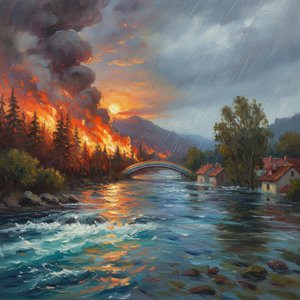
Immerse yourself in the breathtaking drama of nature through an Impressionist lens. Discover how masters like Monet captured the ephemeral beauty of fire and flood. At WahooArt.com, we offer exquisite hand-painted reproductions and expert consultations for the discerning collector.



 Jan Meerhout
 Luminism (American art style)
 River Landscape in Summer
 Chinese painting
 Leopold Rivers
 River Landscape With Trees