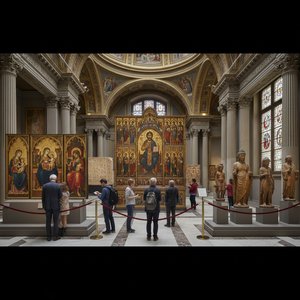
Iconography, as a branch of art history, studies the identification, description and interpretation of the content of images: the subjects depicted, the particular compositions and details used to do so, and other elements that are distinct from arti...
To understand a sacred image, one must first understand that it is intended to be read as much as seen. The term iconography finds its origins in the Greek words eikōn, meaning image, and graphein, which translates to writing or drawing. This linguistic connection reveals the true nature of these works; they are not merely decorations but a form of visual writing used to communicate complex theological truths. In the Byzantine and Orthodox Christian traditions, this practice became a specialized method of producing and studying religious images known as icons.
In the nineteenth century, scholars began to formalize this study into an academic discipline. Figures such as Adolphe Napoleon Didron and Émile Mâle focused their research on Christian religious art, seeking to categorize the symbols that allowed even the illiterate to navigate sacred stories. This scholarly rigor was later expanded by Erwin Panofsky, who defined iconography as the branch of art history concerned with subject matter and meaning rather than mere form. Today, we see this same impulse in how we identify motifs in modern media, where certain visual cues immediately signal a specific genre or mood to a contemporary audience.
The Sacred Glow: Gold Leaf and the Alchemy of Divine Light
The Alchemy of Divinity: Gold Leaf and the Celestial Light Gold Leaf & Gilding: The Sacred Art of Byzantine and Renaissance Masterpieces The Alchemy of Divinity: Gold as the Flesh of the Gods The Sacred Glow: Mastering Gold Leaf and Gilding in Byzant...
In the Byzantine era, the use of gold was far more than a display of imperial wealth. It functioned as an alchemical bridge between the earthly realm and the divine. Through the meticulous process of goldbeating, artisans hammered gold into sheets as thin as 0.1 micrometers. When applied via water gilding to create a "gold ground," this material interacted with the flickering candlelight of dimly lit churches. The resulting radiance made the artwork appear to breathe, transforming a static wall into a window toward heaven.
This technique finds its most profound expression in the way gold represents the uncreated light of God—a substance resistant to tarnish and decay, much like the eternal nature of the divine. We see this same reverence for light in the works of later masters. For instance, the red chalk drawing Virgin and Child (1435) by Fra Angelico utilizes the texture of stone and careful hatching to create a sense of volume that still feels spiritually charged. While the medium changed from gold leaf to chalk and tempera, the goal remained the same: to use physical light to suggest a spiritual presence.
Narrative vs. Iconic: Distinguishing Storytelling from Symbolic Presence
Religious art is a visual representation of religious ideologies and their relationship with humans. Sacred art directly relates to religious art in the sense that its purpose is for worship and religious practices. According to one set of definition...
Sacred art often operates on two distinct levels: the iconic and the narrative. An iconic image focuses on a single figure or a group of figures, such as the Virgin Mary, intended for direct veneration and contemplation. These images do not rely on a sequence of events but rather on the presence of the subject itself. In contrast, narrative images depict specific moments from a story, such as the scenes of Christ's Passion or the lives of the saints, guiding the viewer through a chronological progression of sacred history.
This distinction is vital for identifying the intent behind an artwork. For example, the Glorification of the Cross (1200) functions as an iconic representation of a central symbol of faith, whereas other works might focus on the detailed drama of a specific biblical episode. This structural approach to art allows us to categorize everything from ancient Roman sarcophical sculptures to the complex, multi-panel compositions used in modern religious installations. By recognizing whether an artist is presenting a person or a story, we begin to grasp the deeper theological architecture of the piece.
Hagiography and the Written Word: The Lives of Saints in Art
A hagiography (; from Ancient Greek ἅγιος (hágios) 'holy' and -γραφία (-graphía) 'writing') is a biography of a saint or an ecclesiastical leader, as well as, by extension, an adulatory and idealised biography of a preacher, priest, founder, saint, m...
The identity of many figures in sacred art is preserved through hagiography, the biography of a saint or ecclesiastical leader. These texts, which include the vita (life), the passio (martyrdom), and accounts of miracles, provided the essential "scripts" for artists to follow. In the fourth century, catalogs like the menaion and the synaxarion organized these lives by date, ensuring that the stories of martyrs were commemorated annually. A famous medieval compilation, the Golden Legend by Jacobus de Voragine, became a primary source for artists seeking to depict the miraculous deeds of saints.
This literary tradition also extended into other cultures, such as the development of Persian hagiography in eleventh-century Khurasan, which focused on the lives of Sufi saints. Just as the Life of Anthony of Egypt established the genre of Christian biography, these texts provided a foundation for visual storytelling. When we see Saint Peter depicted with keys or Saint Agnes with a lamb, we are seeing the visual manifestation of these written hagiographies. The art provides the face, but the literature provides the soul and the history.
From Byzantine Tradition to Renaissance Naturalism
A Florentine Revelation: Cimabue’s Virgin and Child Enthroned The painting “Virgin and Child with Two Angels,” attributed to Cimabue (c. 1240 – 1302), stands as a pivotal moment in the artistic evolution of Florence and, by extension, Western Europe....
The transition from the rigid formalism of the Byzantine style to the burgeoning humanism of the Renaissance represents one of the most significant shifts in art history. Early Christian art, heavily influenced by Roman styles, began to evolve significantly after the reign of Constantine. Artists like Cimabue acted as a bridge during this era. In his Virgin and Child Enthroned with Two Angels, we see the monumental scale and hierarchical composition characteristic of Byzantine art, yet there is a new, subtle dynamism that anticipates the Renaissance.
This evolution continued with Fra Angelico, whose work in the early fifteenth century blended the enduring traditions of iconography with an emerging naturalism. In his 1435 Virgin and Child, the elongated proportions of the figures still echo Byzantine mosaics, yet there is a new sense of tenderness and volume. This movement toward realism was not merely a change in technique but a shift in focus, moving from the purely symbolic to a more humanized, emotional connection with the divine. It is a period where the spiritual intensity of the past met the anatomical curiosity of the future.
The Tension of Images: Understanding Iconoclasm and Aniconism
A Sanctuary of Spiritual Splendor Nestled within the verdant, tranquil embrace of Villa Ilissia, the Byzantine and Christian Museum serves as a profound gateway to a lost world of devotion and artistic mastery. Located in the heart of Athens, Greece,...
The history of sacred art is also a history of conflict. The use of images has frequently been a point of intense theological debate, leading to two opposing concepts: aniconism and iconoclasm. Aniconism refers to the opposition to or absence of images in religious practice, while iconoclasm is the deliberate destruction of images by members of the same faith. These periods of upheaval often reshaped the very direction of artistic production, as communities struggled to define the boundaries between legitimate devotion and idolatry.
These tensions were not limited to a single era or religion; they have appeared throughout history in various forms of religious reform and political change. The struggle to balance the power of the image with the sanctity of the faith has left an indelible mark on the collections we see today, such as those in the Byzantine and Christian Museum in Athens. By studying these moments of destruction and creation, we gain a deeper appreciation for the survival of the icons that remain, serving as resilient links to a complex and often turbulent past.
Journey back to the dawn of Renaissance art! Explore 10 iconic Proto-Renaissance masterpieces by Giotto, Cimabue & Duccio. Discover their stories, techniques & lasting impact. Find museum-quality reproductions for your home at WahooArt.com
Explore the rich history of religious iconography in art! Discover symbolism, movements & masterpieces from Byzantine to Renaissance periods. Expert insights for collectors and enthusiasts at WahooArt.



 Iconography
 Byzantine Art Guide: The Golden Splendor and Sacred Iconography of the Eastern Roman Empire
 Religious art
 Hagiography
 The Virgin and Child Enthroned with Two Angels
 Byzantine and Christian Museum