Beyond the Studio Walls: The Shift Toward Direct Observation Mastering the Open Air: A Definitive Guide to En Plein Air Landscapes and the Evolution of Light in Art History The Studio vs. The Sky: The Historical Shift from Idealized Landscapes to Dir...
For centuries, the boundaries of the artistic world were defined by the controlled, often sterile walls of the studio. Within these sanctuaries, a landscape was rarely a lived experience; it was a conceptual one, an idealized form brought into being through the artist’s intellect rather than unmediated sight. Light was meticulously recreated, filtered through layers of varnish and established academic conventions to serve a predetermined narrative. Landscapes functioned as stages for mythological or historical drama, where mountains and rivers were arranged into perfected compositions that prioritized symbolic truth over atmospheric reality.
This paradigm began to shift profoundly during the nineteenth century, driven by a burgeoning Romantic sensibility and an insatiable desire for authenticity. The impulse to move beyond the controlled environment of the studio led to a radical reimagining of what it meant to depict nature. No longer content with mere imitation of classical ideals, artists sought the pulse of the living world. This transition marked the birth of a new way of seeing, where the artist’s presence in the landscape became as vital as the subject itself.
The echoes of this shift remain visible in the early theories of Pierre-Henri de Valenciennes. In his 1800 treatise, Reflections and Advice to a Student on Painting, Particularly on Landscape, he expounded the concept of landscape portraiture, an approach that allowed for the capture of particular details as they changed with the weather. His work laid the intellectual foundation for a movement that would eventually abandon the studio's shadows for the direct observation of the sky.
The Technical Revolution: Portable Innovation and the Open Air
Discover 'En Plein Air' by Edward Arthur Walton (1885). This Impressionistic landscape showcases rural beauty with loose brushstrokes & soft light. A captivating piece of Scottish art.
The transition from studio-bound tradition to the open air was not merely a matter of artistic will; it required a revolution in physical capability. Before the mid-1800s, the logistical challenges of portability kept much of painting activity confined to the studio. Artists were often tethered to their workspaces by the laborious process of grinding raw pigments and mixing them with various media.
The advent of the collapsible paint tube in 1841, invented by American portraitist John G. Rand, fundamentally altered the artist's mobility. This innovation, alongside the development of the French box easel, allowed for a new level of freedom. These portable easels, featuring telescopic legs and built-in palettes, could be folded to the size of a briefcase, making it possible to venture deep into forests or up hillsides.
This technical liberation enabled artists like Edward Arthur Walton to record the unadorned truth of the rural landscape in works such as En Plein Air (1885). The ability to carry one's entire studio into the field meant that the canvas could finally respond to the immediate, physical reality of the environment.
Capturing the Ephemeral: The Science of Light and Atmosphere
Early Life and Academic Foundations Lorenzo Delleani, born in the picturesque town of Pollone in the province of Biella, Piedmont, in 1840, emerged from a region steeped in artistic tradition yet poised for change. His early inclination towards paint...
To paint en plein air is to engage in a race against time. The method demands quick decisions regarding composition and color, as the very subject of the work—the light—is in a state of constant flux. One minute an artist may be working under glorious sunshine; the next, a passing cloud or a sudden gale can alter the entire chromatic temperature of the scene.
This pursuit of the ephemeral is what defines the Impressionist approach. Artists like Claude Monet and Pierre-Auguste Renoir sought to record the precise sensation of a single moment before the light shifted forever. They utilized broken brushstrokes and a luminous palette to capture how light breathes upon the landscape, focusing on the way morning mist clings to reeds or how a setting sun dissolves a horizon into violet haze.
This focus on the transient is also evident in the work of Lorenzo Delleani. While his early training at the Albertina Academy provided a grounding in academic principles, his later career was defined by a commitment to capturing the subtle nuances of light and atmosphere across the Piedmontese and Lombard countryside. His canvases serve as records of immediate sensory experiences, translating the fleeting effects of the Italian sun onto the canvas with remarkable sensitivity.
Regional Variations: From the Barbizon School to American Luminism
Luminism is a style of American landscape painting from the 1850s to 1870s, characterized by effects of light in a landscape, through the use of aerial perspective and the concealing of visible brushstrokes. Luminist landscapes emphasize tranquility,...
While the impulse toward direct observation was universal, it manifested in distinct regional identities. In France, the Barbizon School, including figures such as Charles-François Daubigny and Théodore Rousseau, utilized natural light to emphasize tonal qualities and soft forms. This movement provided a crucial bridge to the later Impressionist revolution, emphasizing a more naturalistic approach to the forest and field.
Across the Atlantic, the movement took on a different character through Luminism. Unlike the visible, energetic brushwork of the French Impressionists, American Luminists such as Fitz Henry Lane and Martin Johnson Heade sought a sense of tranquility through the concealment of brushstrokes. Their work emphasized aerial perspective and a smooth, glass-like surface to depict calm waters and hazy skies, creating an experience of profound stillness.
In Spain, the movement found its own warmth through the Valencian Luminists. Led by Joaquín Sorolla, these artists interpreted the intense Mediterranean sunlight playing on water and sand, imbuing their work with an exuberant energy that reflected the local atmosphere. Whether through the soft, atmospheric studies of the English Newlyn School or the bold, sun-drenched canvases of Spain, the practice of painting outdoors became a vehicle for expressing regional identity and national character.
The Modern Resonance: Integrating Natural Vistas into Contemporary Design
The Architectural Impact of Landscape Art: Enhancing Hospitality Interiors Landscape painting Landscape painting, also known as landscape art, is the depiction in painting of natural scenery such as mountains, valleys, rivers, trees, and forests, esp...
In the contemporary era, the legacy of plein air painting extends far beyond the museum wall, finding a profound place in modern architectural and interior design. For the professional designer, landscape art serves as a strategic tool to manipulate the perceived boundaries of a space. In high-stakes hospitality design, a well-placed panoramic view can dissolve the physical constraints of an urban hotel, offering guests a psychological escape into the infinite.
The introduction of vistas—mountains, valleys, or tranquil rivers—can transform a transient corridor into a curated experience of serenity. This is particularly effective in minimalist contemporary settings, where the organic beauty of a landscape painting provides a necessary counterpoint to rigid structural elements. The ability to utilize custom sizing and multi-panel configurations allows for a seamless integration between the building's architecture and the natural world depicted on the canvas.
Today, we continue to find solace in these works because they mirror our own human experience of time. In an age characterized by rapid movement and digital disconnection, looking upon an Impressionist landscape invites us to rediscover the poetry of the present moment. Whether through a hand-painted reproduction of a Gauguin landscape or a custom commission that reimagines a personal memory, the tradition of capturing the moment remains a vital part of our visual culture. At WahooArt.com, we honor this enduring legacy by providing collectors with meticulously crafted oil paintings that preserve the texture, light, and soul of these historical masters.
By the WahooArt.com Editorial Team
Edward Hopper
b. 1931 · Upper Nyack, United States of America
A master of American realism, he captured solitude in Nighthawks. Discover his iconic paintings and evocative light and shadow today.
Discover Edward Mitchell Bannister, a pioneering African American tonalist painter celebrated for his serene landscapes and impactful journey against societal barriers.
Explore the Barbizon School's pivotal role in 19th-century French painting. Discover how these artists revolutionized landscape art with their commitment to Realism and a profound connection to nature. Learn about key figures like Rousseau, Millet & Corot.
A professional guide for hotel designers on selecting iconic landscape and En Plein Air artworks. Discover how high-quality oil reproductions, custom multi-panel sets, and large-scale murals can elevate hospitality interiors with ease, reliability, and scale.



 The Open Air Revolution: How En Plein Air Redefined the Impressionist Landscape
 En Plein Air
 Lorenzo Delleani
 Luminism (American art style)
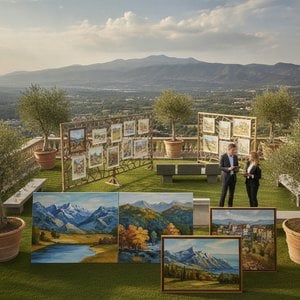 Mastering the Outdoors: A Professional Buyer's Guide to Iconic Landscape and En Plein Air Artworks for Hospitality Design


