Introduction There is a profound, rhythmic poetry in the movement of water—a constant state of becoming that has captivated the human spirit since we first sat by the water's edge to watch the world drift by. Rivers are more than just geographical fe...
To observe a river is to witness a continuous state of becoming. The Seine, carving its snake-like course from the French interior toward the English Channel, has functioned for millennia as more than a mere geographical feature; it is the lifeblood of Parisian commerce and a silent witness to the city's many transformations. There is a profound, rhythmic poetry in this movement—a liquid metaphor for time itself. When we look upon these waters in art, we see the duality of nature: the glass-like stillness that invites introspection and the untamable power capable of reshaping the very earth.
The history of the river is etched into the landscapes of those who lived along its banks. Long before the modern era, the Seine provided the means for transporting firewood, grain, and wine, anchoring the growth of a civilization. This permanence finds an echo in the way artists have used the water as a mirror for human progress. Just as the river carries the sediment of the past toward unknown horizons, the paintings of the nineteenth century carry the weight of a changing world, documenting how we build our lives alongside the current.
Haussmann’s Grand Design: When Urban Renewal Met the Canvas
In Paris, the Belle Époque (1871–1914) saw the construction of the Eiffel Tower, the Métro, the completion of the Opera, the Rue Réaumur and the beginning of the Basilica of Sacré-Cœur on Montmartre. Three lavish "universal expositions" in 1878, 1889...
The mid-nineteenth century brought a radical reconfiguration to the Parisian landscape. Under the direction of Baron Georges Haussmann, the city underwent an intensive campaign of urban renewal that fundamentally altered its relationship with the river. This era of reconstruction, though often criticized for displacing thousands of residents, replaced narrow, crowded streets with grand boulevards and open spaces. The renovation along the Seine provided new bridges and rebuilt existing ones without the shops and structures that had previously cluttered the banks, allowing for a newfound clarity of view.
This architectural shift finds its historical parallel in the way an artist approaches a canvas. Just as Haussmann cleared the clutter to reveal the city's structural elegance, painters like Armand Guillaumin captured the tension between the old and the new, noting even the smoke spewing from factory chimneys. The modernization of Paris created a paradox: while the city lost cherished historical buildings, it gained an unprecedented amount of light and air. This clarity allowed the Impressionists to move beyond the shadows of the old city and focus on the expansive, airy vistas that define the modern Parisian spirit.
The Alchemy of Light: Capturing the Fleeting Seine
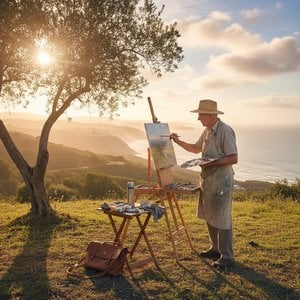
For the painters who frequented the banks of the Seine, the true subject was never merely the water itself, but the light that danced upon it. The ability to capture a single, fleeting moment—the way sunlight hits a ripple or how mist softens the horizon—became the primary pursuit of the era. This dedication to capturing atmospheric effects required a departure from the studio and an embrace of plein air painting, working directly from nature to record the ephemeral shifts in temperature and luminosity.
This pursuit of light finds its roots in the earlier traditions of the Barbizon school, where artists first began to prioritize the honest observation of nature. The transition from the structured landscapes of the past to the light-drenched impressions of the late nineteenth century represents a shift in focus from the permanent to the transient. When we observe the subtle, translucent washes used to depict a morning mist, we are participating in a long-standing dialogue between the artist and the atmosphere, attempting to freeze a moment that is, by its very nature, already passing.
From Tonal Shadows to Luminous Color: An Artistic Awakening
Seine (paintings) is the subject and location of paintings that Vincent van Gogh made in 1887. The Seine has been an integral part of Parisian life for centuries for commerce, travel and entertainment. Here van Gogh primarily captures the respite and...
The late nineteenth century witnessed one of the most significant shifts in the history of Western art: the transition from dark, serious themes to a more joyous use of color and light. Vincent van Gogh’s time in Paris in 1887 serves as a profound example of this evolution. Before his immersion in the Parisian art scene, his palette was often dominated by the somber tones of the Dutch masters, frequently using black to dull his colors. However, exposure to Impressionism and Japanese woodblock prints triggered an awakening, leading him toward a more vibrant, expressive language.
This movement toward light is not an isolated phenomenon but part of a broader artistic lineage. The influence of Pointillism and Symbolism provided new tools for artists to explore the psychological depth of their subjects through color alone. This evolution mirrors the broader cultural optimism of the Belle Époque, an era characterized by enlightenment and technological innovation. As the palette brightened, so too did the perception of the modern world, moving away from the heavy shadows of the past toward a more luminous, interconnected reality.
The Quiet Observer: Finding Stillness in a Changing City
A Quiet Observer of the Seine: The Life and Art of Stanislas Lépine Stanislas Victor Edouard Lépine, born in Caen, France, in 1835, occupies a fascinating, often understated position within the narrative of 19th-century French painting. While not typ...
Amidst the bustle of the Belle Époque—an era of cabarets, bistros, and grand exhibitions—there existed a parallel desire for tranquility. While many artists sought the energy of the crowd, others, like Stanislas Lépine, found their muse in the more understated moments of the river landscape. Lépine, a student of Camille Corot, brought a profound sensitivity to the subtle beauty of the French countryside and the quieter urban views along the Seine. His work was marked by a placid mood and a commitment to capturing the true impression of a scene rather than meticulous, distracting detail.
This search for stillness echoes the way we seek solace in our own modern, fast-paced lives. The works of Lépine invite viewers into moments of quiet contemplation, offering a respite from the noise of progress. In his paintings, the river is not a site of commerce or construction, but a place of peace. This ability to find the eternal within the changing landscape reminds us that even in an era of rapid technological upheaval, there remains a fundamental need to connect with the steady, rhythmic pulse of the natural world.
The Enduring Architecture: Bridges as Anchors of the Landscape
Pont Neuf – A Stone Testament to Parisian Life: The Enduring Legacy of Pont Neuf The Seine River has always been the lifeblood of Paris, a shimmering ribbon weaving through the city’s history and inspiring generations of artists. And spanning this ic...
The bridges of Paris serve as the physical and visual anchors of the riverine landscape, connecting the disparate parts of the city both literally and artistically. The Pont Neuf, despite its name meaning "New Bridge," remains the oldest standing bridge in Paris, a stone testament to Renaissance engineering. Its deliberate openness, designed to allow unobstructed views of the water, set a precedent for the urban aesthetics that would follow. These structures provide the necessary geometric tension in a landscape, offering stability against the fluid motion of the Seine.
This architectural permanence finds its parallel in the way certain artistic techniques ground a composition. Just as the twelve arches of the Pont Neuf provide a sense of structural harmony, the use of deliberate brushstrokes and balanced compositions allows an artist to anchor the viewer's eye amidst the movement of water. Whether it is the bridges at Argenteuil painted by Monet or the historic stone of the Pont Neuf itself, these landmarks remain the constant stage upon which the ever-changing drama of light and water is performed.
At WahooArt.com, we celebrate this enduring connection between history and artistry. We specialize in the creation of hand-painted oil reproductions that honor the techniques of the masters, from the thick impasto of the Post-Impressionists to the delicate glazes of the landscape tradition. Whether you are seeking a bespoke commission to transform a personal memory or a museum-quality reproduction of a Parisian vista, our artists bring academic excellence to every canvas. We invite you to explore our collection and discover how the light of the past can illuminate your contemporary space.
Embark on a visual journey through the luminous world of Impressionism. Discover how masters like Monet and Renoir captured the fleeting dance of light and motion in breathtaking oil paintings. Explore the soul of the movement with our expert art editorial.
Explore the rich history of plein air painting, from its origins to Impressionism & beyond. Discover key artists, techniques, and the enduring legacy of capturing light in landscape art. Find museum-quality reproductions at WahooArt.
Embark on a journey through history with 10 iconic river landscape paintings. From Impressionist light to classical mastery, explore the stories behind these timeless works and find museum-quality art reproductions for your decor. Discover all masterpieces on WahooArt.com.



 Flowing Masterpieces: Top 10 Artworks That Capture the Spirit of Rivers
 Paris in the Belle Époque
 Seine (Van Gogh series)
 Stanislas Lépine
 Pont-Neuf