The Philosophy of Direct Observation
 En plein air
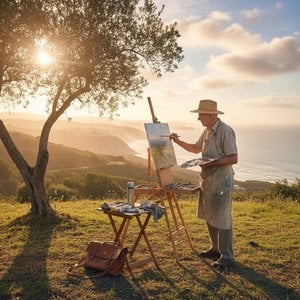
 (pronounced [ɑ̃ plɛ.n‿ɛʁ]; French for 'outdoors'), or plein-air painting, is the act of painting outdoors. This method contrasts with studio painting or academic rules that might create a predetermined look. The theory of 'En plein air' ...
Technological Shifts and Portable Innovations
The history of landscape painting is as much a history of chemistry and engineering as it and of aesthetic vision. For centuries, the necessity of grinding raw pigments and preparing supports kept the artist tethered to the atelier. The ability to venture deep into the woods or up a rugged hillside was severely limited by the weight of one's materials. However, the 1841 invention of the collapsible paint tube by John G. Rand changed the trajectory of the medium entirely. This small, practical innovation granted artists a newfound mobility, allowing them to carry a palette of colors that remained fresh and ready for use in the field. This era of mobility also saw the rise of the French box easel, a portable device with telescopic legs and built-in compartments that could be folded to the size of a briefcase. It transformed the landscape into a workspace that could be deployed anywhere from the marshes of Norfolk to the hills of Piedmont. We see this legacy in the contemporary use of the pochade box, a compact tool that allows modern practitioners to maintain the same spontaneous connection to nature that their predecessors enjoyed. The tools change, but the fundamental desire to capture the terrain remains constant.The Impressionist Revolution of Light
 10 Iconic Impressionist Landscapes That Changed Art Forever
Introduction Close your eyes for a moment and imagine the world not as a collection of fixed lines and rigid shapes, but as a shimmering dance of light and atmosphere. Imagine the way a morning mist clings to the reeds of a pond, or how the setting s...
In the early 1860s, a group of students under Charles Gleyre—including Claude Monet, Pierre-Auguste Renoir, and Alfred Sisley—began to push the boundaries of what a landscape could communicate. They moved beyond the heavy, somber realism of their predecessors to embrace a lighter, more luminous manner of painting. By utilizing new synthetic pigments that offered a brighter, more intense spectrum, they were able to record the flickering movement of light upon water or the hazy warmth of a summer afternoon with unprecedented clarity.
This revolution concerned more than color; it addressed the perception of time. Rather than documenting a static topography, the Impressionists sought the ephemeral sensation of a single moment before the sun shifted. In works like Monet’s reflections on a water-lily pond, the boundaries between sky and water dissolve into a fluid, sensory experience. This approach continues to resonate in our modern era, offering a sanctuary of stillness that encourages us to observe the subtle nuances of our own surroundings.
Regional Legacies of the Open Air
 Lorenzo Delleani
Early Life and Academic Foundations Lorenzo Delleani, born in the picturesque town of Pollone in the province of Biella, Piedmont, in 1840, emerged from a region steeped in artistic tradition yet poised for change. His early inclination towards paint...
The spirit of plein air painting was never confined to a single geography; it took root in various corners of the continent, each adapting the technique to its local light and character. In Italy, the Macchiaioli movement emerged in Florence during the late 1850s, breaking from academic conventions to capture the distinct shade and color of the Tuscan landscape. This impulse toward direct observation finds its echo in the English landscape tradition, where the Newlyn School sought to translate the salt-heavy air of Cornwall onto canvas, much as the painters of the Barbizon school sought the truth of the forest floor.
Even in the Americas, the influence of the French tradition found expression through the Hudson River School, which utilized these principles to depict the vast, untamed wilderness of the New World. From the nocturnal light translated by Henri Le Sidan at the Étaples colony to the rugged, textured studies of Sir Alfred James Munnings, these regional movements prove that the technique of painting outdoors is a universal language. It allows every landscape, no matter how local, to achieve a sense of profound importance.
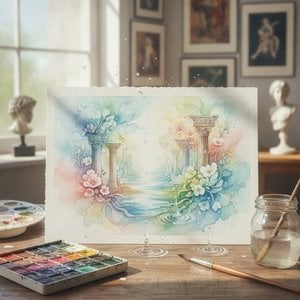
The Transparent Precision of Watercolor
 Watercolor painting
Watercolor (American English) or watercolour (Commonwealth English; see spelling differences), also aquarelle (French: [akwaʁɛl]; from Italian diminutive of Latin aqua 'water'), is a painting method in which the paints are made of pigments suspended ...
Integrating Natural Serenity into Interior Design
 Pastoral Scene
Explore John Lancaster’s ‘Pastoral Scene,’ a serene 1992 impressionistic landscape painting of wildflowers & mountains. Discover its textured oil on canvas style.