The Reaction Against Excess: Moving Beyond the Rococo
The mid-eighteenth century arrived with a sense of exhaustion. The Rococo style, with its dizzying asymmetry and flirtatious, pastel-hued ornamentation, had become a visual language of the superficial. It was a style of the boudoir, favoring the whimsical over the weighty. As the Enlightenment began to demand a more rigorous intellectual framework, the art of Europe sought a departure from this perceived frivolity. The shift was not merely a change in fashion but a fundamental rejection of the decorative in favor of the structural.
This movement found its footing in the pursuit of clarity. Where the Rococo sought to charm, the emerging Neoclassical impulse sought to instruct. The transition was marked by a move away from the serpentine lines of the previous era toward a more disciplined, linear approach. This was a period where the artist’s duty shifted from the pursuit of pleasure to the pursuit of truth, grounded in the perceived stability of the ancient world.
We see this impulse for order echoed in the way we approach modern design and architecture today. When a contemporary architect utilizes clean lines and mathematical precision to create a sense of calm in an urban environment, they are participating in a long-standing Neoclassical tradition. The desire to find clarity through structure is a recurring human response to periods of social upheaval.
The Archaeological Impulse: Pompeii and the Rebirth of Antiquity
The mid-1700s witnessed a profound shift in the European consciousness, driven by the literal unearthing of the past. The rediscovery of Pompeii and Herculaneum provided something the Enlightenment had long craved: tangible, physical evidence of the Greco-Roman world. No longer was antiquity a vague, literary concept; it was a tangible reality of frescoed walls, marble statuary, and domestic precision. This archaeological fervor provided the visual vocabulary for a new era.
The writings of Johann Joachim Winckelmann acted as a catalyst, providing the theoretical backbone to these physical discoveries. He advocated for a return to the "noble simplicity and quiet grandeur" of Greek art. This was not a mere imitation of the past, but an attempt to capture the essence of a lost ideal. The movement was born in Rome, fueled by the Grand Tour, as students returned to their home countries carrying the weight of these rediscovered ideals.
This reverence for the authentic is mirrored in the modern collector’s pursuit of provenance and historical accuracy. Just as the excavators of Pompeii sought to preserve the integrity of the ancient, the discerning collector seeks works that maintain a connection to the true spirit of their era, valuing the weight of history over the fleeting trends of the present.
The Architecture of Reason: Symmetry and the Palladian Legacy
 Andrea Palladio
Explore the world of Andrea Palladio (1508-1580), the influential Italian Renaissance architect behind iconic villas & 'The Four Books of Architecture'. Discover his classical designs!
In the realm of the built environment, Neoclassicism manifested as a rejection of the complex, undulating facades of the Baroque. The architecture was governed by the principles of simplicity and symmetry, drawing heavily from the Renaissance interpretations of Andrea Palladio. It was an architecture of logic, where every column, pediment, and lintel served a clear, structural purpose. The goal was to create a sense of permanence and civic dignity.
Luigi Vanvitelli emerged as a primary interpreter of this monumental style, creating spaces that felt both grand and mathematically ordered. The influence of the Renaissance was filtered through a lens of Enlightenment reason, resulting in structures that emphasized the horizontal and the vertical over the curved and the chaotic. This was the architecture of the state, designed to project stability and authority.
The legacy of this structural clarity persists in the very foundations of our urban landscapes. The preference for symmetry and proportion in classical-inspired facades remains a standard for institutional architecture, providing a sense of continuity and order amidst the shifting skyline of the modern city.
The Painter’s Discipline: Jacques-Louis David and the Moral Line
 The Oath of the Horatii
The Oath of the Horatii, Jacques-Louis David
If architecture provided the stage, painting provided the drama. Jacques-Louis David became the preeminent voice of this movement, particularly in France. His work, such as Patroclus (1780), moved away from the soft, blurred edges of the previous generation toward a sharp, sculptural precision. His compositions were often structured with a rigorous, almost architectural clarity, using light and shadow to define form rather than to create atmospheric mystery.
David’s approach was deeply tied to the moral imperatives of his time. In works like The Oath of the Horatii, the composition is driven by a strong diagonal axis, drawing the eye toward a focal point of resolute, civic duty. This was art as a vehicle for virtue, emphasizing stoicism, self-sacrifice, and the weight of responsibility. The brushwork was controlled, the surfaces smooth, and the emotional register restrained, favoring the intellect over the impulse.
This dedication to technical mastery and the clarity of the subject is a standard we uphold at WahooArt.com. Our artists, many of whom hold degrees from prestigious academies, approach every commission with this same commitment to academic excellence, ensuring that the hand-painted detail and tonal range reflect the true dignity of the original composition.
The Sculptural Ideal: Antonio Canova and the Purity of Form
 Antonio Canova
Explore the world of Antonio Canova (1757-1822), the unrivaled Neoclassical sculptor! Admire his breathtaking marble statues like Cupid & Psyche, The Graces & more. Discover his life and legacy!
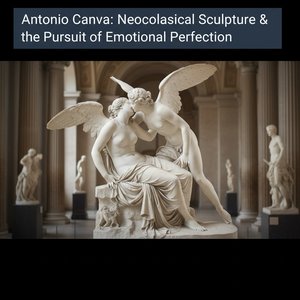
While painters were refining the line, sculptors were perfecting the surface. Antonio Canova, active in the latter half of the 18th century, brought a unique sensitivity to the Neoclassical movement. His work sought to bridge the gap between the idealized perfection of ancient Greek sculpture and a certain refined, lyrical grace. His marble figures possessed a smoothness that seemed to transcend the stone itself, capturing a sense of poised, eternal stillness.
Canova’s work represents the pinnacle of the movement's pursuit of the ideal. Unlike the heavy, emotive tension of the Baroque, his sculptures emphasize balance and a controlled elegance. There is a sense of "quiet grandeur" in his work that aligns perfectly with the theories of Winckelmann. He did not merely carve stone; he sought to manifest the very concept of classical beauty through the manipulation of light and proportion.
The appreciation for such tactile perfection is why we offer an optional Aged & Cracked (craquelure) finish on our oil reproductions. It is an acknowledgment that the beauty of art often lies in its perceived history and the physical presence of the medium, a quality that digital prints can never truly replicate.
The Great Divergence: Neoclassicism versus the Romantic Spirit
As the 19th century progressed, the rigid order of Neoclassicism found itself in a profound struggle with the rising tide of Romanticism. This was the great clash of the age: Reason versus Emotion. While the Neoclassicists looked toward the universal, the objective, and the structured, the Romantics looked toward the individual, the subjective, and the sublime power of nature. It was a tension between the mind's clarity and the heart's passion.
This was not a simple replacement of one style by another, but a dialogue that defined the trajectory of Western art. The Neoclassical emphasis on form and permanence provided a necessary counterweight to the spontaneous, often turbulent expressions of the Romantic movement. This duality prevented art from stagnating, forcing a constant re-evaluation of what constitutes aesthetic truth.
At WahooArt.com, we recognize this enduring duality. We cater to the collector who seeks the disciplined elegance of a Neoclassical portrait, as well as the enthusiast drawn to the emotive, textured power of a Romantic landscape. We understand that the tension between order and expression is what makes art a living, breathing experience.
The Enduring Canon: Classical Order in the Modern Age
Neoclassicism did not simply vanish with the advent of the modern era; it evolved. Its influence can be seen in the Russian Neoclassical revival of the early 20th century, where architects like Ivan Zholtovsky strictly followed the classical canon, resisting the total abandonment of tradition. Even in the 20th century, the "call to order" in music saw composers returning to the clarity and economy of the 18th century as a reaction against the perceived formlessness of late Romanticism.
The movement's survival is a testament to the enduring power of its fundamental principles: symmetry, proportion, and the pursuit of an ideal. Whether in the grand architecture of a government building or the quiet balance of a well-composed portrait, the classical impulse remains a foundational pillar of our visual language. It provides a sense of stability in a world of constant change.
For those seeking to bring this sense of permanence into their own spaces, WahooArt.com offers a bridge to this heritage. From Handmade Oil Reproductions that capture the physical depth of the masters to Custom Commissions that allow you to reimagine history, we provide the means to own a piece of this enduring canon. Whether you require a large-scale mural for a hotel or a single, carefully curated portrait, our service is designed for the discerning collector who values authenticity, craftsmanship, and the timeless authority of the Old Masters.