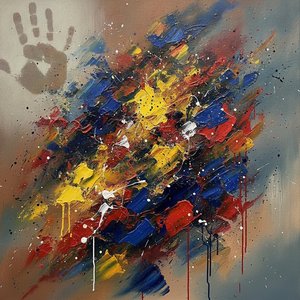
Explore Blanche Lazzell’s ‘Non Objective (b)’ – a vibrant 1928 geometric abstract watercolor. Discover Cubist influence & bold color palettes in this unique early 20th-century artwork.
The reduction of the visible world into a series of essential planes was not an act of destruction, but one of distillation. Before the arrival of total non-objectivity, the Cubist movement provided the necessary vocabulary for this departure. Artists began by fracturing the subject, breaking the continuity of form to explore multiple perspectives simultaneously. This period of experimentation, seen in the works of pioneers like Blanche Lazzell, utilized the logic of the grid and the weight of the line to dismantle traditional representation.
This structural fragmentation finds its logical conclusion in the rigorous discipline of Geometric Abstraction. Where Cubism still relied on a recognizable, albeit shattered, subject, artists such as Piet Mondrian and Kazimir Malevich moved toward a state where no external reference remained. They sought a universal order, a mathematical purity that could exist independently of nature. The transition from the fractured object to the autonomous shape represents a shift from observing reality to constructing a new, self-sufficient truth through geometry.
Chromatic Depth: The Influence of Post-Impressionist Color on Lyrical Abstraction
Raymond Parker: A Life in Color and Abstraction Born: Minneapolis, United States of America (1922) Died: 1990 Raymond Parker was a significant American painter associated with Abstract Expressionism, Color Field painting, and Lyrical Abstraction. His...
Color has long functioned as more than a mere descriptive tool; it is a vessel for psychological resonance. The late nineteenth century, through the lens of Impressionism and Post-Impressionism, introduced a way of seeing where light and hue could dictate the emotional temperature of a canvas. This era taught us that color does not need to adhere to the literal shade of a leaf or a sky to convey the essence of a moment.
This legacy of expressive color found a profound second life in Lyrical Abstraction and Color Field painting. Artists like Raymond Parker utilized large, sweeping gestures and expansive palettes to evoke moods that words often fail to capture. By stripping away the burden of form, these painters allowed color to act as the primary protagonist. The tension between the structured geometry of early abstraction and this more fluid, chromatic freedom creates a dialogue between the intellect and the senses, much like the way a composer balances mathematical notation with melodic soul.
The Spontaneous Mark: Surrealist Automation and the Rise of Action Painting
Abstract expressionism in the United States emerged as a distinct art movement in the aftermath of World War II and gained mainstream acceptance in the 1950s, a shift from the American social realism of the 1930s influenced by the Great Depression an...
The history of abstraction is often viewed as a progression toward control, yet its most radical moments emerged from the surrender of it. The Surrealists introduced the concept of psychic automatism—a method of drawing or painting without conscious premeditation to tap into the subconscious. By allowing the hand to move guided by instinct rather than intellect, they opened a door to a more visceral, unmediated form of expression.
This impulse toward spontaneity reached its zenith in the mid-twity century with the emergence of Abstract Expressionism in New York. The canvas ceased to be a space for depiction and became an arena for action. Jackson Pollock’s technique of dripping paint onto a floor-bound canvas transformed the act of painting into a physical event, a rhythmic dance of energy that captured a fragment of time. This movement took the Surrealist seed of the subconscious and expanded it into a monumental, gestural language that redefined the boundaries of the medium.
Materiality and Pattern: The Historical Echo of Textiles in Modern Abstraction
--- title: Woven Histories: Textiles and Modern Abstraction | National Gallery of Art url: https://www.nga.gov/exhibitions/woven-histories-textiles-and-modern-abstraction hostname: nga.gov sitename: National Gallery of Art date: 2024-07-28 --- Past E...
Abstraction is frequently discussed in terms of high-art movements like Cubism or Suprematism, yet its roots are deeply embedded in the tactile traditions of craft. For centuries, the rhythmic repetition of patterns in weaving and textiles has utilized the very principles of abstraction—repetition, symmetry, and the simplification of form—long before they were codified by the European avant-garde.
In the twentieth century, this intersection of fine art and applied craft became a site of profound innovation. The work of Anni Albers and other textile artists demonstrated how the structural constraints of the loom could inform the complexities of modern composition. This dialogue between the woven thread and the painted line challenges the traditional hierarchies of art, reminding us that the logic of abstraction is as much found in the warp and weft of a fabric as it is in the heavy impasto of an oil painting.
Subjective Reemergence: From German Expressionism to Neo-Expressionist Intensity
Neo-expressionism is a style of late modernist or early-postmodern painting and sculpture that emerged in the late 1970s. Neo-expressionists were sometimes called Transavantgarde, Junge Wilde or Neue Wilden ('The new wild ones'; 'New Fauves' would be...
The trajectory of modern art is rarely a straight line; it is often a series of reactions and resurrections. The early twentieth century saw the rise of Expressionism, a movement that sought to distort reality to evoke intense emotional states, often characterized by an underlying sense of anxiety or spiritual searching. This was art as a subjective outcry, prioritizing the internal psyche over the external landscape.
Decades later, Neo-Expressionism emerged as a powerful response to the perceived austerity of Minimalism and Conceptualism. Artists returned to the figure and the brushstroke with a renewed, often violent, intensity. Much like the original Expressionists, these late twentieth-century painters utilized thick textures and vivid, sometimes abrasive colors to confront the complexities of the human condition. This cyclical return to the emotive power of the mark proves that even in an age of digital precision, the raw, human touch remains an indispensable element of our visual language.
At WahooArt.com, we celebrate this enduring legacy of craftsmanship and expression. Whether you are seeking a meticulously hand-painted oil reproduction of a geometric classic or a custom commission that reimagines your own history through the lens of the masters, our artists bring academic excellence to every canvas. We invite you to explore our collections and discover how the profound evolution of abstraction continues to find its place in the most sophisticated modern interiors.
Embark on a cultural journey through Lyrical Abstraction. Explore how masters like Kandinsky used color and motion to translate emotion into visual poetry. Discover the profound beauty of abstract expressionism and learn to curate emotional resonance in your own art collection.
Explore the visceral power of Neo-Expressionism. From Georg Baselitz to Basquiat, discover how bold colors and raw brushwork redefined modern art. A deep dive into the movement's emotional rebellion for the discerning art collector.
Explore the profound impact of Abstract Expressionism. Discover how post-war artists used gesture and emotion to redefine modern art through Action Painting and the New York School. A definitive guide for students and collectors seeking deep historical context.
Explore the profound emotional depth of Cubism. From geometric abstraction to the soul's rhythm, discover how fragmented forms evoke universal truths through our expert art history insights and museum-quality hand-painted reproductions.



 Non Objective (b)
 Raymond Parker