The Essence of Reduction: Defining the Minimalist Aesthetic
In the grand, often tumultuous narrative of art history, there exists a profound movement defined not by what is added, but by what is courageously stripped away. Minimalism emerged as a radical departure from the emotive excesses of Abstract Expressionism, seeking to strip the canvas of metaphor, biography, and illusion. To understand minimalism is to embrace the beauty of the essential. It is an aesthetic of restraint, where the artist’s hand recedes to allow the physical presence of the medium—the weight of the paint, the edge of the line, and the purity of the form—to speak with unadultered clarity. This movement invites the viewer into a meditative state, stripping away the noise of the external world to focus on the immediate, sensory reality of the object. There is no hidden narrative to decode, no psychological trauma to uncover; there is only the stark, breathtaking truth of the composition itself. For the discerning collector, this reduction offers a unique form of luxury: the luxury of clarity in an era of visual saturation. By embracing the power of less, minimalism achieves a timelessness that transcends fleeting trends, offering a permanent anchor of serenity within any curated space.Geometric Precision and Form: The Language of Abstraction
At the heart of the minimalist lexicon lies the rigorous application of geometry. Where traditional art might use a curve to suggest a human limb or a landscape, minimalism utilizes the circle, the square, and the line as autonomous entities. This is a language of mathematical elegance and structural integrity. Consider the mesmerizing precision found in works like Victor Vasarely’s Untitled 26, where dynamic circles and geometric abstraction create an optical rhythm that dances before the eye. Here, form does not represent something else; it simply is. This pursuit of geometric purity often intersects with the Concrete Art movement, a pivotal era where artists like Gianni Monnet utilized bold colors and architectural influences to explore the intersection of art and structure. The influence of groups such as equipo 57 further refined this approach, bringing a disciplined, systematic method to European abstraction. In these works, the tension between shapes creates a silent energy. Whether it is the precise grid of Piet Mondrian’s Composition with Blue 1 or the stark, ink-on-paper reductions seen in Dwinell Grant’s Contrathemis, the mastery lies in the balance of weight, color, and spatial relationship. For the collector, these pieces serve as architectural anchors, providing a sense of order and sophisticated equilibrium to modern environments.The Psychological Impact of Negative Space and Silence
To the untrained eye, the emptiness within a minimalist composition may appear as mere void; however, to the connoisseur, this is where the true dialogue occurs. In minimalism, negative space—the "silence" between forms—is as vital as the marks themselves. This intentional use of emptiness creates a psychological breathing room, allowing the viewer's mind to expand and settle. It is a deliberate cultivation of stillness, a way to command attention through absence rather than through clamor. This spatial tension fosters a deep, contemplative connection between the artwork and the observer. When an artist masters the balance of presence and void, they create a vacuum that pulls the viewer into the work’s unique atmosphere. This silence is not empty; it is pregnant with potential, offering a sanctuary for thought. In a contemporary world characterized by constant digital stimulation, the ability of a minimalist piece to provide a visual "pause" is an invaluable asset to any collection. It transforms a room from a mere living space into a curated environment of intellectual and emotional repose.Curating Minimalism: Integrating Abstract Works into Modern Interiors
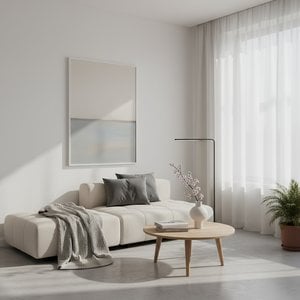
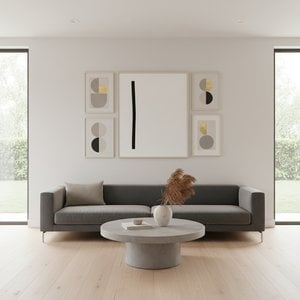
Integrating minimalist art into a sophisticated interior requires a nuanced understanding of scale, texture, and light. Because minimalist works rely so heavily on form and color, they act as powerful architectural elements rather than mere decorations. A large-scale geometric abstraction can define the boundaries of a room, while a delicate, reductive print can serve as a focal point of quiet elegance. The key to successful curation lies in treating the artwork as an extension of the architecture itself. For those seeking to enhance their spaces, consider the tactile dimension of the medium. While a flat Giclée print offers clean lines and modern precision, a handmade oil reproduction introduces a vital layer of depth through impasto textures and visible brushstrokes. This physical presence prevents minimalism from feeling sterile, instead imollating a "living" quality that breathes with the room. Whether utilizing multi-panel layouts to span a wide gallery wall or selecting pieces with specific color palettes to complement bespoke furnishings, the goal is to create a cohesive visual ecosystem where the art and the environment exist in perfect, silent harmony.The Enduring Legacy: From Concrete Art to Contemporary Collections
The legacy of minimalism continues to ripple through the contemporary art market, influencing everything from graphic design to high-end architecture. The movement’s emphasis on truth to materials and the rejection of ornament has become a cornerstone of modern aesthetic values. Today’s collectors find that minimalist works possess an incredible versatility; they are equally at home in a brutalist concrete loft as they are in a classical, light-filled estate. As we look toward the future of art collecting, the principles of minimalism remain more relevant than ever. The movement has taught us that true impact does not require complexity, and true sophistication does not require excess. By investing in pieces that celebrate the fundamental elements of sight and form, collectors are not merely acquiring objects; they are preserving a philosophy of intentionality. In the hands of those who appreciate the profound strength found in reduction, minimalism remains an eternal testament to the power of the essential.For those seeking to expand their collection with museum-quality reproductions or bespoke commissions that capture the spirit of these movements, WahooArt.com offers unparalleled expertise in bringing the world's most significant artistic legacies into the modern home.