The Revolution of the Real: Defining Genre Painting vs. History Painting History painting History painting is a genre in painting defined by its subject matter rather than any artistic style or specific period. History paintings depict a moment in a ...
The seventeenth-century Netherlands underwent a transformation that was as much aesthetic as it was political. As the Republic emerged from the Eighty Years' War, the heavy, didactic weight of Southern European traditions began to lift. In the courts of France or the churches of Italy, the "Grand Genre" of history painting remained the undisputed sovereign, preoccupied with the monumental exploits of gods and monarchs. However, in the Dutch Republic, a new prosperity was being forged not through conquest, and certainly not through religious iconography, but through maritime trade and mercantile grit.
This economic shift necessitated a new kind of art. The burgeoning middle class, having found wealth in the ports of Amsterdam and Haarlem, sought mirrors for their own lived experiences rather than distant allegories. This gave rise to the petit genre, or genre painting—a movement that redirected the artist's gaze from Olympus to the street. Where the history painter sought to depict an event that transcended time, the genre painter captured the ephemeral beauty of what was happening in a single, unscripted moment.
This redirection of focus finds its historical echo in the transition from the monumental to the intimate. Just as the Dutch masters moved away from the divine to embrace the domestic, we see a similar shift in later centuries when artists like Chardin replaced the theatricality of the Rococo with a careful, grounded realism. The revolution was not one of skill, but of perception; it was the realization that the ordinary could hold as much gravity as the epic.
Discover "The Fish Market" by Hendrick Maertensz Sorgh! A vibrant 17th-century Dutch painting of a bustling market scene. Explore its genre style & historical detail.
To observe a Dutch market scene is to engage with a profound commitment to tactile truth. There is no room for the idealized or the vague when an artist intends to document the pulse of commerce. In the works of masters such as Hendrik Martenszoon Sorgh, the canvas becomes a sensory experience. One does not merely see a marketplace; one feels the rough grain of a wooden stall, the heavy weight of woven fabrics, and the weathered skin of the vendors.
The technical mastery required for such realism is immense. Through the disciplined use of chiaroscuro—the dramatic interplay between light and shadow—artists were able to sculpt form and create an atmospheric depth that made even a modest street corner feel expansive. In Jan Victors’s depictions, light does not simply illuminate; it reveals the subtle textures of umbrellas or the focused intensity of a card game. This meticulous attention to detail ensures that the viewer is not a distant observer but a fellow pedestrian navigating the same cobblestones.
This dedication to material truth finds its antecedent in the ancient world. Long before the Dutch Golden Age, the Hellenistic painter Peiraikos was noted for his focus on "low" subjects, such as barbershops and cobbler stalls. The impulse remains unchanged: the belief that the true essence of life is found in the tangible, the edible, and the worn.
The Social Fabric: Human Connection in the Marketplace
Pepper-Pot: A Scene in the Philadelphia Market is an oil-on-canvas genre painting by American artist John Lewis Krimmel (1786–1821). It was painted in Philadelphia in 1811. Gifted by Edward Barnes Leisenring Jr. in 2001, the work is held in the colle...
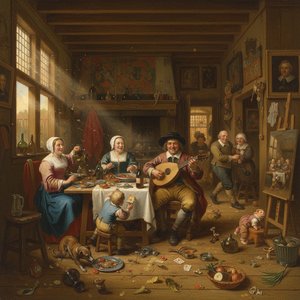
Beyond the exchange of goods, the marketplace served as the vital social engine of the Dutch Republic. It was a space where disparate lives intersected—where the wealthy merchant might brush shoulders with a street vendor. In Jan Steen’s works, such as The Happy Family, we see the conviviality and occasional chaos of these social gatherings. These scenes are rarely about singular heroes; they are about the collective rhythm of a community in motion.
There is a profound psychological depth to be found in these crowded compositions. An artist like Jan Victors captures the unscripted drama of human interaction—the conspiratorial glance, the slight lean forward during a wager, or the shared laughter of a group. These moments of connection are what ground the paintings in a recognizable humanity. The figures often remain anonymous, allowing any viewer to find themselves reflected in the universal motions of daily existence.
This focus on the social collective finds a distant parallel in the American genre painting of John Lewis Krimmel. In his 1811 work, Pepper-Pot: A Scene in the Philadelphia Market, he depicts a free Black woman ladling soup to a diverse crowd. Though separated by centuries and oceans, both Krimmel and the Dutch masters understood that the true character of a nation is revealed in its public squares and the shared rituals of its people.
Hidden Narratives: Symbolic Depth in Everyday Objects
Dive into Salvador Dalí's 'Surrealist Object Gauge of Instantaneous Memory.' A mind-bending 1932 masterpiece blending objects, time, and dreams – a captivating exploration of memory and reality.
While these paintings celebrate the mundane, they are rarely devoid of deeper meaning. The Dutch masters were adept at embedding moral or symbolic layers within seemingly simple compositions. A painting of a market might appear to be a mere record of trade, yet a closer inspection reveals a complex web of emblems. In Gabriel Metsu’s The Poultry Seller, the presence of a rooster is not merely a culinary detail; it carries a subtle, perhaps even scabreous, symbolic weight understood by the contemporary viewer.
This layering of meaning allows a painting to function on two levels: as a beautiful depiction of life and as a meditation on morality. Adriaen Brouwer often used genre groups to represent the five senses or the seven deadly sins, turning a tavern scene into a profound philosophical inquiry. Even the placement of a clock, as seen in Sorgh’s Amsterdam scenes, serves as a silent sentinel, reminding the viewer of the fleeting nature of time and the transience of all earthly commerce.
This tradition of hidden meaning is an old one. We see it in the medieval illuminated manuscripts, such as Les Très Riches Heures du Duc de Berry, where the depiction of peasant life was often intertwined with the liturgical calendar and deeper spiritual truths. The Dutch simply brought this practice into the secular, sunlit world of the street.
An Enduring Legacy: The Persistence of Observational Truth
The legacy of the Dutch Golden Age lies in its refusal to look away from the truth of the everyday. By elevating the "low" subjects of the market and the home, these artists established a standard of observational excellence that continues to inform our understanding of realism. Their work does not seek to impress with grandiosity but to move through authenticity.
Today, this commitment to craftsmanship remains the cornerstone of fine art. Whether it is the meticulous brushwork of a reproduction or the careful curation of an original collection, the value lies in the ability to capture a moment with integrity. The techniques developed in the 17th century—the mastery of light, the respect for texture, and the psychological depth of the subject—remain the very elements that allow art to transcend its era.
At WahooArt.com, we honor this enduring tradition. Our studio specializes in the creation of hand-painted oil reproductions that preserve the visible brushstrokes and deep tonal ranges of the Old Masters. For those seeking to bring this historical depth into a modern space, our artists employ the same dedication to light and shadow that defined the Golden Age, ensuring that every commission is not merely a copy, but a continuation of a storied artistic lineage.
Explore the profound beauty of Dutch Golden Age genre painting. From Ter Borch to Vermeer, discover how masters captured everyday life through exquisite realism and psychological depth in this expert art history guide.
Explore the life & art of Jan Steen, a leading Dutch Golden Age painter renowned for his humorous genre scenes & insightful social commentary. Discover his techniques, legacy, and collecting tips.



 The Art of the Everyday: A Definitive Guide to the Mastery of Dutch Golden Age Genre Painting
 The fish market
 Pepper-Pot: A Scene in the Philadelphia Market
 Surrealist Object Gauge of Instantaneous Memory, 1932