The Weight of a Glance: Entering the Realm of Visual Connection Rueda luminosa Captivating Subject and Symbolism This exquisite monochromatic pencil drawing centers on a human eye, often regarded as the window to the soul. The artist masterfully capt...
To encounter a gaze that holds is to experience a sudden, quiet interruption of one's own thoughts. We often move through the world with a certain visual indifference, yet when eyes meet across a crowded room or from within the depths of an oil painting, the periphery tends to fade. This phenomenon is more than mere social instinct; it is a cognitive event. Research suggests that direct eye contact can actually drain our mental reserves, momentarily interfering with working memory and imagination as the brain priorit's the presence of another mind. In the gallery, this tension becomes palpable. When a figure on canvas fixes us with an unwavering look, we are no longer mere observers; we become participants in a silent dialogue.
This psychological weight finds its historical antecedent in Roman portraiture. Long before the advent of modern psychology, the ancients understood how to wield the eye as an instrument of statecraft. While Republican-era busts often favored a modest, naturalistic approach, the transition into the Imperial age saw the eyes become tools of propaganda. Rulers frequently looked to their predecessors for legitimacy, adopting intense, commanding gazes to suggest an unbroken lineage of power. Much like the leaders who followed Alexander the Great, Roman emperors used the gaze to communicate much more than simple likeness; they utilized it to project authority and an unshakeable presence.
Chiaroscuro: Sculpting Emotion Through Light and Shadow
Introduction To step into the world of Rembrandt van Rijn is to enter a realm where light does not merely illuminate a scene, but breathes life into the very soul of the subject. There is a profound, quiet intimacy in his work—a sense that if you wer...
If psychology provides the soul of a portrait, then chiaroscuro provides its heartbeat. This technical mastery—the dramatic interplay between profound shadow and brilliant illumination—is perhaps the most transformative tool in the artist's repertoire. By utilizing strong contrasts between light and dark, painters achieve a sense of volume, modeling three-dimensional figures that seem to emerge from the very fabric of the canvas. When this technique is pushed to its extreme, known as tenebrism, the shadows become a stage upon which the subject’s internal drama is performed, focusing the viewer's attention entirely on the illuminated truth of the sitter.
The legacy of this dramatic lighting is most profoundly felt in the works of Rembrandt van Rijn. During the Dutch Golden Age, Rembrandt moved away from the polished perfection sought by many of his contemporaries to pursue a more courageous reality. He found it in the weathered wrinkles of an elderly scholar and the subtle flicker of thought passing through the eyes of a merchant. Through his command of light and shadow, he transformed the canvas into a space where light does not merely illuminate a scene but breathes life into the very soul of the subject, making the heavy sigh of a mourner almost audible to the viewer.
Domestic Quietude: Finding Intimacy in the Everyday
LE DUO CHANTEUSE ET JOUEUR DE LUTH THEORBE – A Window into Dutch Golden Age Intimacy Gerard ter Borch’s “Le Duo: chanteuse et joueur de luth théorbé,” painted around 1669-1670, stands as a quintessential example of Dutch genre painting—a movement tha...
There is a profound, quiet intimacy found in scenes that celebrate the mundane. In the 17th-century Netherlands, a burgeoning middle class sought to see their own humanity reflected in art, leading to a fascination with domestic interiors and human interaction. These paintings do not rely on grand historical narratives; instead, they find significance in the stillness of a room, the texture of a fabric, or the shared silence between two people. This focus on the private sphere allows for a unique form of psychological depth, where the smallest gesture carries the weight of an entire narrative.
Gerard ter Borch mastered this sense of tranquility in works such as Le Duo: chanteuse et joueur de luth théorbé. Within a modestly furnished interior, dominated by a dark background that heightens the visual impact of the figures, Ter Borch captures a moment of quiet contemplation. The man playing the lute and the woman singing from sheet music are caught in a serene domestic tableau. This approach to genre painting demonstrates how the most ordinary moments of life can be elevated through meticulous observation, turning a simple musical performance into an enduring study of human connection.
The Iconography of Presence: Symbolism as a Language of Identity
A portrait is rarely just a record of physical features; it is a carefully constructed language of symbols. In many traditions, the objects surrounding a sitter serve as a complex vocabulary, conveying status, virtue, or even political aspiration. From the pearls and roses in Elizabethan portraiture to the religious paintings hanging on walls in Dutch interiors, these elements provide layers of meaning that invite the viewer to decode the subject's true identity. The artist becomes an investigator, using iconography to tell a story that extends far beyond the visible surface.
This layering of meaning is evident in the works of Johannes Vermeer, particularly in Lady Writing a Letter with Her Maid. While the scene appears to be one of quiet industry, the composition is rich with subtle cues. The presence of a painting within the painting—the Finding of Moses—adds a layer of symbolic depth to the domestic setting. Similarly, the arrangement of the figures suggests a complex dynamic marked by both connection and emotional distance. Through such details, the artist bridges the gap between the everyday activity in the foreground and a grander, more symbolic narrative.
From Lineage to Legacy: The Evolution of Psychological Realism
Introduction To step into the world of Sir Anthony van Dyck is to enter an era of unparalleled grace, where the heavy textures of the Baroque period meet a newfound, ethereal elegance. As you wander through this curated selection of his top twenty-fi...
The trajectory of portraiture has moved steadily from the external to the internal. In earlier eras, portraits often functioned as flat patterns or rigid icons designed to communicate power and lineage through fixed symbols. As artistic movements evolved, particularly during the Renaissance and into the Baroque, there was an increasing ambition to map the human soul. This shift saw the artist move away from mere documentation of status toward an unprecedented psychological realism, where the focus shifted from how a person looked to how they felt within the grand theater of their time.
This evolution is perhaps most striking when comparing the formal, symbolic portraits of Elizabeth I to the more fluid, emotive works of later periods. The Elizabethan era utilized heavy iconography—globes, crowns, and swords—to present a complex story of majesty and state power. In contrast, the later development of portraiture, seen in the works of artists like Sir Anthony van Dyck, embraced sprezzatura—an effortless, studied nonchalance. Van Dyck's ability to capture the dignity and psychological depth of the European aristocracy established a new standard, where the sitter's inner life was as much a part of the portrait as their social prestige.
At WahooArt.com, we honor this long tradition of psychological depth through our bespoke services. Whether you are seeking a hand-painted oil reproduction of a Dutch master or commissioning a custom portrait that transforms a modern memory into a historical masterpiece, our artists bring academic excellence to every brushstroke. We invite you to explore our collection and discover how the profound intimacy of the past can be brought into the contemporary home.
Immerse yourself in the elegance of Sir Anthony van Dyck. Explore 25 iconic Baroque masterpieces, from royal portraits to Flemish classics. Find inspiration for museum-quality art reproductions and timeless decor. Discover all masterpieces on WahooArt.com.
Explore the captivating world of Gerard ter Borch, a master of Dutch Golden Age genre painting. Discover his intimate scenes, masterful light, and lasting influence on art history. Learn more at WahooArt.



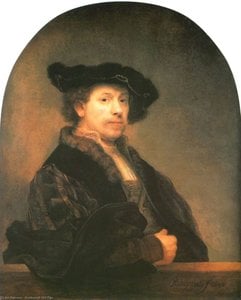


 Unwavering Vision: The Psychological Depth of the Piercing Gaze in Classical Portraiture
 Mastering Light & Shadow: The 25 Greatest Artworks by Rembrandt van Rijn
 LE DUO CHANTEUSE ET JOUEUR DE LUTH THEORBE
 25 Masterpieces by Sir Anthony van Dyck: The King of Baroque Portraiture


