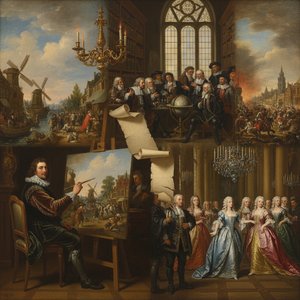
The Geometry of Silence: Light and Order in Dutch Genre Painting
There is a specific type of quiet that exists only within the confines of a well-ordered room. In the seventeenth-century Dutch interior, this stillness is never accidental; it is constructed through a rigorous application of light and shadow. One observes the way a single window, positioned with mathematical precision, allows a pale glow to settle upon a draped table or a heavy pewter pitcher. This is not merely an observation of light, but an imposition of order upon the chaos of the natural world.
The masters of this era understood that to capture a moment, one must first master the architecture of the space itself. When we look at the works of Johannes Vermeer, we see a composition where every shadow carries weight and every highlight serves a structural purpose. The light does not simply illuminate; it defines the boundaries of existence. This same reverence for spatial clarity remains vital today. Whether through a large-scale mural in a contemporary hotel or a carefully placed oil reproduction in a private study, the intention remains to create an environment where the eye can rest and the mind can find focus.
The Porcelain Mirror: Global Trade and the Allure of the Exotic Object
Within these domestic scenes, objects often act as silent ambassadors of a much larger, more turbulent world. A delicate porcelain bowl or a fine tea service resting on a wooden tabletop is never just a vessel; it is a fragment of a global narrative. During the Dutch Golden Age, the influx of Chinese porcelain into the Netherlands brought with it an obsession with texture and the exotic. These objects provided a surface upon which artists could demonstrate their technical prowess, rendering the translucent glaze and the intricate blue cobalt patterns with startling accuracy.
This fascination with the "other" through the medium of fine craft finds a modern parallel in our continued appreciation for material authenticity. The way a painter captures the sheen of a ceramic glaze or the heavy weave of a linen cloth mirrors our own desire for tactile truth in an increasingly digital age. We seek out the weight of real porcelain and the visible brushstrokes of a hand-painted canvas because they offer a connection to a tangible reality. The object, much like the painting, serves as a bridge between the local interior and the vastness of human history.
The Art of Mimicry: From Seventeenth-Century Apprenticeship to Modern Simulation
To speak of the Dutch masters is to speak of a tradition rooted in the skill of imitation. The guild system was built upon the concept of the apprentice learning to mimic the hand of the master, absorbing every nuance of pigment application and tonal gradation. This was not viewed as a lack of originality, but as a profound respect for established technique. To replicate the way light hits a silk sleeve or the way oil settles into a crack in a wooden floor was the highest form of academic achievement.
Today, we find ourselves navigating a new era of mimicry, where artificial intelligence can generate images that simulate the style of Vermeer with unsettling ease. While these digital tools can produce a convincing aesthetic, they lack the physical struggle of the brush against the canvas. There is a fundamental difference between a mathematical simulation of light and the deliberate, layered application of oil paint on cotton. True mastery lies not in the ability to copy a pattern, but in the ability to inhabit a tradition, using the tools of the present to honor the techniques of the past.
Shadows of the Self: Allegory and the Presence of the Absent Subject
The Dutch interior often contains a haunting quality, a sense that someone has just left the room or is about to enter it. This is achieved through the use of allegory—the subtle inclusion of symbols that point toward themes of mortality, virtue, or time. A skeleton drinking tea, though an absurd and surreal concept in a modern context, functions as a memento mori, reminding the viewer of the fleeting nature of life amidst the comforts of domesticity. The presence of the subject is felt through their absence, captured in the tilt of a chair or the steam rising from a cooling cup.
This tension between the seen and the unseen allows art to transcend simple decoration. A portrait commission that captures a loved one, or a custom reproduction that brings a historical scene into a modern home, carries this same emotional weight. We do not merely look at these works; we inhabit them. The ability to transform a personal photograph into a period-accurate painting—perhaps shifting a modern moment into the somber, dignified style of Rembrandt—allows us to participate in this long tradition of making the ephemeral permanent.
The Tactile Truth: Preserving the Weight of History Through Hand-Painted Oil
Ultimately, the allure of the Old Masters lies in their physicality. A print or a digital image can capture the likeness of a scene, but it cannot replicate the depth of a true oil painting. The texture of impasto, the subtle variations in a hand-mixed pigment, and the way light interacts with the raised surface of the paint create a sensory experience that is uniquely human. This is the difference between seeing an image and encountering an object.
At WahooArt.com, we believe that the integrity of this tactile experience must be preserved. Our artists, holding degrees from prestigious academies, work on 100% cotton canvas to ensure that every brushstroke possesses the necessary depth and character. Whether it is a custom portrait or a large-format mural for a professional interior design project, our focus remains on the authenticity of the medium. We provide the means to bring the weight and dignity of historical tradition into the contemporary space, ensuring that the stillness of the Dutch masters continues to resonate in the homes of today.
Journey through the Golden Age with our guide to the Top 10 Dutch Baroque masterpieces! Explore iconic paintings by Rembrandt, Vermeer & Frans Hals. Find museum-quality art reproductions and elevate your home decor at WahooArt.com.
Discover how to elevate digital designs into museum-quality oil masterpieces. Learn the art of transforming AI concepts and personal photos into textured, hand-painted canvas works through classical techniques, impasto mastery, and professional atelier craftsmanship.
Explore the artistic brilliance of the 17th-century Dutch Golden Age & Baroque period. Discover Rembrandt, genre painting, and chiaroscuro techniques. Expert insights for art lovers & collectors.