Captivating Subject and Symbolism This exquisite monochromatic pencil drawing centers on a human eye, often regarded as the window to the soul. The artist masterfully captures the intricate details of the eye’s anatomy, emphasizing the iris, pupil, e...
To encounter a gaze that holds is to experience a sudden, quiet interruption of one's own thoughts. We often move through the world with a certain visual indifference, yet when eyes meet across a crowded room or from within the depths of an oil painting, the periphery tends to fade. This phenomenon is more than mere social instinct; it is a cognitive event. Research suggests that direct eye contact can actually drain our mental reserves, momentarily interfering with working memory and imagination as the brain prioritists the presence of another mind.
In the gallery, this tension becomes palpable. When a figure on canvas fixes us with an unwavering look, we are no longer mere observers; we become participants in a silent dialogue. This connection often triggers a sense of being scrutinized, a feeling that the subject possesses their own agency and perspective. Whether it is the subtle dilation of a pupil or the slight narrowing of the eyes to signal complex emotion, the gaze serves as the primary conduit for human empathy and recognition.
Roman portraiture was one of the most significant periods in the development of portrait art. The surviving portraits of individuals are almost entirely sculptures, covering a period of almost five centuries. Roman portraiture is characterised by unu...
Long before the advent of modern psychology, the ancients understood how to wield the eye as an instrument of statecraft. Roman portraiture, characterized by a striking commitment to realism, utilized the gaze to communicate much more than simple likeness. While Republican-era busts often favored a modest, naturalistic approach, the transition into the Imperial age saw the eyes become tools of propaganda.
Rulers frequently looked to their predecessors for legitimacy. Much like the leaders who followed Alexander the Great, Roman emperors adopted specific hairstyles and intense, commanding gazes to suggest an unbroken lineage of power. In some instances, veristic portraiture—which celebrated weathered features and even perceived imperfections—was employed to project strength, wisdom, and a seasoned capacity for leadership. These stone eyes were designed to persuade, to instill confidence in the stability of the empire, and to remind the viewer of the unyielding nature of the state.
Mapping the Soul: Psychological Realism in the Renaissance
The Soul Behind the Surface: Psychological Realism in Renaissance Portraiture Portrait of Giovanni della Volta with his Wife and Children Lorenzo Lotto: A Venetian Master's Portrait of Domestic Tranquility Lorenzo Lotto’s “Portrait of Giovanni della ...
As we move from the rigid permanence of stone into the fluid possibilities of oil on canvas, the purpose of the gaze underwent a profound transformation. The Renaissance marked a departure from the flat, symbolic iconography of the Middle Ages, moving instead toward an ambitious attempt to map the human soul. Artists began to treat the sitter not as a mere icon of status, but as a living, breathing entity with an internal life.
In the works of masters like Lorenzo Lotto, we see this shift manifest in subtle facial expressions that hint at the weight of thought or the flicker of sentiment. The focus moved from the external trappings of wealth—the sheen of pearls or the texture of velvet—to the psychological depth found within the eyes themselves. This era established the portrait as a window into the subject's character, where a slight tilt of the head or a softened gaze could convey familial intimacy or social prestige with far more efficacy than any heraldic symbol.
Chiaroscuro and Command: The Dramaturgy of Light and Shadow
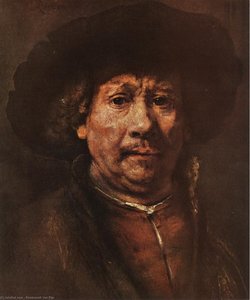
Self-Portrait with Shaded Eyes: A Glimpse into Rembrandt's Soul Rembrandt van Rijn’s Self-Portrait with Shaded Eyes , painted in 1634, is a captivating example of Baroque portraiture and a testament to the artist’s profound self-examination. This int...
If psychological realism provides the soul of a portrait, then technique provides its heartbeat. The mastery of chiaroscuro—the dramatic interplay between profound shadow and brilliant illumination—became the essential language for directing the viewer's attention. By manipulating light, artists could sculpt three-dimensional volume out of a flat surface, using deep, velvety blacks to force the eye toward sudden bursts of warmth and detail.
This technique reached its zenith during the Baroque period, particularly in the hands of Rembrandt van Rijn. In his self-portraits, such as Self-Portrait with Shaded Eyes, the undulating brim of a hat might cast a shadow that partially conceals the eyes, creating an atmosphere of mystery and introspection. This use of light does not merely illuminate; it reveals. It allows the artist to highlight the texture of a fur collar or the glint of a tear, using the contrast of dark and light to create a cinematic tension that makes the canvas feel less like a static relic and more like a captured moment of intense emotion.
The Tudor Iconography: Power, Symbolism, and the Royal Gaze
The portraiture of Queen Elizabeth I (1533–1603) spans the evolution of English royal portraits in the early modern period (1400/1500–1800), from the earliest representations of simple likenesses to the later complex imagery used to convey the power ...
In the courts of Tudor England, the gaze was often layered with complex political meaning. The portraiture of Elizabeth I evolved from simple likenesses into intricate compositions of power. These works were not merely about a face; they were about an image of empire. Through the use of carefully chosen objects—globes, crowns, swords, and pearls—the Queen's image was constructed to convey her majesty and her status as the Virgin Queen.
Interestingly, this era also saw a tension between realism and decorative pattern. While artists like Hans Holbein the Younger brought a profound psychological penetration to their work, later Elizabethan portraits often moved toward a flatter, more stylized approach to meet the demand for "face patterns." Even within this move toward ornamentation, the eyes remained central. The gaze of the monarch was intended to be both accessible and divine, a steadying force in times of political turbulence, ensuring that her subjects felt the weight of her presence even in her absence.
Expressionist Echoes: The Raw Vulnerability of the Unseen
The Haunting Gaze: Unveiling Edvard Munch's *Eye in Eye* Edvard Munch’s *Eye in Eye*, painted in 1894, isn’t merely a depiction of two figures; it’s a visceral plunge into the depths of human emotion. This arresting canvas, measuring just over a foot...
By the late 19th and early 20th centuries, the focus shifted once more, this time away from the external world and into the turbulent landscape of the psyche. Expressionism sought to convey subjective experience rather than objective reality, often using the gaze to communicate profound anxiety or existential dread.
Edvard Munch’s Eye in Eye (1894) provides a visceral example of this shift. Here, the eye contact between two figures is not a moment of social connection, but one of intense, perhaps even confrontational, intimacy. The thick, visible brushstrokes and distorted forms mirror the psychological landscape of the subjects. Similarly, in works like The Eyes of Omega, the eyes may be closed or averted, suggesting an inward journey or a desperate attempt to shut out a chaotic reality. In these works, the gaze—or the absence of it—becomes a tool for exploring the raw, unvarnished truths of human suffering and isolation.
The Eternal Dialogue: Reflections on the Enduring Eye
Introduction Step into the frame. Portraiture has never been just about capturing a likeness; it is about the raw, unfiltered energy of human identity. It is the original high-definition capture, long before pixels and sensors existed. From the heavy...
Whether we are examining the hyper-realistic precision of a modern pencil drawing or the heavy impasto of a Baroque masterpiece, the power of the gaze remains a constant in the history of art. It is the thread that connects the viewer to the artist, and the artist to the subject. We return to these works because they offer something that the fleeting digital images of our modern age often lack: a permanent, tactile connection to the human condition.
To look into a portrait is to engage in an eternal dialogue. These works remind us that to be seen is to be recognized, and to see is to understand. As we continue to curate and discover new ways to interpret these classical traditions—whether through custom oil reproductions or modern re-imaginings—we ensure that the profound impact of the human gaze continues to resonate across generations.
At WahooArt.com, we celebrate this enduring connection by offering hand-painted reproductions that honor the technical mastery of the Old Masters. From the dramatic chiaroscuro of Rembrandt to the psychological depth of the Renaissance, our collection is designed for those who seek to bring the profound weight of history into their own living spaces.
Lorenzo Lotto (1480-1556): Discover the unique Renaissance style of this Venetian master, known for emotive portraits & mystical religious art. Explore his rediscovered legacy!
Explore the profound psychological depth of emotional portraiture. From Expressionist masterpieces to custom oil commissions, discover how fine art captures the human soul through light, color, and masterful technique for discerning collectors.
Explore the rich history of portraiture with WahooArt.com! Discover iconic masterpieces, influential artists & movements. Expert insights for collectors and enthusiasts – find your next treasured artwork.
Discover the profound beauty of portraiture. Explore how master artists capture emotion through meticulous detail, from Renaissance realism to contemporary oil paintings. Learn to curate timeless, soulful art for your home with expert guidance from WahooArt.com.
Explore the captivating world of Lorenzo Lotto, a Venetian Renaissance master renowned for his psychologically insightful portraits & enigmatic symbolism. Discover his life, style, and rediscovered legacy with WahooArt.





 Rueda luminosa
 Roman portraiture
 Beyond the Frame: The Psychological Depth and Lasting Legacy of Renaissance Portraiture
 Self-Portrait with Shaded Eyes
 Portraiture of Elizabeth I
 Eye in Eye
 Beyond the Face: 10 Iconic Masterpieces That Redefine Portraiture