


The Canvas of Ancestry: Art as a Living Archive of Cultural Memory
 Vibrant Legacies: The Art of Preserving Indigenous Heritage Through Fine Art Mastery
The Canvas of Ancestry: Understanding Art as a Vessel for Cultural Memory To hold a piece of fine art is to touch the pulse of history itself. For the discerning collector, art has never been merely an aesthetic pursuit; it is an act of preservation,...
To hold a piece of fine art is to touch the pulse of history itself. For the discerning collector, art has never been merely an aesthetic pursuit; it is an act of preservation, a way to anchor the ephemeral nature of human experience into something tangible and enduring. Within the realm of indigenous cultures, this connection becomes even more profound. Art serves as the primary vessel for cultural memory, acting as a living archive where oral traditions, spiritual cosmologies, and ancestral lineages are etched into pigment and fiber.
Every stroke of a brush or intricate pattern in beadwork carries the weight of generations, embodying the very essence of a people's survival and identity. These works do not simply represent a moment in time; they function as a bridge between the seen and the unseen worlds. When we examine indigenous art through a lens of historical reverence, we witness a medium where the boundaries between the physical landscape and the spiritual realm blur, allowing the soul of a culture to resonate across centuries, inviting us to witness the enduring strength of legacies that refuse to be forgotten.
Geometric Echoes: Decoding the Symbolic Language of Indigenous Traditions
 kreen-akore
The Soul of Geometric Tradition: Exploring the Artistry of Kreen-Akore Deep within the emerald expanse of Brazil’s Xingu National Park resides a vibrant culture—the kreen-akore people—and at its heart lies an artistic tradition unlike any other. More...
Deep within the emerald expanse of Brazil’s Xingu National Park resides a vibrant culture—the Kreen-Akore people—and at its heart lies an artistic tradition unlike any other. Their visual language is characterized by striking geometric patterns—circles, squares, and triangles—that dominate textiles, baskets, carvings, and ceremonial masks. These shapes are far more than decorative embellishments; they represent a complex system of symbolic expression rooted in millennia of ancestral knowledge.
In this intricate lexicon, circles symbolize wholeness and continuity, mirroring the cyclical rhythms of life and death, while squares represent stability and order—the foundational elements required to maintain harmony with the spirits of the forest. This geometric precision is mirrored in other corners of the globe, such as the work of Alan Donovan Phillips Leitch, whose exploration of Kenyan craftsmanship utilized radial patterns in Kisii soapstone to symbolize interconnectedness and cosmic order. To decode these patterns is to read the very blueprint of a civilization's spiritual architecture.
Nature’s Sacred Geometry: The Symbiosis of Environment and Artistic Expression
 Tamsui River – An Indigenous Old Woman
The photo is a portrait of an old Atayal woman, her face tattooed in the traditional tribal manner. Gaze fixed, she is drawing on a thin-stemmed bamboo pipe. The pipe and the inclining tree trunk just beyond the woman
Indigenous artistry is an organic outgrowth of the earth itself, a profound dialogue between the creator and the landscape. This symbiosis is evident in the use of natural pigments—ochre reds, indigo blues, and earthy browns—derived directly from plants and minerals to achieve vibrant, living hues. The Kreen-Akoré artisans, for instance, utilize fibers extracted from local palms and grasses, imbuing each piece with the energy of the forest through rhythmic, sacred weaving techniques.
This connection extends to the depiction of the natural world, where animals such as jaguars, monkeys, and parrots appear in masks and carvings, embodying qualities like courage and adaptability. We see this same reverence for the natural spirit in the portraiture of the Atayal people, where a single image of an elder, her face tattooed in the traditional tribal manner, captures a gaze fixed upon the world with a depth that transcends mere photography. Whether it is the ancestral screens of the Kalabari Ijo people in Nigeria or the sun-baked mud architecture influences found in African heritage sites, the environment provides both the medium and the message.
Stewardship and Sovereignty: Navigating the Ethics of Cultural Heritage and Intellectual Property
 Indigenous intellectual property
Indigenous intellectual property is a term used in national and international forums to describe intellectual property held to be collectively owned by various Indigenous peoples, and by extension, their legal rights to protect specific such property...
As we admire these masterpieces, we must also confront the complex ethical landscape surrounding their ownership and preservation. The history of art is often a history of movement—sometimes through much more contentious means. The concept of repatriation has become central to modern discourse, as nations seek the return of cultural property and artifacts taken during eras of imperialism or war. The debate over the restitution of African cultural heritage, for instance, has ignited international conversations regarding the moral responsibilities of Western museums.
Furthermore, the protection of Indigenous intellectual property is a critical frontier in contemporary law. This includes the legal rights to protect collective knowledge, oral histories, and specific cultural motifs. In Australia, the term Indigenous Cultural and Intellectual Property (ICIP) highlights the necessity of safeguarding the intangible legacies—the songs, stories, and traditions—that are just as vital as any physical artifact. For the modern collector, true stewardship involves a deep respect for these boundaries, ensuring that the appreciation of beauty does not come at the cost of cultural sovereignty.
The Eternal Legacy: Curating Indigenous Beauty for Future Generations
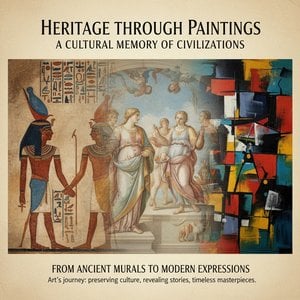 Heritage Through Paintings: A Cultural Memory of Civilizations – From Ancient Murals to Modern Expressions
The Enduring Legacy: How Paintings Preserve Cultural Memory From the ochre handprints pressed onto cave walls millennia ago to the vibrant canvases of contemporary artists, paintings have served as humanity’s most enduring visual chronicle. They are ...
The act of collecting is, ultimately, an act of curation for the future. It is about selecting those elements of our shared human story that we deem significant enough to pass on. Whether through the meticulous ethnographic documentation seen in the 19th-century works of Karl Bodmer or the contemporary textile designs of Robyn Caughlan and Tracie Bertram, art remains our most enduring visual chronicle.
At WahooArt.com, we believe in honoring this legacy of craftsmanship. Our mission is to provide a platform where the grandeur of art history can be celebrated through museum-quality reproductions and bespoke commissions. We specialize in bringing the textures and soul of historical styles to life on 100% cotton canvas, ensuring that the depth of every brushstroke and the vibrancy of every pigment is preserved for your collection. Through our professional digital mockup services and expert art consultations, we invite you to become a part of this eternal narrative, acquiring pieces that serve as both aesthetic triumphs and profound connections to the heritage of humanity.


