The Rupture of Representation: From Objective Mirror to Subjective Truth
For centuries, the painter’s primary duty was to act as a mirror, capturing the precise anatomy of a sitter or the fleeting light upon a landscape with near-perfect fidelity. This pursuit of objective reality provided a sense of order and stability. However, at the dawn of the twentieth century, this comfortable certainty began to fracture. As rapid industrialization and political instability reshaped Europe, the polished veneer of progress could no longer contain the growing sense of alienation. The Expressionist pioneers realized that the external world—the measurable, the visible, the documented—was insufficient to capture the true essence of a modern existence that felt increasingly fragmented.
This shift was not merely a change in style but an artistic revolt against the predictable. Where the Impressionists sought to record the transient effects of light, the Expressionists aimed to seize the enduring essence of inner states. They abandoned the comfort of anatomical accuracy to embrace a more radical ambition: the depiction of how the world feels rather than how it looks. This transition mirrors the broader intellectual shifts of the era, particularly the burgeoning field of psychology led by figures like Sigmund Freud, which offered new frameworks for understanding the hidden depths of the subconscious and the repressed emotions that reside beneath the surface of civilized life.
A Vocabulary of Color: Symbolic Palettes and Emotional Resonance
A Vision of Suffering: Savior's Face Alexej von Jawlensky’s “Savior’s Face: Waiting in Suffering” is not merely a depiction of a face; it’s an intensely felt exploration of human vulnerability and the quiet agony of faith. Painted in 1921, this work ...
In the hands of an Expressionist, color ceases to be decorative; it becomes a vocabulary of the soul. To encounter these works is to move beyond the intellect and strike directly at the emotions through a symbolic shorthand. A sky might burn with an unnatural, fiery orange, or a face might be cast in sickly, melanchative greens. These choices are deliberate rejections of naturalism, intended to communicate profound psychological states that words often fail to reach.
We see this intensity clearly in the works of Alexej von Jawlensky. In his 1921 work, Savior's Face: Waiting in Suffering, the palette is deliberately restrained, dominated by a stark blue background. These blues do not merely represent a color; they evoke melancholy, introspection, and a spiritual yearning. The use of color here serves to emphasize the emotional weight of the subject, stripping away the distractions of the external world to focus on the quiet agony of faith and human vulnerability.
The Psychological Portrait: Beyond Physical Likeness to Inner Turmoil
Richard Gerstl: A Tragic Pioneer of Expressionism Born: Vienna, Austria (1883) Died: Vienna, Austria (1908) Richard Gerstl was an Austrian painter and draughtsman whose brief but intense career placed him at the forefront of early Expressionism. Desp...
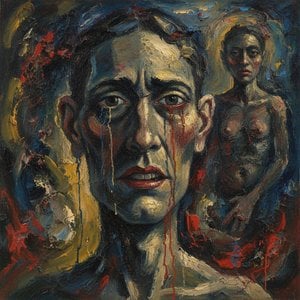
The portrait in the Expressionist tradition moved away from the social status or physical beauty of the sitter, focusing instead on a psychological truth that could be unsettling to behold. The goal was to capture not just a likeness, but the underlying emotional state of the subject. This often required a distortion of features—elongated necks, hollowed eyes, or contorted expressions—to mirror the fractured state of the inner world.
The brief, intense career of Richard Gerstl provides a poignant example of this psychological depth. A figure in Viennese modern art, Gerstl rejected the decorative aesthetics of the Vienna Secession in favor of bold colors and expressive brushwork that anticipated the movement's focus on subjective experience. His portraits reveal a keen understanding of human psychology, capturing the tension and unrest of an era. Similarly, the works of Witold Wojtkiewicz utilized motifs of masks and puppets to explore the ephemeral nature of existence, presenting figures that felt like solemn actors in a cosmic drama, navigating the thin boundary between childhood innocence and adult decay.
Distorted Horizons: Landscapes as Reflections of Internal Unrest
Tragical Landscape by Georges Rouault: A Descent into Emotion Georges Rouault’s “Tragical Landscape” is not merely a depiction of a scene; it's an immersion in profound sorrow and contemplation, a testament to the artist’s deeply rooted empathy for h...
The landscape, once a site of pastoral beauty or topographical study, was transformed by Expressionism into a metaphorical space for internal turmoil. The horizon line might tilt, perspectives might flatten, and the very earth might appear to heave with anxiety. These landscapes are rarely literal; they are "tragical" or "subjective," serving as projections of the artist's or the viewer's psychological state.
Georges Rouault’s Tragical Landscape demonstrates this descent into emotion. Through a heavy use of dark, brooding backgrounds punctuated by flashes of red, Rouault creates a sense of danger and a desperate yearning for redemption. The landscape becomes an immersion in sorrow. This is echoed in the work of Otakar Lebeda, whose early training in realism eventually gave way to a more expressive style influenced by Antonín Slavíček. In his later works, landscapes became imbued with a sense of isolation and unease, where the environment itself seems to participate in the subject's solitude.
The Weight of the Brushstroke: Texture as a Medium for Human Agony
The physical application of paint—the very substance of the artwork—became a vehicle for conveying urgency and emotional turmoil. The Expressionists often utilized thick impasto strokes, applying paint with a forceful energy that left a palpable sense of the artist's movement and struggle. This tactile quality adds a layer of physicality to the suffering depicted on the canvas; the viewer does not just see the pain, they feel its texture.
In Jawlensky’s work, this thick application of paint adds a physical weight to the image, imbuing the face with a sense of palpable suffering. The lack of traditional modeling creates an almost mask-like quality, intensifying the symbolic power of the features. This raw, almost brutal honesty in technique ensures that the brushwork is not merely a method of application, but a direct expression of the soul's struggle against the weight of existence.
Enduring Echoes: The Persistence of Suffering in Modern Vision
Introduction: The Enduring Depiction of Suffering From the earliest cave paintings to contemporary installations, humanity has grappled with representing its most profound experiences – among them, suffering. This impulse isn’t merely a reflection of...
The themes explored by these artists—loss, despair, and the search for meaning amidst chaos—remain profoundly relevant. While the specific social upheavals of the early twentieth century have passed, the fundamental human experience of suffering remains an inescapable part of our condition. The Expressionist movement provided a visual language for this reality, one that continues to influence how we perceive the intersection of art and human emotion.
From the haunting depictions of mortality in the works of Franz Marc to the visceral despair found in Edvard Munch’s The Agony, the legacy of these artists persists. They taught us to look past the surface of the canvas to find the pulse of human emotion vibrating beneath the paint. Whether through the heavy black contours of Rouault or the geometric abstractions of Paul Klee in Child Consecrated to Suffering, the movement remains a vital reminder that art is often most powerful when it grapples with our darkest, most vulnerable truths.
At WahooArt.com, we honor this tradition of technical excellence and emotional depth. We specialize in high-quality, hand-painted oil reproductions that preserve the essential textures and tones of these historical works. For professionals managing large-scale decor projects or collectors seeking specific aesthetic impacts, our service provides reliable, museum-grade results. From custom "period shifts" to large-format murals for hospitality spaces, we ensure that the profound weight of art history can be integrated into modern environments with precision and care.
Explore the profound emotional depth of Expressionist masterpieces. From Edvard Munch to Franz Marc, discover how hand-painted oil reproductions capture the raw empathy and subjective truth of art history for your professional or personal collection.
Explore the powerful world of Expressionism with WahooArt. Discover key artists like Kirchner & Nolde, understand its emotional impact, and learn about this revolutionary art movement's lasting legacy. Handmade oil paintings available.
Explore the captivating world of tactile abstraction! Discover impasto techniques, influential artists like Richter & Hoyland, and expert insights for collecting textured art. Elevate your space with museum-quality pieces.
Explore the profound emotional depth of Expressionist portraiture. From Edvard Munch to Francis Bacon, discover how masters used distortion and color to reveal inner truths. Learn about this pivotal movement and find museum-quality oil reproductions for your collection.



 Savior's Face: Waiting in Suffering
 Richard Gerstl
 Tragical landscape
 Echoes of Anguish: Representing Human Suffering in Art Across Historical Contexts