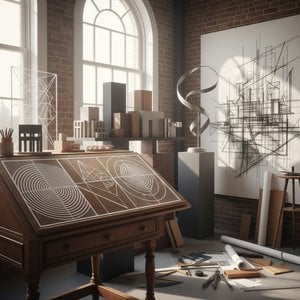
Geometric abstraction is a form of abstract art based on the use of geometric forms sometimes, though not always, placed in non-illusionistic space and combined into non-objective (non-representational) compositions. Although the genre was popularize...
The human brain functions as a sophisticated pattern-recognition machine, programmed from infancy to identify symmetry and repetition. In the context of high-end interior environments, this biological imperative becomes a tool for psychological regulation. When a gaze rests upon a set of parallel lines or interlocking triangles, the visual cortex activates with a specific intent, seeking order and anticipating the continuation of a logical pattern. This process reduces ambient visual noise, providing a sense of stability that is often absent in more chaotic, organic environments.
This neurological response finds its historical precedent in the early explorations of movement-defining artists like Wassily Kandinsky. Long before the advent of modern neurodesign, Kandinsky explored how specific geometric approaches could communicate spiritual and intellectual truths. His work suggested that the arrangement of shapes was not merely decorative but a method of directing the viewer's internal state. Today, we recognize this as the foundation of structured thinking; where straight lines and grids promote sequential, methodical thought, circles and spirals invite a more cyclical, iterative form of creativity.
The intentional use of these forms allows a designer to dictate the mental tempo of a room. A workspace defined by orthogonal compositions encourages planning and method, whereas a lounge utilizing softer, concentric geometries can foster a sense of controlled evolution and movement. By selecting works that exploit our ancestral wiring for symmetry, we create spaces that act as silent allies to human efficiency and focus.
Mathematical Harmony: The Precision of Proportion and Ratio in Composition
A proportion is a mathematical statement expressing equality of two ratios. a : b = c : d {\displaystyle a:b=c:d} a and d are called extremes, b and c are called means. Proportion can be written as a b = c d {\displaystyle {\frac {a}{b}}={\frac {c}{d...
True balance in art is rarely accidental; it is the result of rigorous mathematical truth. At the heart of the most enduring geometric compositions lies the concept of proportion—the mathematical statement expressing equality between two ratios. Whether through the use of the golden ratio or more complex geometrical proportions expressed as fractions, these works utilize the relationship between extremes and means to achieve a state of equilibrium that feels inherently "correct" to the observer.
This pursuit of mathematical perfection echoes the profound intellectual atmosphere of the Isaac Newton Institute for Mathematical Sciences in Cambridge. Within such institutions, the boundary between scientific logic and aesthetic beauty dissolves, revealing that complex equations often contain a hidden geometry as rhythmic as any brushstroke. The architecture of the Institute itself, with its graceful parabolic curves designed by Edward Cullinan, serves as a physical manifestation of this mathematical heart, proving that precision can produce profound grace.
In contemporary practice, integrating works that respect these ratios provides an anchor for large-scale installations. When a composition adheres to the cross-products property or precise geometric intervals, it achieves a structural clarity that transcends mere decoration. This mathematical integrity ensures that even the most minimal arrangement of shapes possesses a weight and presence that commands respect within a sophisticated architectural program.
Industrial Logic: Constructivism and the Aesthetic of Modernity
A Pioneer of American Abstraction: The Life and Art of Paul Kelpe Paul Kelpe, born in Minden, Germany in 1902, emerged as a pivotal figure in the development of abstract art within the United States. His journey, spanning both continents and artistic...
The twentieth century introduced a visual language that celebrated the machine age, moving away from decorative stylization toward an industrial assemblage. This was the essence of Constructivism, a movement founded by visionaries like Vladimir Tatlin and Alexander Rodchenko. They rejected the superfluous, focusing instead on faktura—the material properties of an object—and tektonika—its spatial presence. Their work reflected the energy of urban space and the burgeoning technological optimism of a modernizing society.
This era of industrial logic can be traced back to the radical proposals of Tatlin’s Tower, which sought to combine a machine aesthetic with dynamic, functional components. While the tower itself remained unbuilt, its influence permeated the Bauhaus and De Stiel movements, establishing a precedent for art that functions as an organized construction rather than a mere representation. The movement demanded that art participate in the reality of modern life, utilizing the very geometry of man-made objects to reflect the progress of civilization.
For the designer of contemporary hospitality spaces, this Constructivist legacy offers a way to celebrate urbanity and structure. Utilizing works that emphasize mechanical motifs—wheels, gears, or intersecting planes—can infuse a space with a sense of forward-looking innovation. It allows for an aesthetic that is both austere and powerful, mirroring the strength of modern architecture through the disciplined application of geometric form.
Chromatic Balance: Using Color to Anchor Abstract Geometry
Paolo Cotani: Exploring the Geometry of Emotion Paolo Cotani, born in Rome in 1940, is an Italian painter whose distinctive approach to abstraction has garnered international acclaim. His artistic journey began amidst the vibrant intellectual current...
While geometry provides the skeleton of a composition, color provides its pulse. In geometric abstraction, color is never used merely to fill space; it is employed as an anchor, a disruptor, or a source of tension. A single, well-placed square of blue within a grid can serve as a visual focal point that stabilizes an entire room, much like a structural pillar supports a grand hall. The interplay between contrasting hues generates a dynamic tension that prevents a minimalist composition from becoming static.
The artist Paolo Cotani exemplifies this mastery, utilizing bold palettes and simplified shapes to distill complex emotions into tangible forms. His work demonstrates how the juxtaposition of contrasting colors can generate a visceral feeling, proving that even the most intellectually rigorous geometric arrangements can resonate on an emotional level. The color does not obscure the geometry; rather, it amplifies its impact, directing the eye through the composition with intentionality.
In large-scale design, the choice of color within geometric art must be handled with extreme care to avoid overwhelming the architectural intent. Monochromatic or neutral palettes maximize the structuring effect of the shapes, promoting a sense of calm and clarity. Conversely, introducing a primary color can inject vitality into a space, making the artwork a central protagonist in the room's narrative. The goal is to achieve a chromatic harmony that supports, rather than competes with, the surrounding environment.
Spatial Dynamics: The Interplay of Line, Shape, and Void
Exploring Geometric Precision and Visual Harmony This captivating artwork invites viewers into a world of disciplined abstraction, where concentric circles and layered geometric forms create a mesmerizing visual rhythm. Its minimalist composition emp...
The true power of geometric abstraction lies in its ability to manipulate the perception of space without the use of illusionistic depth. By arranging lines, shapes, and negative space, an artist can create a sense of movement and dimension on a two-dimensional plane. This is particularly evident in works like those of Marcel Duchamp, where concentric circles and layered forms create a rhythmic, almost optical, sensation of depth and rotation.
This manipulation of the void is a fundamental principle found throughout art history, from the intricate patterns of Islamic art to the modern explorations of Suprematism. In these traditions, the use of geometric motifs serves to connect the physical space with a higher sense of order, using the "empty" areas of a composition to define the boundaries of the "filled" areas. The relationship between the shape and the void is what gives a painting its breath and its scale.
For the professional designer, understanding this spatial dynamic is essential when selecting works for varied wall dimensions. A composition with heavy, intersecting lines can ground a large, expansive wall, while a work focused on delicate, floating shapes can add lightness to a more enclosed area. The ability to control the perceived weight of a space through the strategic placement of geometric voids allows for a highly nuanced approach to environmental curation.
Curating Order: Integrating Geometric Abstraction into Large-Scale Hospitality Design
Integrating large-scale abstract works into hospitality environments requires a sophisticated understanding of logistics, durability, and guest impression. Whether commissioning a multi-panel triptych to span a grand staircase or selecting a singular, monumental canvas for a lobby, the artwork must function as an integral component of the architectural fabric. The selection process involves more than aesthetic preference; it requires consideration of scale, texture, and the way light interacts with the surface of the piece.
At WahooArt.com, we specialize in facilitating these complex requirements for interior designers and hospitality professionals. We offer a full-service approach to art procurement, from professional digital mockups that allow you to visualize a composition on your specific wall before production begins, to bespoke "multi-panel" layouts designed to flow seamlessly across wide architectural spans. Our artists, all holders of prestigious Fine Arts degrees, execute every hand-painted oil reproduction with meticulous attention to the physical texture—the impasto—that provides a depth far superior to any digitalprint.
Our commitment to excellence extends to the technicalities of global logistics and long-term preservation. We provide custom framing in solid woods, such as gold leaf or espresso, and ensure that every painting is finished with a protective Damar varnish to withstand the atmospheric demands of public spaces. With our dedicated Project Coordinators managing every step—from initial color matching to secure international shipping via DHL or FedEx—we ensure that your vision for an ordered, intellectually stimulating environment is realized with absolute precision.
Explore the profound legacy of American Modernism. From Geometric Abstraction to Abstract Expressionism, discover how this era redefined art history. Expert insights for elite collectors seeking to curate timeless, museum-quality masterpieces for their private collections.
Explore the profound influence of geometry and line in fine art. Discover how structural composition creates visual impact, from Cubist mastery to Op Art precision, and learn to curate sophisticated, mathematically balanced collections for discerning art connoisseurs.
Discover the profound connection between abstract geometry and human emotion. Explore how shapes like circles and squares reflect your true personality through an expert psychological lens, perfect for the discerning art collector seeking deeper meaning in their curated collection.
Explore 10 defining masterpieces of Geometric Abstraction! Discover Kandinsky, Mondrian & Malevich’s iconic works. Find museum-quality art reproductions and curated decor ideas to elevate your home at WahooArt.com.



 Geometric abstraction
 Paul Kelpe
 Paolo Cotani
 Rotoreliefs (Optical Discs) 1