The Dignity of the Mundane: Intimacy and Technical Mastery in Dutch Genre Painting

Explore the technical mastery and hidden symbolism of Dutch Golden Age genre painting. Discover the beauty of the everyday with our experts.
The Dignity of the Mundane: Intimacy and Technical Mastery in Dutch Genre Painting

The Descent from the Epic: Reorienting the Artistic Gaze

Jan Sanders van HemessenJan Sanders van Hemessen

Jan Sanders van Hemessen (c. 1500-1566) was a key Flemish Renaissance painter of the Romanist school, known for pioneering genre painting & moralizing scenes with contemporary detail. Influenced by Italian art, he foreshadowed Mannerism and developed

The seventeenth century in the Netherlands marked a profound departure from the established hierarchies of European art. While the academies of France and Italy continued to venerate the grand narratives of mythology and biblical epic as the highest calling, the Dutch Republic found its soul in a different direction. This was not an abandonment of skill, but a redirection of it. The economic prosperity of a newly independent nation, fueled by maritime trade and a burgeoning middle class, created a demand for art that mirrored the lived reality of its citizens rather than the distant legends of antiquity.

This shift is visible in the transition from the large-scale, didactic works of the sixteenth century to the intimate scale of the Dutch Golden Age. Where Jan Sanders van Hemessen once utilized large canvases to weave religious themes into complex compositions, later masters turned their attention inward. The focus moved from the heavens to the hearth. This was a revolution of perspective, where the importance of a subject was no longer measured by its proximity to the divine, but by its truthfulness to the human condition.

The echoes of this transition remain palpable in how we perceive value today. Just as the Dutch burghers found dignity in the depiction of their own commerce and domesticity, modern collectors often seek art that speaks to the tangible and the personal. The movement away from the monumental toward the intimate established a new standard for what art could achieve: the ability to find significance in the small, the quiet, and the local.

Shadow and Substance: The Architecture of Light in Small Spaces

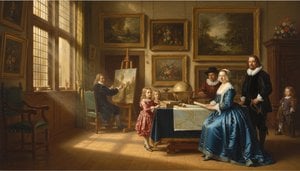
Room in a Dutch HouseRoom in a Dutch House

A Window into 17th-Century Domesticity Pieter Janssens Elinga’s “Room in a Dutch House” (1668) offers an intimate glimpse into the heart of everyday life during the Dutch Golden Age. This captivating oil on canvas, now residing at The Hermitage in St...

If there is a single heartbeat within Dutch Golden Age painting, it is the rhythmic pulse of light and shadow. This technique, known as chiaroscuro, became the definitive language of the era's masters. It was never merely an aesthetic choice; it was a psychological tool used to sculpt form and evoke emotion. In the hands of artists like Rembrandt van Rijn, light does not simply illuminate a scene; it reveals the very essence of the human spirit, pulling figures from an obsidian void into a state of profound visibility. In the smaller, more enclosed worlds of genre painting, light takes on a structural role. Consider the way sunlight might stream through an unseen window to define the edge of a pewter goblet or the texture of a linen cloth. In works such as those by Pieter Janssens Elysga, light actively shapes the room, defining depth and lending a sense of realism to the textures of wood and tile. This careful manipulation of illumination directs the eye, creating a sense of presence that makes the painted space feel inhabited and real. This mastery of light finds a historical parallel in the architectural innovations of the same period. The Royal Palace Amsterdam, designed by Jacob van Campen, utilizes monumental windows to flood its halls with natural light, much like the Dutch painters used light to animate their interiors. Both the architect and the painter understood that light is the fundamental element that transforms a mere structure or surface into a space of profound character and depth.

Hidden Narratives: The Moral Weight of the Mundane
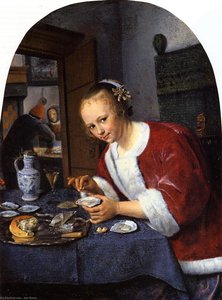
Girl Offering OystersGirl Offering Oysters

Girl Offering Oysters - A Window Into Dutch Golden Age Domestic Life Jan Havickszoon Steen’s “Girl Offering Oysters” stands as an exceptional testament to the artistic spirit of the Dutch Golden Age, capturing a moment of quiet industry and subtly hi...

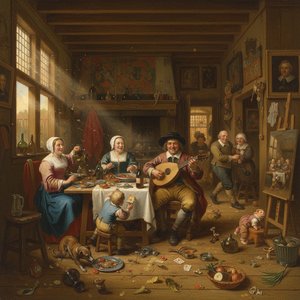
To the casual observer, a Dutch genre scene might appear to be nothing more than a simple depiction of daily life—a woman sweeping a floor, a man playing a lute, or a group of travelers at an inn. However, beneath this surface of realism lies a complex layer of symbolism and moral commentary. The Dutch masters were adept at embedding meaning within the mundane, using everyday objects as emblems of virtue, vice, or the transience of life. A single object could carry a heavy weight of interpretation. In Gabriel Metsu’s works, a poultry seller might appear to be engaged in simple commerce, yet the suggestive pose of a bird can hint at more scandalous undertones. Similarly, Jan Steen often used the "merry company" motif to illustrate the consequences of excess, sometimes even including literal notes on the canvas to clarify his moral lesson. Even the act of sorting seashells, as seen in Jan Havickszoon Steen’s work, can serve as a subtle allusion to the economic realities and social roles within a household. This tradition of finding deeper meaning in the everyday is mirrored in the history of religious art. In the sixteenth century, painters like Pieter Aertsen would foreground market scenes while tucking small, profound religious scenes into the background. The practice remains relevant; we continue to look for the narrative beneath the surface, understanding that the most profound truths are often hidden in plain sight, tucked within the details of a well-observed life.

Material Truths: The Technical Pursuit of Texture and Surface

Gerrit DouGerrit Dou

Explore the exquisite Dutch Golden Age paintings of Gerrit (Gérard) Dou (1613-1675). Known for his meticulous 'fijnschilder' style, genre scenes, and masterful use of light in candlelit interiors. Discover his legacy & works!

The allure of Dutch genre painting lies in its tactile precision. The artists of this period were obsessed with the physical reality of the world they depicted. They sought to capture the specific sheen of polished wood, the heavy drape of velvet, the cold glint of silver, and the delicate translucency of skin. This was achieved through a rigorous application of technique, often involving multiple layers of thin oil glazes that allowed light to penetrate the surface and reflect back with a luminous quality.

The *fijnschilders*, or fine painters, such as Gerrit Dou, pushed this pursuit of detail to its absolute limit, producing small-format works with a finish so smooth that brushstrokes were nearly invisible. This technical prowess allowed for a level of realism that was revolutionary. Whether it was the meticulous rendering of a weaver's tools in the work of Johannes Dircksz. van Oudenrogge or the dramatic, textured impasto of Rembrandt, the goal was always to honor the material truth of the subject.

This dedication to craftsmanship finds an echo in the modern collector's insistence on the physical integrity of a work. The distinction between a mere print and a proper reproduction lies in the weight of the medium and the presence of the artist's hand. Just as the Dutch masters relied on the quality of their pigments and the precision of their brushes to achieve realism, the preservation of an artwork's character depends upon the use of traditional materials, such as heavy cotton canvas and professional-grade oils, to ensure the surface retains its intended depth.

The Private Stage: Domesticity as a Social Chronicle

Frans HalsmuseumFrans Halsmuseum

A Window into Haarlem’s Golden Age: The Frans Hals Museum Nestled within two meticulously preserved historic buildings in the heart of Haarlem, Netherlands, the Frans Hals Museum is more than simply a repository of paintings; it's an immersive journe...

Ultimately, Dutch genre painting functioned as a social chronicle, documenting the values, roles, and aspirations of a society in transition. The domestic interior became a stage where the complexities of human interaction were performed. These paintings offered a window into the private lives of the middle class, celebrating the order, cleanliness, and quiet dignity that defined their world. From the tranquil musical performances in Gerard ter Borch’s interiors to the industrious scenes of women engaged in household tasks, these works captured the essence of a culture finding its identity. They were not merely decorations for the homes of burghers; they were reflections of their own stability and prosperity. The genre painting allowed the viewer to identify with the subjects, finding a sense of shared humanity in the quiet moments of contemplation or the simple joys of a family evening. This tradition of using art to document the essence of an era continues through the preservation of these works in institutions like the Frans Halsmuseum or the Mauritshuis. These collections do more than store paintings; they maintain a connection to the lived experience of the past. By studying these domestic scenes, we gain an understanding of how humanity has always sought to find meaning within the walls of the home, turning the private sphere into a lasting legacy of cultural identity. At WahooArt.com, we honor this legacy of craftsmanship and observation. Whether through our bespoke oil reproductions that capture the tactile depth of the Old Masters or our custom portrait services that transform modern memories into historical masterpieces, we remain dedicated to the art of the profound and the personal.