


The Barbizon School: Atmospheric Tension and Naturalist Roots
 Landscape with Cattle at Limousin
The Drama of the Pastoral: Capturing Movement in Dupre's Landscape To stand before Jules Dupré’s Landscape with Cattle at Limousin is to be enveloped by a moment suspended between tranquility and impending drama. This magnificent oil on canvas, datin...
To observe the works of the Barbizon School is to witness a departure from the staged, idealized landscapes of the previous century toward a more visceral engagement with the earth. This movement prioritized direct observation, seeking to capture the weight of the atmosphere rather than merely documenting scenery. In the early nineteenth century, the French Academy upheld a strict aesthetic code, requiring artists to emulate the Neoclassical traditions of the Renaissance and classical antiquity. Jean-Baptiste-Camille Corot moved against this restriction. In his work Les hauteurs de Sèvres — Le chemin Troyon (1835-40), the focus shifts toward the immediate reality of the terrain, capturing a sense of light and shadow that moves beyond the rigid compositions of the Academy.
This commitment to naturalism was a rejection of academic artifice in favor of the en plein air tradition. Artists often gathered at the Auberge Ganne to share technical practices and discuss the shifting light of the Forest of Fontainebleau. They sought to record the textures of foliage and the subtle movement of herds. This grounded the viewer in a landscape that felt palpably alive. Instead of the polished, mythological vistas favored by the Salon, these painters offered the weathered reality of the French countryside.
Impressionism: The Pursuit of Light and Fleeting Moments
 The Boulevard Montmartre at Night
The Boulevard Montmartre at Night, Camille Pissarro
The Barbizon painters, who gathered at the Auberge Ganne to discuss technical practices, were among the first to embrace the en plein air method, bringing their pigments directly into the Forest of Fontainebleau. This departure from the studio allowed for a more direct engagement with the natural world. The Impressionists, including Claude Monet and Pierre-Auguste Renoir, took this precedent and expanded it into a radical investigation of light. While the Barbizon school focused on the weight of the atmosphere and the tangible textures of the landscape, the Impressionists sought to capture the fleeting, transient qualities of perception.
This evolution moved the focus from the permanence of the subject to the immediacy of the visual sensation. The brushwork became more fragmented, capturing the way light dissolves form and color in a single, unrepeatable moment. For the collector, this shift represents a move toward the study of light's movement across a surface. These works offer a sensory experience of the world, where the emphasis lies in the immediate impression of a scene rather than its formal, academic structure. The value of such works resides in their ability to freeze a momentary perception, providing a window into the rapid shifts of light and atmosphere.
Landscape Evolution: From Formal Symmetry to Romantic Freedom
 French landscape garden
The French landscape garden (French: jardin anglais, jardin à l'anglaise, jardin paysager, jardin pittoresque, jardin anglo-chinois) is a style of garden inspired by idealized romantic landscapes and the paintings of Hubert Robert, Claude Lorrain and...
The Industrialized Pastoral: Preserving a Vanishing Rurality
 Jean-Baptiste-Camille Corot
Discover Jean-Baptiste-Camille Corot (1796-1875), the master of atmospheric landscapes bridging Neoclassicism & Impressionism. Explore his serene paintings and lasting influence on art history.
As the industrial revolution reshaped the European continent, a new form of landscape art emerged, driven by a desire to document a world on the cusp of disappearance. The work of the Vermorel studio exemplifies this period, acting as a collective visual record of a France undergoing rapid modernization. Unlike the romanticized views of earlier eras, these works often focused on the dignity of labor and the changing face of agriculture. Through depictions of wheat fields and grain markets, the studio captured the transition from traditional farming to a more mechanized reality.
This sense of nostalgia for a vanishing way of life finds a parallel in the works of Jean-Baptiste-Camille Corot. In his later, more lyrical landscapes, Corot often rendered the French countryside with a soft, atmospheric quality that seemed to anticipate the loss of the old order. Much like the Vermorel studio, Corot’s approach provides a snapshot of a landscape being altered by social and economic shifts. Both bodies of work share a quiet respect for the subject matter, treating the changing agricultural landscape not with mourning, but with a recognition of its historical significance.
Provençal Permanence: Regional Identity in Art
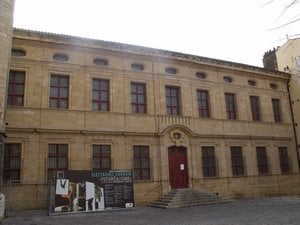 Granet Museum
A Provençal Sanctuary of Art: Exploring the Musée Granet Nestled in the sun-drenched heart of Aix-en-Provence , a city where history breathes through every cobblestone, lies the Musée Granet —a profound sanctuary for those who seek the eternal dialog...


