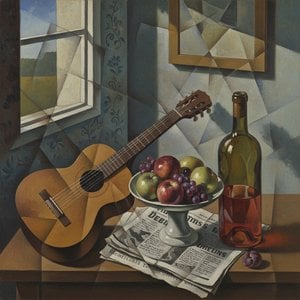
The Geometric Seed: Paul Cézanne and the Reduction to Essential Volume
Before the radical fracturing of the twentieth century, a quiet structural revolution was already underway in the late nineteenth-century ateliers. Paul Cézanne did not seek to destroy the object, but rather to reveal its skeletal truth. He approached the landscape not as a collection of fleeting light, but as a rigorous arrangement of fundamental volumes. In his studies of Montagne Sainte-Victoire, he sought the underlying permanence of the world by reducing nature to the cylinder, the sphere, and the cone. This was an attempt to find stability within the visual field, a pursuit of the essential structure that exists beneath the surface of perception.
This disciplined approach provided the necessary foundation for the Cubist experiment. When Pablo Picasso and Georges Braque began their explorations, they did not invent the idea of geometric reduction; they simply pushed Cézine’s logic to its inevitable conclusion. Where Cézanne used geometry to anchor the subject, the Cubists used it to dismantle it. The transition from the solid volumes of the late nineteenth century to the splintered facets of 1908 marked a shift from observing structure to actively deconstructing it.
Dissolving the Fixed Lens: Analytical Cubism versus Renaissance Perspective
For centuries, Western painting operated under the tyranny of a single, fixed viewpoint. The Renaissance tradition established a window-like illusion, a mathematical precision that forced the viewer into a static position, frozen in time and space. Analytical Cubism, emerging between 1908 and 1912, sought to shatter this singular perspective. By breaking objects into multiple facets and intersecting planes, artists like Braque in Le Portugais allowed the eye to move across the subject, experiencing various angles simultaneously. This concept of simultaneity rejected the snapshot quality of traditional realism in favor of a more complete, albeit fragmented, understanding of form.
This intellectual rigor finds its echo in the scientific shifts of the era, particularly the burgeoning theories regarding relativity that challenged the notion of absolute space and time. Just as physics began to suggest that observation is inextricably linked to position, Analytical Cubism presented a reality that was no more fixed than the movement of the viewer's own gaze. In works such as Portrait of Ambroise Vollard, the subject is not merely seen; he is analyzed through a muted palette of ochre, grey, and brown, ensuring that the complexity of the form remains the primary focus rather than the distraction of color.
Reconstructing Reality: Synthetic Collage and the New Surface
As the movement progressed toward 1912, the cerebral intensity of the analytical phase gave way to a more tactile, additive approach known as Synthetic Cubism. If the earlier period was about dissection, this era was about assembly. Artists began to reconstruct objects from disparate, often non-artistic elements, introducing the revolutionary technique of collage. In Picasso’s Still Life with Chair Caning, the integration of oilcloth and newspaper fragments transformed the canvas from a window into a physical object in its own right. The surface became a site of construction, where texture and pattern were as vital as line and shade.
This shift toward the additive mirrors the broader evolution of modern design, where the boundaries between high art and applied craft began to blur. The use of wood-effect paper, fabric scraps, and typography introduced a directness and a decorative legibility that had been absent in the monochromatic density of the analytical years. This period proved that reality could be rebuilt from the fragments of the everyday, creating a new visual language that was both more accessible and more layered with the textures of modern life.
Chromatic Dynamism: Orphic Cubism and the Liberation of Color
While the primary Cubist lineage often focused on structural analysis, a parallel current known as Orphic Cubism sought to infuse the movement with light and rhythm. Named by the poet Guillaume Apollinaire, this branch moved away from the somber tones of Braque and Picasso toward a more luminous, musical exploration of color. Artists such as Robert Delaunay utilized overlapping colored circles to evoke the dynamism of light and motion. In works like Prismes électriques, the focus shifted from the deconstruction of physical objects to the expressive power of pure, rhythmic color.
This pursuit of a total, sensory art finds its most profound expression in the work of Sonia Delaunay. Her ability to translate Cubist principles into textiles, furniture, and fashion demonstrated that the movement's impact extended far beyond the gilded frame. By applying the concept of simultaneity to pattern and hue, she bridged the gap between the avant-garde painting and the lived environment, proving that the fragmentation of form could be used to create a cohesive, vibrant aesthetic for the modern world.
The Primal Influence: African Artistry and the Angularity of Form
The radical aesthetic of early Cubism was not solely a product of European intellectual evolution; it was deeply informed by the encounter with non-Western artistic traditions. The stylized, often brutal angularity found in Picasso’s Les Demoiselles d’Avignon bears the unmistakable imprint of African masks and sculptures. These objects were valued by the Cubists not for their ethnographic context, but for their ability to convey profound meaning through abstraction and the rejection of naturalistic proportion. The use of sharp, geometric planes and distorted features provided a template for breaking away from the exhausted traditions of Western mimicry.
This encounter with the "other" allowed the Cubists to tap into a more primal, symbolic way of representing the human condition. By adopting the expressive power of these stylized forms, they were able to move beyond mere representation toward a more potent, psychological realism. The fragmentation of the figure became a tool for exploring the complexities of identity and the raw energy of existence, ensuring that Cubism would remain a movement rooted in both the cutting edge of modern science and the deep, enduring power of ancestral form.
At WahooArt.com, we appreciate the profound complexity found within these fragmented histories. Whether you are seeking a hand-painted oil reproduction of an Analytical masterpiece or a custom commission that reimagines your own history through a Cubist lens, our artists bring academic excellence to every canvas. We invite you to explore our collection and discover how the architecture of the past continues to shape the beauty of the present.
Explore the revolutionary world of Cubist Still Life with WahooArt. Discover Picasso & Braque's groundbreaking techniques, its philosophical roots, and lasting impact on modern art. Expert insights for collectors.
Explore the revolutionary world of Cubism with WahooArt. Discover Picasso & Braque's groundbreaking techniques, its philosophical roots, and lasting impact on modern art. Expert insights for collectors.
Explore Orphism, the vibrant abstract art movement pioneered by Robert & Sonia Delaunay. Discover its unique color theory, lasting influence on modern art, and how to bring this 'symphony of color' into your home with WahooArt.