The Allure of Green: A Historical Overview From the earliest cave paintings depicting lush prehistoric landscapes to the vibrant canvases of modern masters, green has held a unique and often complex position within the artistic realm. Unlike some col...
A room anchored by deep, verdant tones possesses an immediate, quiet authority. Unlike the more assertive presence of crimson or the celestial distance of blue, forest green offers a grounded stability that settles the eye. It provides a sense of organic depth, acting as a visual anchor that suggests both permanence and life. In contemporary interiors, this palette functions as a psychological retreat, offering a moment of stillness amidst the frenelled pace of digital existence.
This capacity for grounding is mirrored in the historical weight of the color itself. In ancient Egyptian funerary art, the use of malachite pigments was far from accidental; it represented rebirth and the protective power of vegetation. To bring these tones into a modern space is to invite that same sense of renewal and enduring strength. The color does not demand attention through volume, but rather through its ability to cultivate an atmosphere of profound tranquility.
Pigment and Permanence: The Technical Evolution of Green
The Alchemy of Pigment: The Historical Evolution and Chemistry of Green Verdant Visions: Exploring the Symbolism & Aesthetic Impact of Green in Art History The Allure of Green: A Historical Overview From the earliest cave paintings depicting lush pre...
The history of green in fine art is, at its core, a narrative of scientific triumph over chemical instability. For centuries, the pursuit of a lasting green was one of the most daunting challenges for any painter. Early pigments were often fugitive, prone to fading under light or shifting into unappealing ochres as the medium aged. This technical fragility lent the color an unintended association with transience and decay, mirroring the very organic life it sought to represent.
The emergence of synthetic pigments revolutionized this landscape. The introduction of emerald green, colored by its chromium content, and the later arrival of Phthalo Green, changed how artists captured the essence of nature. These newer hues offered a transparency and staining capability that allowed for much richer, more layered compositions. This technical progression enabled the transition from mere documentation to an emotional experience of color, where the depth of a sun-drenched canopy could finally be rendered with true fidelity.
Growth and Decay: Navigating the Dual Symbolism of the Natural World
Introduction To step into a forest is to enter a sanctuary of shifting light and whispered secrets, a realm where the boundary between the earth and the sky becomes beautifully blurred. For centuries, the forest has served as one of the most profound...
Green occupies a complex position in our collective consciousness, existing simultaneously as a symbol of fertility and a reminder of mortality. The etymological roots of the word itself—linked to "grow" and "grass"—point toward an inherent connection to vitality. Yet, this same verdancy can signify the process of decomposition, where lushness eventually gives way to the earth. This duality allows the color to represent the entire cycle of existence, from the first sprout of spring to the heavy shadows of a late summer forest.
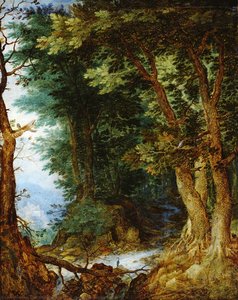
This tension is palpable in the works of the Northern Renaissance. In the intricate compositions of artists like Jan Brueg_hel the Elder, the forest landscape is not merely a backdrop but a living entity. His 1610 work, for instance, utilizes deep, velvety shadows and pockets of soft luminescence to create a sense of mystery. The greenery here is both life-affirming and enigmatic, suggesting a realm that exists between the waking world and deep contemplation.
The Forest as Sanctuary: Exploring Solitude through Landscape Traditions
Explore 'Landscape at Fontainebleau Forest' by Abbott Thayer (1876). This Impressionistic landscape showcases light & shadow in a serene forest scene, evoking peace and solitude.
The forest has long served as one of the most profound metaphors in human expression—a site of both primordial terror and spiritual rebirth. In Western art, particularly during the Romantic era, the woods became a stage for the sublime, where the greatness of nature could dwarf the individual. This tradition established the forest as a place of solitude, an environment that invites quiet introspection and a reconnection with the ancestral wild.
This sense of sanctuary is beautifully articulated in the Tonalist-influenced works of contemporary artists like Robert Green. His landscapes, rooted in the raw beauty of Alaska, utilize subtle gradations of light and shadow to capture a palpable sense of tranquility. By focusing on the atmosphere rather than mere topography, such works allow the viewer to experience the forest as a meditative space, far removed from the noise of civilization.
Light Through the Canopy: Mastering Depth with Tonalist Gradations
Anthony Eric Sandall Green (1939–2023): A Painter's Journey Through Landscape and Symbol Anthony Eric Sandall Green RA (born September 30, 1939 – died February 14, 2023) was a British realist painter and printmaker whose distinctive style captivated ...
Achieving true depth in a landscape requires more than just the application of color; it requires a mastery of light filtration. The most successful depictions of woodland scenes are those that capture the way light interacts with a dense canopy, creating an interplay between heavy shadows and ethereal glows. This technique, often involving the use of impasto to give foliage a sculptural quality, transforms a flat surface into a three-dimensional experience.
This manipulation of light finds a sophisticated parallel in the works of Anthony Green. Through the meticulous use of glazing techniques—applying multiple layers of translucent paint—he achieves a remarkable luminosity that mirrors the complexities of the natural world. His ability to build depth through light and shadow allows the viewer to feel the weight and texture of the scene, much like the historical masters who used chiaroscuro to breathe life into their landscapes.
Curating Atmosphere: Integrating Deep Greens into Sophisticated Design
A Vision of Geometric Serenity Monolithic Emerald Grid: A Meditative Study in Sculpted Forest Green Textures is a profound exploration of minimalism, offering a fresh and modern perspective on structural abstraction. This piece presents a hypnotic 4x...
For the discerning collector or designer, integrating forest green into a space is an exercise in curation rather than mere decoration. The goal is to create an emotional landscape within the home. Whether through a large-scale reproduction of a classical landscape or a modern, minimalist study in texture, such as Laurent Vionnet’s geometric explorations of emerald tones, the color should be used to define the room's character.
When selecting works for a professional or private collection, one must consider how these verdant tones interact with light and existing textures. A hand-painted oil reproduction, with its visible brushstrokes and deeper tonal range, offers a tactile soul that a simple print cannot replicate. By carefully placing these works, one can transform a room into a sanctuary of quiet drama, ensuring that the art does not merely sit upon the wall but actively participates in the architecture of the space. At WahooArt.com, we specialize in providing these museum-quality connections to history, offering bespoke services to ensure every commission perfectly complements your curated vision.
Explore the profound history of forest green in art history. From the organic depth of Sap Green to Impressionist light, discover how masters captured nature's vitality in museum-quality oil reproductions and fine art masterpieces.



 Verdant Visions: Exploring the Symbolism & Aesthetic Impact of Green in Art History
 Deep Verdant Depths: Exploring the Majesty of Forest Green in Masterpiece Paintings
 Enchanted Woodlands: Top 10 Masterpieces Exploring the Magic of Forests
 Landscape at Fontainebleau Forest
 Anthony Green
 Monolithic Emerald Grid: A Meditative Study in Sculpted Forest Green Textures


