Arrival at the Canvas: The Line as a Point in Motion Beyond Shapes: Top 10 Masterpieces That Redefine Abstract Art Introduction To step into the world of abstract art is to abandon the safety of the recognizable and embark on a journey through pure e...
Every significant mark on a canvas begins with a singular moment of intent, a dot that decides to move. As the artist Paul Klee famously observed, a line is simply a dot that went for a walk. This fundamental movement serves as the DNA of all visual expression, providing the first dimension of space upon a flat surface. When we observe the transition from static points to active trajectories, we begin to understand how an artist records their physical presence within a composition.
In the early experiments of the twentieth century, this movement became a way to capture the unseen. In the works of Wassily Kandinsky, particularly his 1916 Abstract Composition, we witness lines that range from thick, heavy strokes to shaky, uncertain movements. These are not merely marks; they are the tracks left by an artist’s movement through thought and space. By using fluid lines to suggest the vibrations of symphonic music or organic forms, Kandinsky transformed the line into a record of a physical gesture.
This transition from a point to a path allows for the birth of rhythm. In the hands of a master, a line can become a pulse. This is evident when observing how artists use repetition to guide the eye, creating a sense of direction that feels both inevitable and spontaneous. The movement of the hand, captured through the medium of ink or paint, remains the primary messenger of the artist's initial contact with the void.
Structural Gravity: How Directionality Establishes Stability
Abstract Composition [Triptych] by Vaclav Vytlacil (1937). Explore this dynamic black & white triptych featuring bold lines, textures & geometric shapes. A key example of American modernism.
Beyond the movement of a single point, lines establish the gravity of a composition. There is an inherent psychological weight to directionality that we feel before we can even name it. The orientation of a line dictates the energy level of the entire work, acting as a silent guide for the viewer's emotional response.
Horizontal lines act as the foundation of repose; they suggest the horizon, the earth, and a sense of quiet stability. They lower the energy of a piece, inviting a state of contemplation or rest. Conversely, vertical lines introduce a different tension—one of strength, growth, and authority. They reach upward, pulling the viewer's gaze toward height and permanence. This structural logic is visible in the precise, mathematical graphite lines found in Barbara Hepworth’s Project for Wood and Strings, where line is used to suggest three-dimensional space through controlled direction.
This sense of stability can also be disrupted by diagonal lines, which suggest motion and action, creating higher energy levels. We see this tension in the works of Piet Mondrian, such as The Grey Tree, where bold, crossing lines suggest overlapping branches, creating a dynamic effect that moves away from the stillness of the horizon. By manipulating these directions, an artist can dictate whether a viewer feels a sense of calm or a surge of kinetic energy.
The Weight of the Stroke: Exploring Thickness and Texture
Vibrant Abstraction: A Dance of Color and Light Gerhard Richter's "Abstract Painting 780-1" is a mesmerizing exploration of color, texture, and movement. Created in 1992, this piece exemplifies Richter's mastery of abstract expressionism, offering a ...
The quality of a line is profoundly affected by the material used to create it. Whether through charcoal, pencil, or heavy oil paint, the thickness and texture of a stroke communicate volume and presence. An artist can manipulate the width of a mark by changing their grip; holding a tool in an overhand grip allows for the use of both the sharp point and the side of the lead, creating a rich variety of thick and thin lines.
This variation is essential for creating the illusion of form. When an artist uses thick and thin lines, the eye reads the thinner marks as areas of light and the thicker marks as shadows or weight. This technique is evident in the works of John Howard Jephcott, whose luminous landscapes use varied line weights to capture the atmosphere of nature. Similarly, the heavy, wavy lines around the eyes in Van Gogh’s Portrait of Dr. Gachet create a sense of psychological depth and physical texture.
In more modern contexts, this weight becomes even more tactile through the use of impasto. In the works of Gerhard Richter, such as Abstract Painting 780-1, the thick layers of paint build up to create a three-dimensional effect. Here, the line is no longer just a boundary; it is a physical ridge of pigment that catches the light. This heavy texture adds a sculptural quality to the canvas, inviting the viewer to engage with the materiality of the paint itself.
Psychic Connections: Implied Lines and Mental Links
Introduction To step into the world of abstract art is to abandon the safety of the recognizable and embark on a journey through pure emotion, rhythm, and form. It is an invitation to stop asking what a painting represents and instead begin feeling h...
Not all lines are visible to the eye. Some of the most powerful connections in art are those that exist only in the mind of the viewer. These are known as implied or psychic lines, formed by dashes, dots, or the direction of a gaze. They do not exist as continuous marks on the surface, yet they create a mental connection between two or more objects, guiding the eye around the picture plane.
A classic example of this can be found in works that utilize the direction of eyes to create tension. In certain historical compositions, such as those following the tradition of Hieronymus Bosch, the gaze of various figures acts as a psychic line, leading the viewer from one character to another, often revealing a hidden narrative or a moment of deception. These invisible threads hold the composition together, creating a web of interaction that transcends the physical marks on the canvas.
This concept extends to how we group elements through proximity. By placing dots or short dashes near one another, an artist can suggest a continuous path or a boundary without ever drawing a solid line. This allows for a more subtle, sophisticated way of directing attention, making the viewer an active participant in decoding the hidden structure of the artwork.
The Satirical Mark: Deconstructing the Painted Gesture
Brushstrokes is a 1965 oil and Magna on canvas pop art painting by Roy Lichtenstein. It is the first element of the Brushstrokes series of artworks that includes several paintings and sculptures. As with all of his Brushstrokes works, it is in part a...
In the later stages of abstraction, the expressive line was sometimes used not to express raw emotion, but to comment on the very nature of expression itself. This period saw a fascinating shift where the "spontaneous" gesture became a subject of scrutiny and even parody.
Roy Lichtenstein’s Brushstrokes series serves as a primary example of this intellectualized approach. While the works appear to depict the energetic, dripping paint characteristic of Abstract Expressionism, they are actually highly controlled, mechanical renderings. Using techniques inspired by comic books, Lichtenstein drew "drips" that were actually precise, calculated marks. This was a satirical response to the perceived bravado of gestural painting, turning the idea of an impulsive stroke into a premeditated, graphic element.
This movement demonstrates that the line can be used as a tool for critique. By mimicking the appearance of a thick, expressive brushstroke through a flattened, commercial style, Lichtenstein challenged the hierarchy of "authentic" emotion in art. It reminds us that even the most familiar marks can be recontextualized to question our understanding of sincerity and technique in the modern era.
At WahooArt.com, we believe that every stroke tells a story worth preserving. Whether you are drawn to the fluid, musical lines of Kandinsky or the bold, textured layers of Richter, our collection offers hand-painted oil reproductions that capture the true physical essence of these historical movements. We invite you to explore our catalog and bring the profound language of the expressive line into your own space.
Explore the profound emotional depth of Cubism. From geometric abstraction to the soul's rhythm, discover how fragmented forms evoke universal truths through our expert art history insights and museum-quality hand-painted reproductions.
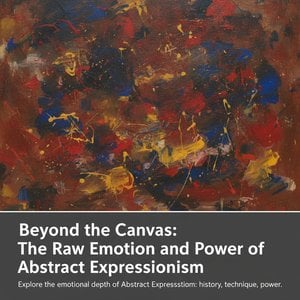
Explore the profound emotional depth of Abstract Expressionism. From the visceral energy of Action Painting to the serene beauty of Color Field, discover the history and mastery behind this transformative movement for the discerning art collector.
Embark on a visual journey through the top 25 masterpieces of Paul Klee. Explore his iconic use of color, rhythm, and abstraction through museum-quality stories and art reproductions. Find perfect inspiration for your decor. Discover all masterpieces on WahooArt.com.
Discover the profound connection between abstract geometry and human emotion. Explore how shapes like circles and squares reflect your true personality through an expert psychological lens, perfect for the discerning art collector seeking deeper meaning in their curated collection.



 The Architecture of Feeling: Decoding the Emotional Resonance of Expressive Lines in Abstract Art
 Abstract Composition [triptych]
 Abstract Painting 780-1
 Beyond Shapes: Top 10 Masterpieces That Redefine Abstract Art