The Essence of Expressionism: Beyond Visual Representation
To understand the soul of Expressionism, one must first abandon the pursuit of mere mimesis. Unlike the Impressionists, who sought to capture the fleeting dance of light upon a surface, or the Realists, who documented the unvarnable truths of social existence, the Expressionists turned their gaze inward. They were not interested in how a landscape looked under the midday sun, but rather how that landscape felt during a moment of profound existential dread or ecstatic joy. This movement emerged as a visceral reaction to the rapid industrialization and urban alienation of the early 20th century, seeking to strip away the veneer of polite society to reveal the raw, often turbulent, human psyche beneath.
In this artistic revolution, the subject matter became secondary to the subjective experience. A portrait was no longer a study of anatomical precision but a map of psychological tension; a forest was not a collection of trees but a swirling vortex of spiritual energy. By prioritizing inner necessity over external accuracy, Expressionism redefined the boundaries of what art could communicate. It offered a language for the unspeakable—the anxieties, the passions, and the profound dislocations of the modern era. For the discerning collector, an Expressionist work offers more than aesthetic pleasure; it provides a window into the very essence of human feeling, captured through a lens that refuses to look away from the truth.
The Pioneers of Raw Emotion: From Munch to Kirchner
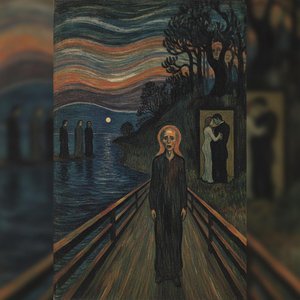
The lineage of Expressionism is anchored by figures whose names evoke the very concept of emotional intensity. At the vanguard stood Edvard Munch, a master of the psychological landscape. His works, such as the haunting Commitment (Attraction), utilize distorted figures and a sense of rhythmic instability to evoke deep-seated anxiety and the complexities of human intimacy. Munch’s ability to translate the invisible tremors of the soul into visible, sweeping strokes laid the groundwork for an entire generation of artists to explore the darker recesses of the subconscious.
As the movement matured, groups like Die Brücke (The Bridge) in Germany brought a new, jagged energy to the canvas. Ernst Ludwig Kirchner, a central figure of this group, utilized bold, clashing colors and sharp, angular forms to depict the frenetic pulse of urban life. In masterpieces such as Herrenbildnis or his depictions of Berlin street scenes, Kirchner captures the alienation of the modern individual amidst the crowd. His work often features a sense of claustrophobia and tension, achieved through a deliberate rejection of traditional perspective. Alongside him, artists like Arthur Segal and Aurel Bordenache further expanded this vocabulary, blending Expressionist fervor with elements of Dadaism and Cubism to create works that are as intellectually stimulating as they are emotionally arresting.
Visual Language: Distorted Forms and the Power of Color
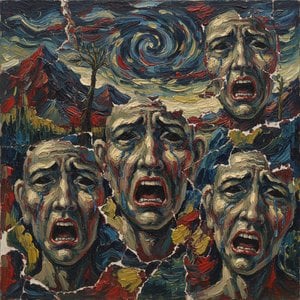
The technical brilliance of Expressionism lies in its radical departure from traditional aesthetics. The movement’s visual vocabulary is built upon the deliberate use of distortion and non-naturalistic color to achieve emotional resonance. Artists abandoned the subtle gradations of light and shadow in favor of heavy, often impasto, brushstrokes that lend a tactile, three-dimensional quality to the canvas. This texture does not merely sit upon the surface; it vibrates with the energy of its creation, making the artist's physical movement an integral part of the narrative.
Color, in the hands of an Expressionist, is used as a psychological tool rather than a descriptive one. A sky might be rendered in a bruised purple to signal mourning, or a face might be splashed with sickly greens to suggest decay and malaise. This chromatic autonomy allows the artist to dictate the emotional temperature of the piece. When combined with distorted forms—elongated limbs, tilted horizons, and fragmented planes—the result is a visual experience that bypass enough to unsettle the viewer. For the collector, these technical choices create a "living" quality in the artwork, where the interplay of pigment and texture invites continuous reinterpretation and deep emotional engagement.
Expressionism in the Modern Era: Legacy and Contemporary Influence
The echoes of the Expressionist movement can be heard across the entire spectrum of modern and contemporary art. The movement’s emphasis on the artist's subjective truth paved the way for Abstract Expressionism, where artists like Jackson Pollock pushed the concept of emotional gesture to its ultimate, non-representational conclusion. The raw, gestural energy found in the works of mid-century masters is a direct descendant of the early 20th-century pioneers who first dared to prioritize feeling over form.
Today, we see the spirit of Expressionism alive in contemporary painters who utilize evocative narratives and poignant, often abstract, forms to address modern themes of identity, trauma, and global connectivity. Artists like Ira Norminsky continue this tradition, blending elements of abstraction with deeply moving human stories. The movement’s legacy is not found in a specific style, but in a fundamental permission granted to all subsequent artists: the permission to use the canvas as a site for profound psychological exploration, unconstrained by the requirement of literal accuracy.
Curating Intensity: Integrating Expressionist Works into Private Collections
Integrating Expressionist works into a private collection requires a nuanced understanding of both art history and interior composition. Because these pieces are characterized by their high emotional frequency and visual impact, they often serve as the gravitational center of a room. A single, powerful Expressionist canvas can transform a minimalist space, providing a much-needed layer of depth, texture, and narrative complexity. When selecting works, collectors should consider how the intense color palettes and energetic brushwork will interact with the existing light and architecture of their environment.
For those looking to expand their collection, there are various avenues of acquisition. While original museum-grade masterpieces remain the pinnacle of achievement, the tradition of high-quality reproduction allows for a more accessible way to experience this movement. At WahooArt.com, we specialize in bringing these intense historical moments into the modern home through meticulously handcrafted oil reproductions. Our artists, trained in prestigious academies, apply the same layers of texture and passion found in the originals, ensuring that the "soul" of the Expressionist movement is preserved. Whether through a bespoke commission that reimagines a personal memory in an Expressionist style or a museum-quality Giclée print, we provide the means to curate a collection that is not only visually stunning but emotionally profound.