


The Quiet Revolution: From Sacred Narratives to the Rise of Genre Painting
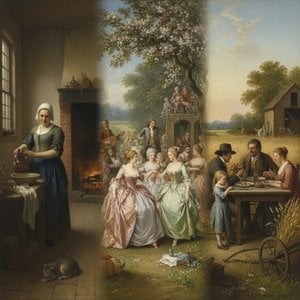 Scenes of Daily Life: A Comprehensive Exploration of Genre Painting Through History
The Rise of Genre Painting: From Religious Narrative to Everyday Life Wikipedia: Genre painting Genre painting (or petit genre) is the painting of genre art, which depicts aspects of everyday life by portraying ordinary people engaged in common activ...
For centuries, the grand stage of Western art was reserved for the monumental and the divine. The canvas served as a pulpit for biblical epics, a theater for mythological legends, and a mirror for the untouchable nobility. To gaze upon a masterpiece in the Renaissance or early Mannerist era was to encounter the extraordinary—the celestial, the heroic, and the mythic. However, a subtle yet profound shift began to stir within the 16th century, a quiet revolution that redirected the artist's gaze from the heavens toward the earth beneath our feet. This movement, known as genre painting or petit genre, did not emerge through an abrupt rupture but rather through a gradual widening of the artistic lens.
Initially, these glimpses of the mundane were mere footnotes within larger religious compositions—a meticulously rendered kitchen scene glimpsed through a window or the realistic depiction of peasant clothing in a Nativity scene. Yet, as artists like Joachim Beuckelaer and Pieter Aertsen began to weave complex moral narratives into displays of food and goods, the commonplace began to acquire its own weight. These works often carried hidden religious symbolism, reminding viewers of earthly transience even amidst abundance. This evolution laid the essential groundwork for a new era where the identity of the subject mattered less than the truth of their existence, paving the way for an art form that celebrated the dignity of the human condition in its most unadorned state.
The Dutch Golden Age: Capturing Intimacy and Domestic Tranquility
 LE DUO CHANTEUSE ET JOUEUR DE LUTH THEORBE
LE DUO CHANTEUSE ET JOUEUR DE LUTH THEORBE – A Window into Dutch Golden Age Intimacy Gerard ter Borch’s “Le Duo: chanteuse et joueur de luth théorbé,” painted around 1669-1670, stands as a quintessential example of Dutch genre painting—a movement tha...
As the 17th century dawned, the Netherlands became the vibrant epicenter of this newfound fascination with the everyday. The Dutch Golden Age was a period of unprecedented prosperity, yet its most enduring artistic legacy lies not in the depiction of wealth, but in the mastery of intimacy. Within the modest interiors of Dutch homes, painters sought to capture the fleeting essence of a moment, imbuating domestic life with a psychological depth that remains unparalleled. This era saw the rise of specialists who could transform a simple room into a profound meditation on light and presence.
Consider the captivating works of Gerard ter Borch, particularly his masterpiece Le Duo: chanteuse et joueur de luth théorbé. In this serene domestic tableau, the artist utilizes a dark, minimalist background to heighten the visual impact of the figures at the center—a man diligently playing a lute and a woman gracefully singing. There is no grand historical drama here, only the quiet, rhythmic beauty of musical expression within a familial setting. Similarly, the influence of masters like Johannes Vermeer and Pieter de Hooch can be felt in the way light dances across a tabletop or settles upon a letter being written. These artists understood that true grandeur is found in the subtle interplay of shadow and silk, in the stillness of an afternoon, and in the profound sanctity of a shared, quiet moment.
Romantic Realism: Finding Emotional Depth in the Commonplace
 Romantic Realism's Finest: 10 Masterpieces for Your Home | WahooArt
Introduction To gaze upon these ten masterpieces is to step into a world suspended between dream and reality, where the raw power of human emotion collides with meticulous observation. The Romantic Realism movement, though relatively short-lived, lef...
Moving into the mid-19th century, the art world encountered another transformative movement: Romantic Realism. Emerging as a sophisticated reaction against both the rigid idealism of classicism and the cold, mechanical progression of industrialization, this movement sought to depict life exactly as it was—yet with an added layer of soulful resonance. It was a period where the raw power of human emotion collided with meticulous observation, creating a world suspended between dream and reality.
< 1p>Artists such as Courbet, Millet, and Daumier dared to portray the laboring classes and the complexities of urban existence with an unprecedented level of honesty. They rejected the sweeping, often detached narratives of history painting in favor of intimate portraits of ordinary people, imbuing their subjects with a palpable dignity and pathos. Unlike strict Realism, which focused primarily on objective representation, Romantic Realism infused these depictions with an emotional charge. It was an exploration of the individual psyche within a rapidly changing world, reminding us that even in the face of hardship or the mundane routines of toil, there exists a profound capacity for grace, beauty, and enduring human strength.The Art of Observation: Technical Mastery in Depicting Everyday Life
 Genre Scene
A Window into Seventeenth-Century Life: Jan Miel’s “Genre Scene” Jan Miel's "Genre Scene," painted circa 1650s, is more than just a depiction of rural life; it’s a meticulously crafted portal into the heart of early modern Europe. This oil on copper ...
The true magic of genre painting lies in the technical virtuosity required to elevate the ordinary. To capture a scene of daily life without descending into mere illustration requires an extraordinary command of light, texture, and composition. The masters of this genre were not merely observers; they were architects of atmosphere. Whether it was the way Jan Miel utilized oil on copper to create a meticulously crafted portal into a 17th-century Flemish village, or the way Walter MacEwen employed a sensitive touch to render the subtle nuances of American character, the technical execution was always paramount.
This mastery is evident in the tactile quality of the paint itself—the visible brushstrokes that suggest movement, the layered glazes that create a sense of luminous depth, and the careful management of color temperature to evoke the warmth of a hearth or the cool light of a morning. In the hands of an academic master, a simple market scene becomes a vibrant tapestry of community and exchange, where every piece of fruit and every fold of fabric is rendered with such precision that the viewer can almost sense the scent of the marketplace. It is this dedication to meticulative observation that allows these works to transcend their humble subject matter, turning a snapshot of existence into a permanent monument of art.
Timelessness in the Mundane: How Masterpieces Transform the Ordinary into the Eternal
 Atassi Foundation for Art and Culture
A Beacon of Syrian Realism: Exploring the Atassi Foundation for Art and Culture in Dubai Nestled within the vibrant cultural landscape of Dubai, the Atassi Foundation for Art and Culture stands as a singular institution—a testament to both artistic r...
Ultimately, the enduring allure of genre painting lies in its ability to grant immortality to the ephemeral. We live our lives in a series of fleeting moments—a glance, a shared meal, a quiet afternoon of study. While these moments pass quickly in our reality, the masterworks of art freeze them in time, allowing us to revisit them with a sense of reverence. By focusing on the "beauty of the ordinary," these artists have provided us with a mirror that reflects not just who we were, but the universal truths of what it means to be human.
Whether through the 19th-century realism of Henry James Haley or the contemporary echoes found in the Atassi Foundation’s commitment to representational techniques, the impulse remains the same: to find the extraordinary within the ordinary. These paintings serve as a bridge between the tangible world and the human soul, inviting us to pause, to look closer, and to rediscover the breathtaking complexity of the reality we often overlook in our hurried lives. In every brushstroke of a well-executed reproduction, there is a celebration of life's enduring rhythm and an invitation to find beauty in the most unexpected places.
At WahooArt.com, we honor this profound tradition of excellence. We specialize in bringing these timeless narratives into the modern home through our premium, hand-painted oil reproductions. Each piece is a labor of passion, meticulously crafted by artists holding degrees from prestigious academies, ensuring that every brushstroke and tonal range remains at a "Master" level. Whether you seek to transform a personal milestone into a masterpiece via our Custom Paintings from Photos service, or wish to curate a collection of historical grandeur for a professional interior design project, our commitment to authenticity and craftsmanship is absolute. We invite you to explore our vast catalog and experience the enduring power of art that celebrates the beauty of life.


